Covered Call vs Cash-Secured Put: Compare Income and Downside Risk
Quick Summary
- A covered call requires owning shares and selling a call option to collect income while capping upside.
- A cash-secured put requires holding cash collateral to collect income while agreeing to buy shares at a discount.
- Both strategies generate options premium, but covered calls start with stock exposure while puts start with cash.
- Using automated chart patterns helps time entries and strike selections for both options strategies.
The glow of the laptop screen was the only light in the quiet room. It was 2:00 AM, and my eyes hurt from staring at candlestick charts for five hours straight. The coffee had gone cold, and my account balance was bleeding out from tiny, frustrated losses.
Every time a stock broke out, jumping into a buy position felt right, only for the market to reverse a second later. Every time selling short felt correct, the stock shot straight up. It felt like the charts were actively working against every trade.
That grueling night forced a shift in perspective. Chasing directional price moves with raw stock purchases was emotional and exhausting. Moving toward options income strategies, specifically Covered Calls and Cash-Secured Puts, offered a way to get paid while waiting for price setups to unfold. Combining these strategies with automated chart pattern recognition transformed market trading from guessing games into structured probabilities.
For deep analytical research, automated forecasting tools, and technical breakdowns, check out Becoin Premium to get a true edge in your trading.
Covered Call or Cash-Secured Put: Definition and How Each Works
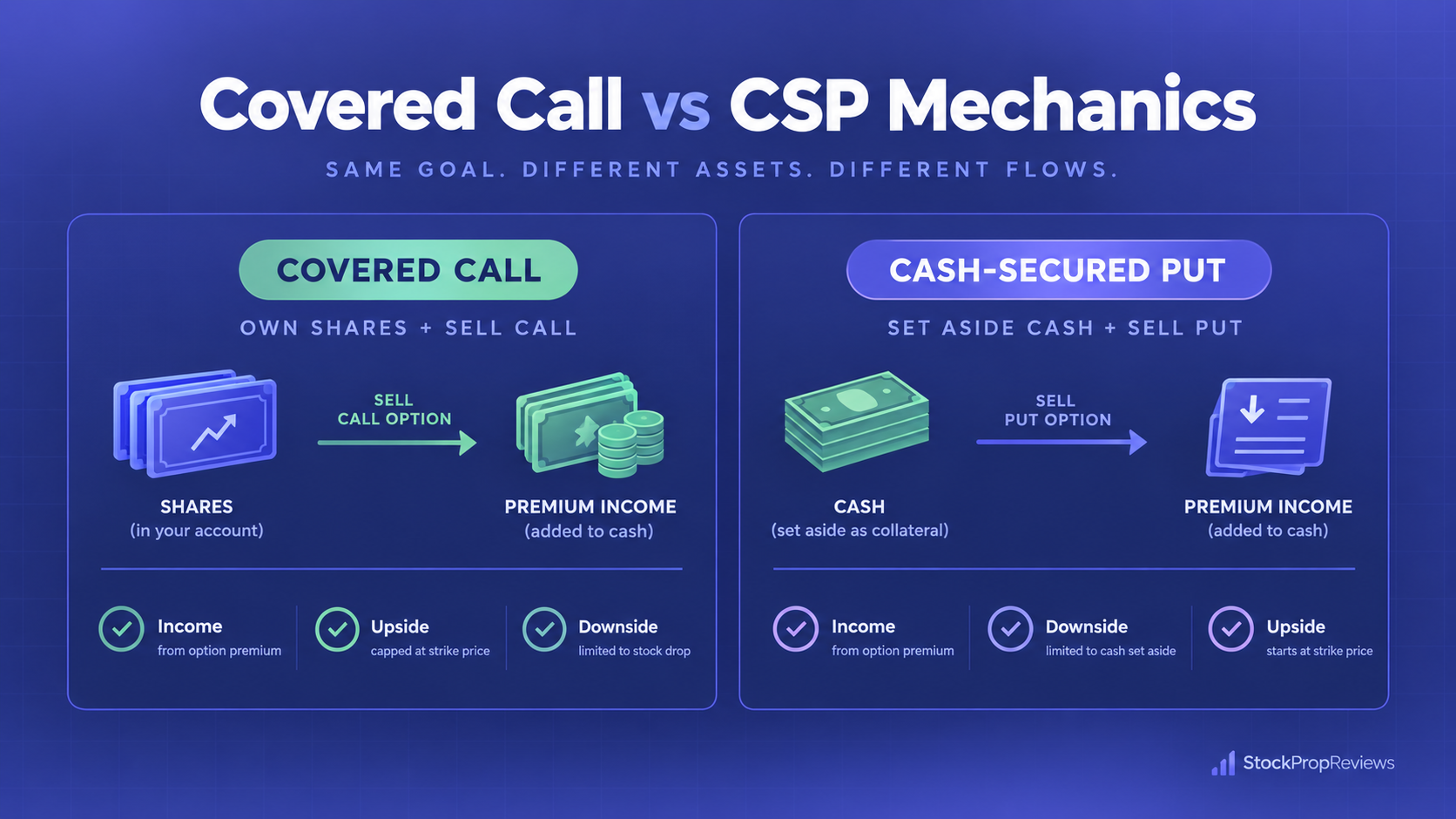
Both covered calls and cash-secured puts (CSPs) are single-leg options strategies used to generate cash flow. While their expiration risk profiles share underlying mathematical similarities through put-call parity, their execution begins from opposite sides of your portfolio, and outcomes are subject to practical market dynamics including transaction costs, bid-ask spreads, and unexpected volatility.
Covered Call
A covered call requires owning 100 shares of stock for every call option contract sold. You collect an immediate cash premium in exchange for accepting the obligation to sell your shares at the agreed-upon strike price if assigned.
- Starting position: Long 100 shares of stock.
- Option sold: Sell 1 Call.
- Obligation: Sell shares at the strike price if the stock rises above it.
Cash-Secured Put
A cash-secured put requires keeping enough cash collateral in your account to purchase 100 shares of stock at the strike price. You collect an immediate cash premium in exchange for accepting the obligation to buy the shares if assigned.
- Starting position: Cash collateral set aside in your account.
- Option sold: Sell 1 Put.
- Obligation: Buy 100 shares at the strike price if the stock falls below it.
| Strategy Attribute | Covered Call | Cash-Secured Put |
|---|---|---|
| Starting Asset | 100 Shares of Stock | Cash Collateral |
| Option Contract | Sell Call | Sell Put |
| Premium Collected | Immediate Credit | Immediate Credit |
| Primary Obligation | Sell shares at strike if assigned | Buy shares at strike if assigned |
| Primary Asset Flow | Shares leave account on assignment | Shares enter account on assignment |
Income, Profit Potential, and Downside Math
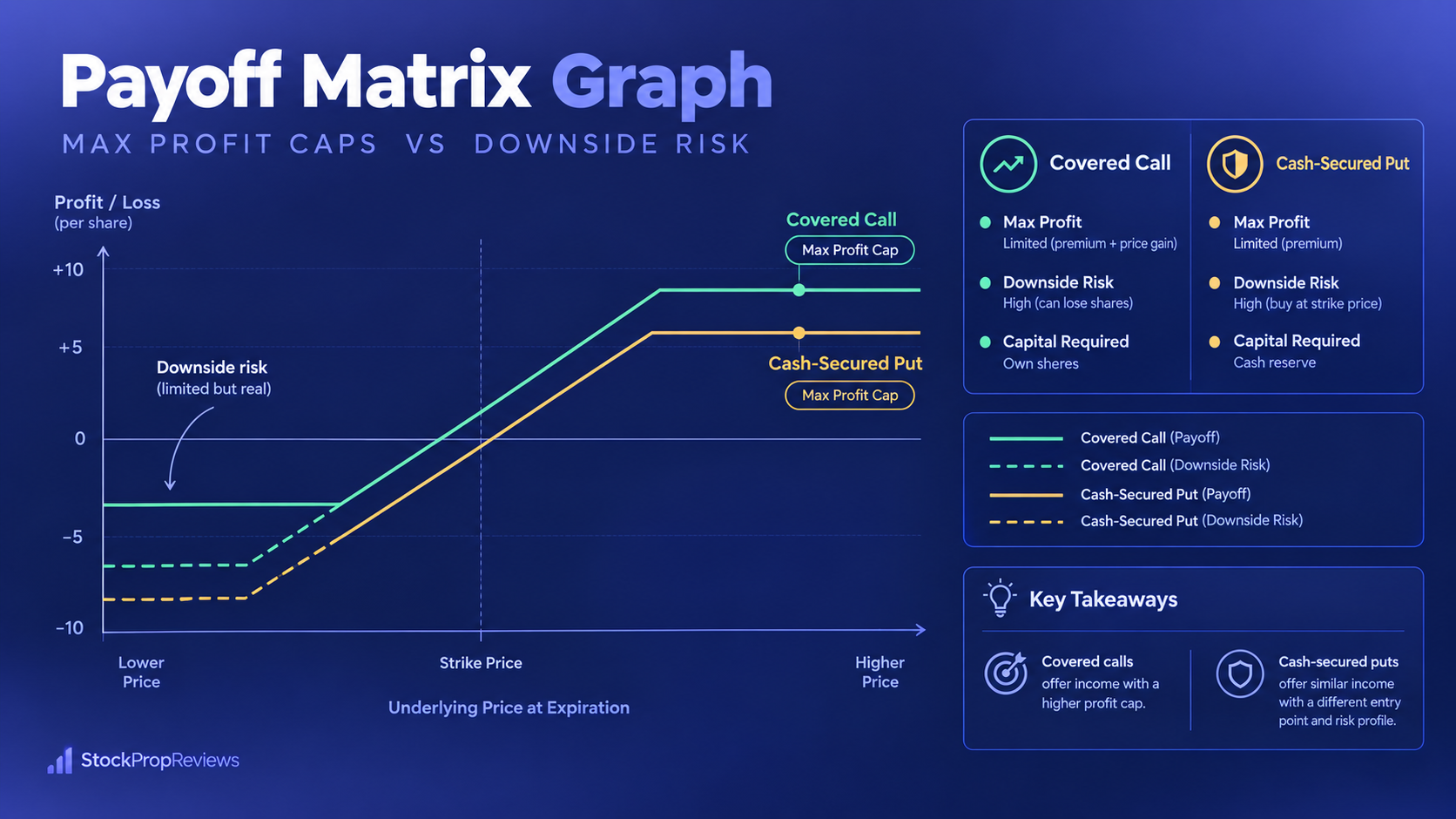
To compare these strategies fairly, let's look at an example using a single stock trading at $100.
Covered Call Setup ($100 Stock)
- Buy 100 shares at $100 = $10,000 outlay.
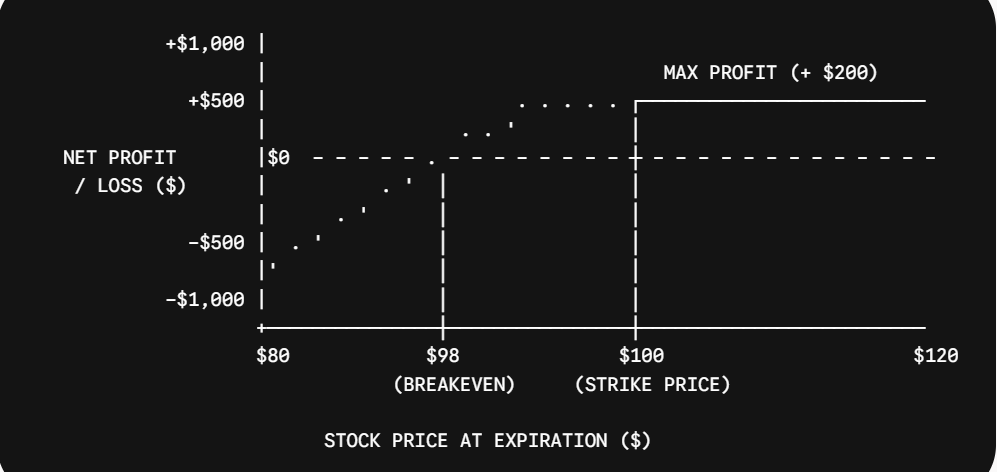
- Sell 1 Call at a $105 strike for $2.00 premium ($200 gross income before commissions and execution slippage).
- Maximum Profit: ($105 Strike - $100 Stock Cost) + $2 Premium = $700 Max Profit.
- Breakeven Price: $100 - $2 = $98.00.
Cash-Secured Put Setup ($100 Stock)
- Set aside 9,500cashcollateral(95 strike × 100 shares).
- Sell 1 Put at a $95 strike for $2.00 premium ($200 gross income before commissions and execution slippage).
- Maximum Profit: $200 Premium Retained.
- Effective Purchase Price (if assigned): $95 Strike - $2 Premium = $93.00 per share.
- Breakeven Price: $93.00.
Scenario Analysis Across Stock Movements
| Stock Price at Expiration | Covered Call Outcome ($105 Strike) | Cash-Secured Put Outcome ($95 Strike) |
|---|---|---|
| $120 (Strong Rally) | Assigned at $105 (+ $700 Max Gain) | Put Expires Worthless (+ $200 Max Gain) |
| $105 (Moderate Gain) | Assigned at $105 (+ $700 Max Gain) | Put Expires Worthless (+ $200 Max Gain) |
| $100 (Unchanged) | Option Expires (+ $200 Premium) | Put Expires Worthless (+ $200 Max Gain) |
| $95 (Small Drop) | Option Expires (- $300 Unrealized) | Put Expires Worthless (+ $200 Max Gain) |
| $90 (Moderate Drop) | Option Expires (- $800 Unrealized) | Assigned at $95 (- $300 Net Loss) |
| $70 (Severe Drop) | Option Expires (- $2,800 Unrealized) | Assigned at $95 (- $2,300 Net Loss) |
The Role of Automated Pattern Recognition
Selecting strikes for options trades can be guided by analyzing price history and chart patterns. Technical analysis seeks to interpret market psychology reflected in price structures. While visual levels like support, resistance, and momentum indicators can help identify probabilistic areas of interest, chart patterns are non-deterministic and can fail depending on overall market context.
Academic research in Derivatives Applications in Asset Management confirms that systematically combining out-of-the-money puts and calls significantly reduces volatility and smooths risk-adjusted returns compared to single-leg strategies; explore the full analysis on Springer Research on Options-Based Income Strategies.
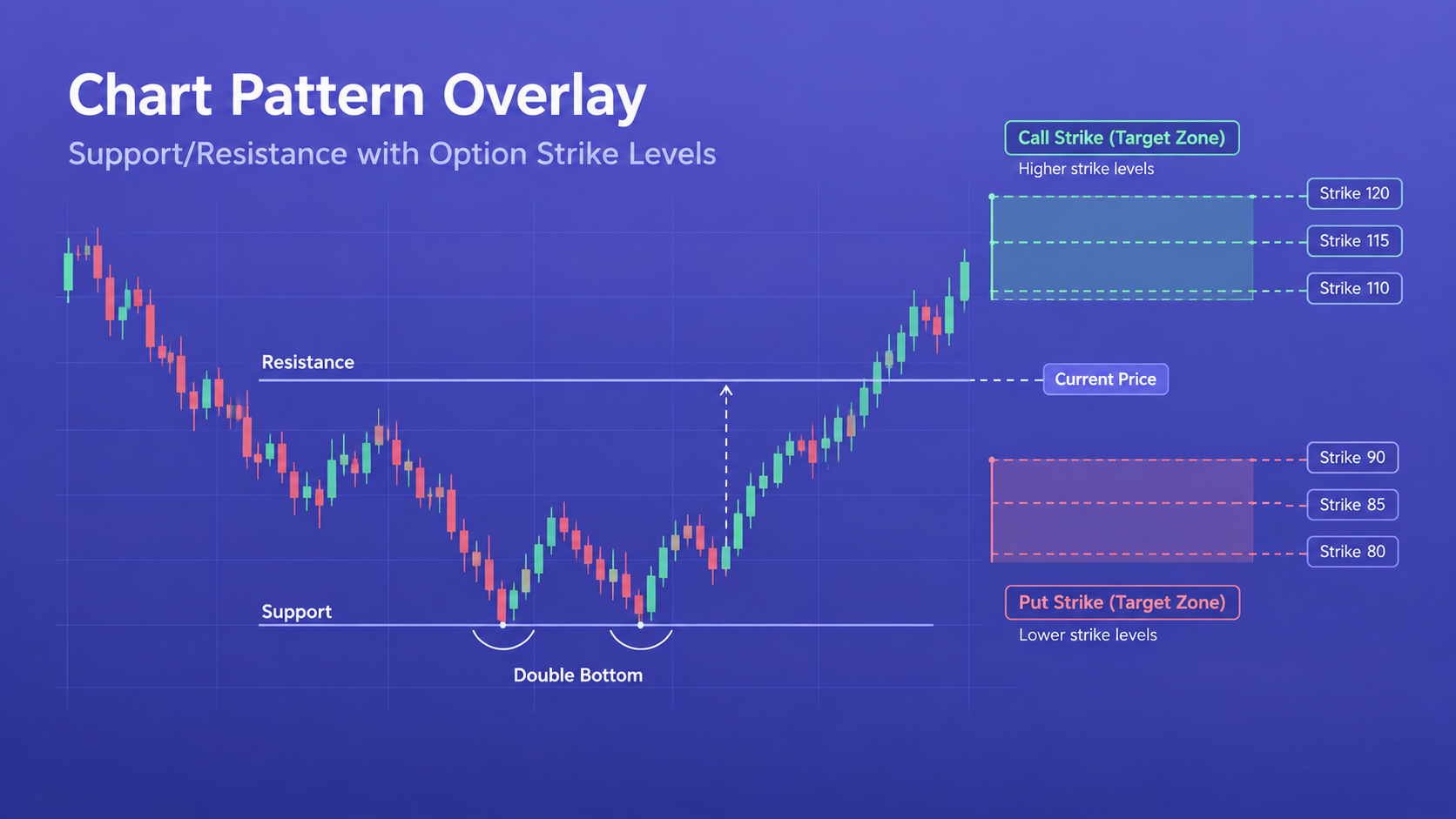
Using automated software to spot double bottoms, head and shoulders, or ascending channels allows for better option strike placement:
- Evaluate Cash-Secured Puts near Potential Support: When automated tools signal a potential double bottom, selling a cash-secured put near established support may align strike selection with areas where buyers historically emerged, though underlying asset price drops can still cause assignment and losses.
- Evaluate Covered Calls near Potential Resistance: When technical indicators suggest price momentum is stalling near resistance, selling a covered call allows for premium collection, though strong upside breakouts will result in capped stock gains.
Evaluating Execution Platforms
Finding the right broker determines execution speed, fee structures, and tool availability. Over time, several platforms were tested across dynamic market conditions.
Testing the Binomo Platform revealed a streamlined interface for quick market navigation, making it straightforward for beginners learning options and chart rhythms. Meanwhile, trading on the IQ Option Brokerage provided advanced charting capabilities, built-in indicators, and customizable timeframes essential for technical pattern trading
For additional platform feature comparisons:
- For fast execution setups, check the account tools on Pocket Option.
- For clean registration mechanics, review Quotex Broker.
- For international asset availability, test Expert Option.
- For chart analysis features, explore Olymp Trade.
- For alternative analytical platforms, review Capital Core.
Building a Repeatable Trading Workflow
To succeed across dozens of option cycles, replace emotional impulses with a structured decision protocol:
- Check Starting Asset Availability: If holding cash, look for Cash-Secured Put setups. If holding 100 shares of stock, evaluate Covered Call setups.
- Scan for Automated Patterns: Use algorithmic scanners to identify support and resistance zones before picking option strikes.
- Calculate Real Breakevens & Account for Frictions: Factor in commissions, exercise fees, and bid-ask slippage alongside premium received to establish accurate breakeven points.
- Accept Assignment Conditions: Never sell a CSP unless comfortable owning the stock at the net price. Never sell a covered call unless comfortable parting with the shares at the strike.
To read more in-depth stop loss and breakeven, explore our guides on the Becoin Blog and check real-time market data on the Becoin Forecast Hub.
FAQs
Is a Cash-Secured Put safer than buying stock directly?
A cash-secured put provides a minor upfront buffer compared to buying stock directly at current market prices because the option premium lowers your net cost basis. However, cash-secured puts carry significant downside risk similar to stock ownership; in catastrophic market drops or severe tail-risk events, assigned put holders remain exposed to substantial or total capital loss on the underlying shares.
What happens if my Covered Call gets assigned?
If the stock price rises above your call strike price at expiration, your 100 shares are sold at that strike. You keep the cash proceeds from the stock sale along with the option premium collected upfront.
Can automated tools guarantee winning options trades?
No software tool guarantees profits. Automated chart patterns identify high-probability technical setups, but disciplined risk management and position sizing remain necessary on every trade.
Ready to enhance your trading strategies with institutional analysis, real-time forecasts, and technical insights? Gain a statistical edge in today's markets by joining Becoin Premium today!

Deriv vs Binomo Deposit Methods: My 2026 Real Money Comparison Guide
I sat in the corner of a crowded coffee shop, my eyes fixed on my phone screen. After months of testing strategies on a demo account, I had finally saved up a small pocket of risk capital. I felt ready to trade live. A high-probability setup was forming on my charts, and my heart rate […]

Safest Broker for Small Deposits in 2026
Looking for the safest broker for small deposits in 2026? Discover beginner-friendly trading platforms with low minimum deposits, reliable withdrawals, risk controls, and the best options for starting safely with limited capital. Starting trading with a small amount of money sounds easy until you actually deposit real funds. Most beginners quickly realize that choosing the […]

Safest Trading Platforms (Risk Breakdown) – Real Comparison for 2026
Choosing a trading platform isn’t about features — it’s about avoiding hidden risk. Most traders compare brokers like Quotex vs Pocket Option vs Deriv vs Olymp Trade expecting a clear winner. Instead, they find conflicting reviews, promotional claims, and no real explanation of how these platforms behave when money is on the line. The real […]

Capital Core Account Types Explained: Which One Fits Your Trading Budget?
When I first started looking at Capital Core account types, I made the same mistake most traders make. I looked at the bonus first. Then I looked at the leverage. And only after that did I start asking the question that actually matters: Which account can I realistically manage without forcing trades just because I […]
Capital Core 40% Deposit Bonus Explained: Worth It or Risky?
The first time I saw the Capital Core 40% deposit bonus, I reacted exactly the way most traders do. I saw the extra credit, did the quick math in my head, and immediately thought, “That’s more room to trade.” That’s how these offers are designed to feel. They look simple. Deposit money, get 40% more, […]
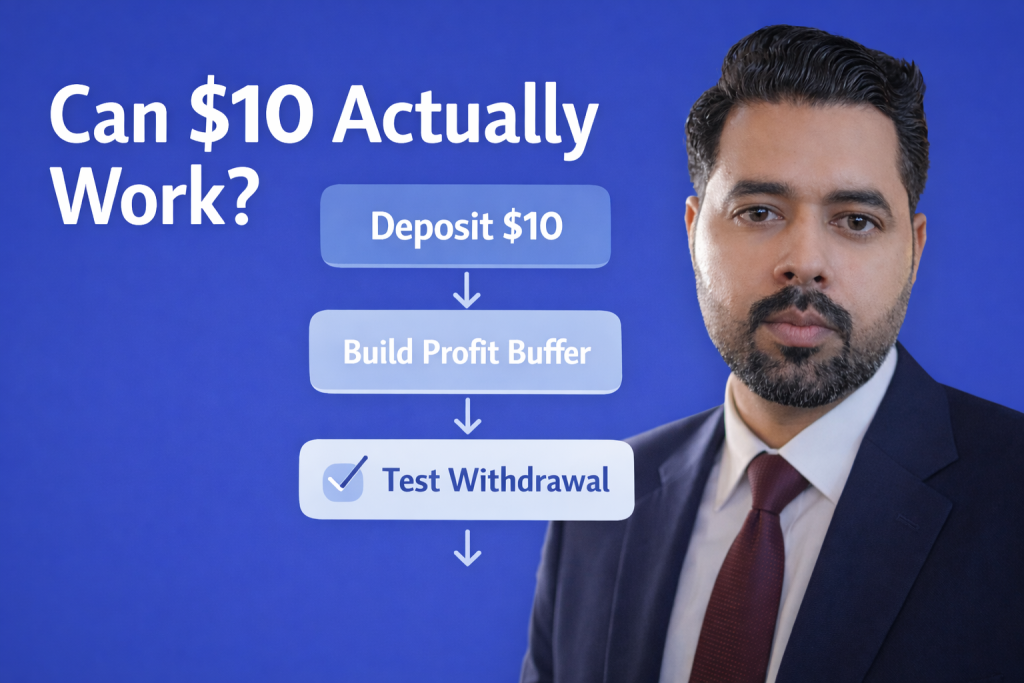
Capital Core Minimum Deposit Strategy: Can You Grow a Small $10 Account?
There’s something dangerously attractive about a broker that lets you start with just $10. It feels harmless. Low risk. Easy to test. Almost too easy. That’s exactly why I wanted to test the Capital Core minimum deposit strategy for myself. Not because I believed a $10 account could become life-changing money. Not because I wanted […]