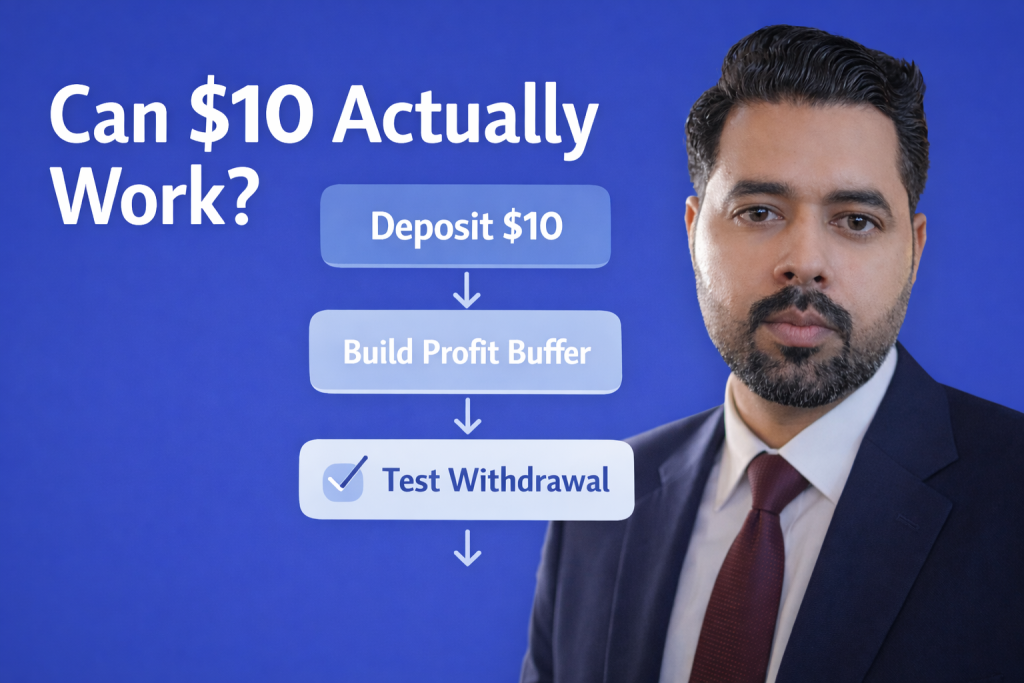
Capital Core Minimum Deposit Strategy: Can You Grow a Small $10 Account?
There’s something dangerously attractive about a broker that lets you start with just $10.
It feels harmless. Low risk. Easy to test. Almost too easy.
That’s exactly why I wanted to test the Capital Core minimum deposit strategy for myself.
Not because I believed a $10 account could become life-changing money. Not because I wanted to chase one of those fake “$10 to $1,000 in one day” fantasies. I did it because I wanted a real answer to the question most search results avoid:
Can you actually use a $10 Capital Core account intelligently, or is the minimum deposit just a marketing hook that encourages bad trading behavior?
That difference matters.
A lot of broker review pages will tell you the minimum deposit. Some will repeat the bonus offers. Others will say it’s “beginner friendly” because the entry barrier is low. But very few of them actually show what happens when you sit down, fund the minimum, and try to trade with discipline under real pressure.
That’s what I wanted to document.
I treated this as a live field test, not a hype experiment. I wanted to know whether the Capital Core minimum deposit strategy could help me:
- test the platform cheaply,
- understand how the account behaves under tight constraints,
- and see whether small capital can be managed in a realistic, sustainable way.
If you want to follow the same approach, the smartest move is not to deposit big on day one. It’s to open a small test account first and treat it like a controlled experiment. That’s exactly how I approached it, and if you want to do the same, you can open a Capital Core account here and start with the minimum instead of turning your first deposit into a blind leap.
This article is not about false promises.
It’s about what actually happens when a trader tries to make a Capital Core minimum deposit strategy work with only $10 and no illusions.
Why I Wanted to Test the Capital Core Minimum Deposit Strategy
The reason was simple.
Small accounts reveal the truth faster than large accounts do.
A larger balance can hide a lot of bad habits. You can overtrade, oversize, break rules, and still survive for a while. A $10 account doesn’t give you that luxury. It exposes every mistake almost immediately.
That’s why I’ve started using minimum deposit tests as part of my broker evaluation process.
With Capital Core, the low entry point was the obvious hook. Several broker review sources consistently list the minimum deposit at $10, especially for entry-level access, and Traders Union’s 2026 review also notes a Classic account starting at $10 with a $1 minimum trade size, which is a crucial detail because a low deposit only matters if the trade size is still manageable.
That combination got my attention.
A $10 deposit is one thing. A $10 deposit with a usable minimum trade size is another. That’s where the test becomes meaningful.
So I wasn’t asking, “Can I deposit $10?”
I was asking:
Can I use that $10 in a way that teaches me something useful without turning the account into a slot machine?
That’s the real content gap in most of the top search results.
My Rules Before I Deposited the First $10
Before I funded the account, I wrote my rules down.
That might sound overly cautious, but this is where most small-account traders already fail. They deposit first, get excited second, and invent rules after the damage is done.
I wanted the opposite.
I decided that this $10 would be treated as test capital, not investment capital. That distinction mattered a lot. I wasn’t trying to “build wealth” with it. I was trying to measure three things:
- My own discipline under pressure
- Whether the platform was practical for small balances
- Whether the account structure made sense for gradual scaling later
That immediately changed how I thought about the deposit.
I also made one rule that ended up becoming the most important of the entire experiment:
If the balance dropped to a level where proper risk management became impossible, the test was over.
That saved me later.
Because the truth is, a Capital Core minimum deposit strategy is not really about growth first.
It’s about survival, platform fit, and proof of process.

What the Capital Core Minimum Deposit Really Means in Practice
A lot of traders misunderstand what a minimum deposit strategy is supposed to be.
They assume it means:
Deposit the minimum, take aggressive trades, compound quickly, and hope momentum carries the account.
That isn’t a strategy. It’s just low-budget gambling.
For me, the Capital Core minimum deposit strategy only made sense if the minimum deposit translated into actual flexibility. That depends on a few practical realities:
- Can the trade size stay small enough to absorb normal losses?
- Can I follow my usual process without being forced into oversized positions?
- Does the platform feel usable when the margin for error is tiny?
- If I do grow the account slightly, can I test a withdrawal without friction?
That last point matters more than most people think.
A small deposit is easy. A small withdrawal is where trust begins.
That’s why I never evaluate an offshore-style broker based only on how easy it is to fund. I judge it by whether the whole cycle makes sense: deposit, trade, preserve, withdraw, then scale.
If you haven’t read it yet, my Capital Core withdrawal test and payout timing breakdown is the perfect companion to this article, because a low minimum deposit only matters if the broker also behaves reasonably when you try to take money out.
My First Week Trading the $10 Account
I went into the first week with a very specific mindset.
I was not trying to “flip” the account.
I was trying to see whether the account was structurally usable.
That sounds subtle, but it changes everything.
Instead of chasing activity, I slowed down. I focused on only the cleanest setups. If I didn’t see something I would normally take on a larger account, I passed.
That’s where the psychology got interesting.
A $10 account creates a weird kind of pressure. Every dollar feels important, but not because the amount is large. It feels important because the margin for error is so small.
A careless entry on a big account is annoying.
A careless entry on a tiny account feels like sabotage.
That forced me to simplify my execution.
I stopped thinking about profit and started thinking in terms of decision quality. Was this a clean setup? Was the timing justified? Was I trading because I saw an edge, or because I was impatient?
That shift made the test more valuable than I expected.
The Trade Journal That Changed My View of Small Accounts
Once I started logging the trades honestly, the truth became obvious.
The account wasn’t growing because I was “good.” It was only surviving when I was disciplined.
That’s an important distinction.
Here’s a simplified version of how my early test looked:
| Trade # | Setup Type | Stake | Result | Account After Trade | What I Learned |
| 1 | Trend continuation | $1 | Win | $10.80 | Good entry, but no reason to get excited |
| 2 | Weak countertrend | $1 | Loss | $9.80 | I forced this one |
| 3 | Retest at level | $1 | Win | $10.60 | Patience worked |
| 4 | News-adjacent trade | $1 | Loss | $9.60 | Should have stayed out |
| 5 | Clean rejection | $1 | Win | $10.40 | Best trade was the simplest |
| 6 | Boredom trade | $1 | Loss | $9.40 | This is how small accounts die |
That table is more useful than most glossy broker reviews.
Because it shows what the Capital Core minimum deposit strategy actually feels like in real life:
- progress is slow,
- mistakes are expensive,
- and one emotional trade can erase the work of several disciplined ones.
That’s why I stopped seeing the $10 account as a “small opportunity” and started seeing it as a discipline stress test.
Can You Really Grow a Small $10 Account on Capital Core?
Here’s the honest answer:
Yes, but only if you define “grow” realistically.
If by “grow” you mean turning $10 into something slightly larger while learning the platform, refining your discipline, and building confidence for a future scale-up, then yes, the Capital Core minimum deposit strategy can make sense.
If by “grow” you mean serious compounding, fast account flipping, or trying to create meaningful income from tiny capital, then no. That’s where traders start lying to themselves.
This is where most search results miss the point.
A $10 account can absolutely be useful.
It can help you:
- experience live execution with low exposure,
- understand how the platform behaves under pressure,
- test your own emotional control,
- and maybe create enough profit buffer to attempt a small withdrawal.
But a $10 account is not a serious income plan.
It’s a proof-of-process account.
That’s the mindset that made this whole experiment worthwhile.
If you want to approach it the same way I did, not recklessly, you can open your Capital Core account here and start with the minimum as a live test rather than assuming a larger deposit will magically make bad habits disappear.
Why Most $10 Accounts Blow Up So Fast
The interesting thing about my test is that the broker didn’t almost ruin it.
I did.
There was a point early on when I got a couple of decent trades, felt a little too comfortable, and started seeing setups that weren’t really there. That’s the moment where most small accounts begin to collapse.
It usually happens in a predictable sequence.
A trader starts with a small balance, gets one or two wins, becomes emotionally attached to the idea of “momentum,” and then begins trading more often or with less selectivity. The account stops being a test and starts becoming a chase.
That’s exactly what I had to catch in myself.
The real enemy of a Capital Core minimum deposit strategy is not the size of the deposit. It’s what that tiny balance does to your psychology.
A small account creates urgency.
Urgency creates overtrading.
Overtrading creates forced entries.
And forced entries destroy fragile balances quickly.
That’s why I now define a proper small-account strategy in one sentence:
A minimum deposit account should be used to test execution, discipline, and withdrawal confidence before any meaningful scale-up.
Once I started thinking that way, the whole experiment made more sense.
The Risk Framework I Used Instead of Chasing Fast Growth
The biggest change I made was this:
I stopped trying to “grow” the account and started trying to protect its structure.
That may sound boring, but it’s the only reason the test remained useful.
I set a hard daily loss limit. If the account dropped too much in one session, I was done for the day. I also capped how many trades I could take, because small balances are especially vulnerable to boredom and revenge behavior.
I didn’t need a giant rulebook.
I just needed a few rules that were strict enough to prevent emotional spirals:
- no trading after two consecutive losses,
- no adding funds during frustration,
- no “one more trade” decisions after a bad setup,
- and no using the bonus as an excuse to increase size.
That was enough.
A tiny account doesn’t need complex risk management. It needs simple rules that are impossible to misunderstand.
If you want a stronger foundation for that mindset, I highly recommend reading my piece on why traders blow accounts even with a decent win rate because it explains the hidden math behind why small balances disappear much faster than people expect.

What I Was Really Testing With This $10 Account
The more I traded, the more I realized I wasn’t really testing profitability.
I was testing platform fit.
That’s something most review articles completely miss.
A minimum deposit test tells you whether a broker fits your style when the room for error is tight. It reveals whether the platform encourages patience or impulsiveness. It shows you whether you can place trades cleanly, whether small sizing feels workable, and whether the overall environment supports structured decision-making.
That matters more than the promotional material ever will.
For me, the most useful question became:
Does this platform make disciplined trading easier, or does it constantly tempt me into unnecessary action?
That’s a much better question than “Does this broker offer a low minimum deposit?”
Because a low minimum deposit only helps if the trading environment still supports restraint.
The Part Most Traders Ignore: Small Withdrawal Tests Matter More Than Small Deposits
This was one of the biggest lessons from the entire experiment.
Traders obsess over deposits because deposits feel exciting.
Withdrawals feel boring.
But withdrawals are where the real trust starts.
If I grow a $10 account to $18, $22, or even $30, that number isn’t life-changing. What matters is whether I can use that small gain to test the broker’s payout behavior in a controlled way.
That’s why I now think every Capital Core minimum deposit strategy should follow the same sequence:
Start small. Trade carefully. Build a little cushion. Test a small withdrawal. Only then think about scaling.
That’s also why my Capital Core withdrawal test article is not just related content. It’s a necessary second step. A minimum deposit means very little if you never verify how the platform behaves on the way out.
And if you’re comparing Capital Core with other offshore-style platforms, my analysis of Deriv vs offshore brokers and how the execution model changes your risk adds useful context before you commit more capital anywhere.
What the Top Google Results Usually Miss
After looking at how most pages cover this topic, the gap is obvious.
Most of them repeat the same surface-level information: the minimum deposit amount, account types, payment methods, and sometimes the bonus structure.
What they rarely answer is the actual trader question:
Is the $10 minimum deposit truly usable in a disciplined way, or does it only exist to get people in the door?
That’s the real issue.
The missing discussions are usually about:
- whether the minimum trade size still makes the account practical,
- how quickly a few normal losses can make the account structurally weak,
- how much psychological pressure a tiny balance creates,
- and why a small deposit should lead to a small withdrawal test before any scale-up.
That’s why I wrote this article differently.
Because the important question is not “Can you start with $10?”
It’s:
Can you use that $10 intelligently enough to gather useful data without letting emotion turn the account into a fast loss?
That’s the question most review pages skip.
Should Beginners Use the Capital Core Minimum Deposit Strategy?
My honest answer is:
Yes, but only if they treat it as a controlled live drill, not a profit plan.
For beginners, a $10 live account can be helpful because it introduces real emotions without requiring large exposure. It can teach patience, show how hard it is to follow rules under pressure, and reveal whether the platform feels intuitive enough to support a process.
But it only helps if the trader already has a basic framework.
If someone is still randomly entering trades, still chasing candles, or still reacting emotionally to every small loss, then a $10 account won’t “teach discipline.” It will usually just confirm bad habits faster.
That’s why I still believe the best path is simple:
- use demo to build execution,
- use the minimum live deposit to test your psychology,
- then test a small withdrawal,
- and only after that consider a gradual scale-up.
If you’re ready to use Capital Core that way, not recklessly, you can open your Capital Core account here and start with the minimum as a structured live test rather than a high-pressure gamble.

My Final Verdict: Can You Grow a Small $10 Account on Capital Core?
After testing it honestly, my answer is simple:
Yes, but only if your definition of “growth” is realistic.
If growth means becoming a better trader, understanding the platform, learning how a fragile balance changes your decision-making, and maybe building a small enough profit buffer to test a withdrawal, then the Capital Core minimum deposit strategy can be useful.
If growth means trying to turn tiny capital into serious money quickly, then it usually becomes self-deception.
That’s the biggest lesson I took from the experiment.
I no longer look at minimum deposit accounts as “starter wealth.”
I look at them as truth detectors.
They reveal whether:
- your discipline is real,
- your process works under pressure,
- the platform fits your execution style,
- and the broker deserves a deeper test later.
That’s far more valuable than another generic review page that just repeats the minimum deposit amount.
And if you want to approach it the same way I did, the smart way is simple: start small, stay selective, test the withdrawal early, and only scale after repeated proof.
If that’s your plan, not just another impulse trade, you can open your Capital Core account here and start with the minimum deposit as a structured live test rather than a blind commitment.
Quick FAQ: Capital Core Minimum Deposit Strategy
What is the Capital Core minimum deposit?
Current third-party broker reviews commonly list the minimum deposit at $10, especially for entry-level or Classic-style access, though exact conditions can vary by funding method or account structure.
Can I really grow a $10 account?
You can grow it modestly, but it should be treated as a test account, not an income account. The real value is discipline, execution practice, and withdrawal verification.
Is a $10 account good for beginners?
It can be, but only if the beginner already understands basic risk control and has a clear setup. Without that, a small account usually becomes an emotional trap.
What should I do after a small win?
The smartest next step is not to scale aggressively. It’s to test a small withdrawal first, then continue only if the platform and your own discipline remain consistent.
Final Thoughts
If I had to summarize my entire Capital Core minimum deposit strategy in one sentence, it would be this:
Use the $10 minimum to test yourself first, and the broker second.
That’s the real edge.
Because in my experience, the broker is not usually the first thing that breaks a small account.
The trader is.
So if you want to use Capital Core intelligently:
Start small. Stay boring. Log everything. Protect the account structure. Test a withdrawal early. Then scale only after repeated proof.
That’s how a $10 account becomes useful.
Not glamorous.
Not magical.
Useful.

Capital Core Verification Process Explained: KYC, Restrictions, and Withdrawal Delays
I learned something the hard way with offshore-style brokers: the smoothest part is usually opening the account, funding it, and placing the first few trades. The real test starts when you try to move money back out. That’s exactly why I wanted to document the Capital Core verification process from a trader’s perspective, not from […]

Safest Broker for Small Deposits in 2026
Looking for the safest broker for small deposits in 2026? Discover beginner-friendly trading platforms with low minimum deposits, reliable withdrawals, risk controls, and the best options for starting safely with limited capital. Starting trading with a small amount of money sounds easy until you actually deposit real funds. Most beginners quickly realize that choosing the […]

Binomo Minimum Deposit vs Minimum Withdrawal: The Real Trap Beginners Miss
I almost fell for the simplest trap on Binomo. Not a bad entry.Not a losing strategy.Not even a bad signal. It was the gap between the Binomo minimum deposit vs minimum withdrawal that quietly changes how beginners behave. When I first opened a real account, the low entry point looked harmless. That’s exactly why it […]

Binomo vs IQ Option for Small Accounts: Which Platform Is Better for Beginners in 2026?
Most people entering online trading do not start with thousands of dollars. They start small. Usually with $10, $20, or maybe $50. That small balance changes everything about how a trader behaves. Every loss feels bigger, every win feels emotional, and every mistake has a stronger impact on the account. This is exactly why beginner […]

Binomo First $10–$50 Test Deposit Plan: The Safest Way to Validate the Platform Before Scaling
I didn’t start with confidence. I started with doubt. Every time I searched for answers about Binomo, I found opinions, not proof. Some people claimed fast withdrawals. Others complained about delays. But almost nobody showed a complete journey from deposit to withdrawal using real money. So I stopped reading and started testing. Instead of risking […]

Capital Core $100 Challenge: Can a Small Account Survive Day Trading?
There’s a reason I wanted to do a Capital Core $100 challenge instead of another flashy “flip a tiny account” stunt. I was tired of the fantasy version of small-account trading. You know the one. A trader deposits a small amount, catches a hot streak, posts a few winning screenshots, and suddenly the whole story […]