
Capital Core $100 Challenge: Can a Small Account Survive Day Trading?
There’s a reason I wanted to do a Capital Core $100 challenge instead of another flashy “flip a tiny account” stunt.
I was tired of the fantasy version of small-account trading.
You know the one. A trader deposits a small amount, catches a hot streak, posts a few winning screenshots, and suddenly the whole story becomes about speed. Fast wins. Fast growth. Fast confidence. Nobody talks about the slower truth underneath it all. Nobody talks about the pressure of watching a $100 balance shrink after a couple of sloppy entries. Nobody talks about how one emotional decision can completely change the life expectancy of a small day trading account.

That was the real reason I did this.
I did not want to prove that $100 could become some unrealistic number in a week. I wanted to answer a much more honest question:
Can a small account actually survive long enough to show whether the trader behind it has any real discipline at all?
That is what this challenge became for me.
If you want to run the same kind of controlled test I did, the smartest way is to keep it simple and start with a balance you can treat as a real discipline exercise, not a lottery ticket. You can open a Capital Core account here and approach it exactly that way.
What I found during this Capital Core $100 challenge was not glamorous, but it was useful. It taught me that small accounts do not die because the broker is “too hard.” They usually die because the trader wants too much from them too quickly. That was the part I wanted to document honestly, because most of the content ranking around this topic still focuses on platform features, payouts, and deposit thresholds, while the real problem is what happens between trade one and trade thirty.
This is my actual small-account story. No fake hero arc. No “easy money” nonsense. Just what I learned when I tried to keep a $100 day trading account alive on Capital Core.
Why I Chose a $100 Challenge Instead of Depositing More
The funny thing is, I never believed $100 was “enough” in the way beginners often mean it.
I did not start this challenge because I thought $100 would create meaningful income. I started it because a small account forces honesty. With a bigger balance, you can hide bad habits for longer. You can overtrade, you can size too big, you can take mediocre entries and still tell yourself you are “testing.” A larger balance gives you more room to be wrong without immediately feeling the consequences.
A $100 account does the opposite.
It puts every bad habit under a microscope.
That is why the Capital Core $100 challenge interested me more than a standard broker review ever could. It was a cleaner test of trader behavior. If I could not protect $100, there was no point pretending I would magically become disciplined with $500 or $1,000.
I had already been thinking about this after my earlier small-balance experiment on whether a tiny $10 Capital Core account can really grow. That article made me realize something important: the smaller the account, the more brutal the emotional feedback becomes. Every mistake feels bigger. Every unnecessary click hurts more. Every “I’ll just take one more trade” decision becomes dangerous faster.
That was exactly the environment I wanted.
Not because it was comfortable, but because it was honest.
What Most Traders Get Wrong About a Small Day Trading Account
Before I started, I noticed the same pattern everywhere.
Most people talking about small trading accounts focus on one of two extremes:
- The dream scenario where the account grows quickly
- The disaster scenario where the account gets blown in a day
Both are possible, but neither one teaches you much on its own.
The real educational value of a Capital Core $100 challenge is in the middle ground. The slow sessions. The boring sessions. The sessions where you win one, lose one, then decide not to force a third trade just because the platform is open.
That middle ground is where traders either become more professional or expose themselves as gamblers.
That was the part I wanted to capture.
And before I even started, I was still grounding everything in one question: is this broker even worth using for a small live test in the first place? If you are asking that same question before you deposit, my full breakdown on is Capital Core safe or a scam? is the better place to start before you fund anything.
Because a $100 challenge is still real money. Small does not mean careless.
My Exact Rules for the Capital Core $100 Challenge
I knew from the start that if I did not define rules before the first trade, the challenge would eventually turn into emotion disguised as “flexibility.”
So I wrote my framework down first.
My small-account rules
| Rule | My Limit |
| Starting balance | $100 |
| Base risk per trade | $2 to $3 |
| Max risk on only top-tier setups | $5 |
| Daily loss cap | $10 |
| Max consecutive losses before stopping | 3 |
| Max trades per session | 5 to 8 |
| Preferred expiries | 1-minute and 5-minute |
| Trade focus | Only clean, structured setups |
| Challenge goal | Survival first, growth second |
This table looks simple, but it changed everything.
It stopped me from improvising.
That is the difference between a real Capital Core $100 challenge and a social-media challenge. A social-media challenge is built around a result. A real one is built around constraints.
My account was not allowed to become “creative.”
If I hit three losses, I stopped.
If I hit the daily loss cap, I stopped.
If I felt the urge to raise size because I was frustrated, that was my signal that I needed to walk away.
I also did not want to overcomplicate the setup. If you are still deciding what type of account structure makes sense before you start, my guide on which Capital Core account type fits your trading budget is worth reading first, especially if you are comparing small-balance testing versus more aggressive funding.

The First Real Lesson: The Account Did Not Need More Strategy, It Needed Less Impulse
I expected the first week to be about chart reading.
It was not.
The first week was mostly about catching myself wanting to trade when there was no real reason to trade.
That was the most uncomfortable part of the challenge.
With a small balance, there is a strange psychological pressure that is hard to explain unless you have felt it. It is “only” $100, but because the balance is small, every minor drawdown feels emotionally exaggerated. Two or three losses do not look huge in dollar terms, but they look huge relative to the account. That makes your brain start whispering things like:
- “Just make it back quickly”
- “This next one looks close enough”
- “You’ve already spent the time, so keep trading”
- “If you stop now, the day feels wasted”
That internal conversation is where small accounts get killed.
I noticed it especially on 1-minute trades.
Whenever I stayed selective and only took clean, obvious setups, the account felt stable. The balance moved slowly, but it felt controlled. When I started justifying entries because I wanted more action, the quality dropped fast. The problem was not that I lacked a strategy. The problem was that I was trying to manufacture opportunities where there were none.
That was my first major insight from the Capital Core $100 challenge:
A small day trading account is usually destroyed by impatience before it is destroyed by market conditions.
What Made the $100 Account Fragile
The fragility of a $100 account is not mysterious. It comes from a few very specific mistakes that stack on top of each other.
Oversizing too early
This is the obvious one, but it still catches traders constantly.
If you have a small account and you start pushing 8%, 10%, or more on regular trades, you are shortening the challenge immediately. You may not feel it after one loss, but you will feel it after a streak.
I kept coming back to this thought: a small account can survive variance, but it cannot survive emotional leverage.
That is why I kept most of my risk around $2 to $3. Even when I felt confident, I wanted the challenge to stay alive longer than my ego.
Chasing payout instead of quality
One of the easiest traps in day trading is letting payout percentages make a setup look better than it actually is.
A strong payout does not turn a weak entry into a good trade.
This mattered a lot during the Capital Core $100 challenge because I realized how easy it is to mentally justify lower-quality setups when the potential return looks attractive. That logic is backwards. The payout is secondary. The quality of the setup has to lead.
Letting bonus psychology change your behavior
I also stayed very cautious around the idea of trading “larger” just because a promotional balance makes the account look bigger than it really is.
That is exactly why I kept reminding myself that a small-account challenge should be based on real risk capital, not inflated confidence. If you are tempted by that offer, read my full breakdown of the Capital Core 40% deposit bonus first, because it can look helpful at first glance but it can also completely distort how a disciplined $100 challenge should be managed.
For me, the cleanest approach was simple: mentally ignore the bonus and trade the challenge as if only the original deposit mattered.
Confusing activity with progress
This was the sneakiest mistake.
There were days when I was green after two clean trades, but I still felt the urge to continue because the actual dollar gain looked small. That is the trap of a small account. Because the profit per win is modest, you start believing you need more trades to make the session “worth it.”
That is where discipline breaks.
Some of my best sessions during the Capital Core $100 challenge were the shortest ones. One or two solid trades. Then stop. That is not exciting. But it is exactly why the account stayed healthier.

My Real Goal Was Not Growth. It Was Survival.
This was the biggest mental shift of the entire challenge.
At the start, even though I told myself this was about discipline, I still had a quiet urge in the background to “prove” something. I wanted the balance to move. I wanted to see progress. I wanted the challenge to feel like it was going somewhere.
That mindset sounds harmless, but it subtly changes your decisions.
It makes you:
- take trades that are almost good enough
- stay in front of the chart longer than you need to
- think in terms of targets instead of quality
- measure the day by dollars instead of rule execution
At some point, I realized I was treating the Capital Core $100 challenge like it needed a dramatic ending.
That was a mistake.
So I changed the metric.
I stopped asking:
How fast can I grow this?
And I started asking:
How many clean sessions can I stack without breaking my rules?
That question made me calmer instantly.
Once I started thinking like that, the account stopped feeling like a race and started feeling like a test of professionalism.
That was the point where the challenge became genuinely useful.
My 1-Minute and 5-Minute Trading Logic During the Challenge
Because this was a short-expiry challenge, most of my focus stayed on 1-minute and 5-minute entries. But I did not treat them the same way.
That is one of the biggest mistakes I see traders make. They think short expiries are interchangeable. They are not.
If you want the deeper technical version of the filters I use, I already broke it down in detail in my guide to the best Capital Core day trading strategy for 1-minute and 5-minute trades. But inside this challenge, the way I actually used them was very practical.
When I used 1-minute trades
I only liked 1-minute entries when the structure was already obvious before the entry candle even formed.
That meant:
- clear directional bias
- clean candles with decent bodies
- obvious reaction from a meaningful level
- shallow pullback, not messy retracement
- no hesitation or indecision around the zone
If the chart looked “busy,” I did not care how tempting the payout was. I skipped it.
The fastest way to damage a small account is to convince yourself that noisy structure is tradable just because you are bored.
When I used 5-minute trades
The 5-minute setups felt slower, but often more forgiving.
I leaned on them when:
- the structure was clearer than the momentum
- the move had logic but not immediate speed
- I wanted less noise
- the setup needed more breathing room after a pullback
- I wanted to reduce the urge to micromanage every candle tick
This mattered more than I expected.
The 5-minute trades often felt easier on me psychologically because they reduced that frantic, second-by-second emotional tension that 1-minute trades can create. For a small account, that mental breathing room is valuable. Sometimes the better trade is simply the one that makes you less likely to panic.

The Withdrawal Mindset Changed How I Traded the Challenge
One of the most important things I refused to do during this challenge was trust the platform too early.
That was not fear. That was just experience.
A broker is not “proven” because the interface looks smooth or because a few trades go your way. A broker starts becoming real when the money can leave the platform and actually reach you.
That mindset came directly from my own Capital Core withdrawal test, because that experience reinforced something I think too many traders ignore: a profitable account is not the same thing as a trustworthy broker relationship.
That affected how I handled the Capital Core $100 challenge in a big way.
I never viewed it as:
- deposit
- win
- scale immediately
Instead, I viewed it as:
- deposit small
- trade normally
- see if the account can stay stable
- if it grows enough, test the withdrawal path
- only then think about future size
That is a much less exciting story than the usual “small account flip” content, but it is also much closer to how real traders should think.
Why the Challenge Was More About Behavior Than Broker Features
This might sound strange in an article with “Capital Core” in the title, but the biggest lesson had less to do with Capital Core and more to do with me.
Yes, the platform environment matters. Yes, entry size matters. Yes, payout structure matters. But once the account is funded, the day-to-day survival of a small balance becomes a behavioral problem.
That was the most valuable part of the Capital Core $100 challenge.
The broker did not force me to overtrade.
The broker did not force me to size up after a loss.
The broker did not force me to chase late entries.
The broker did not force me to ignore my stop after three losing trades.
Those decisions were always mine.
And that is why I think this kind of challenge is useful if you approach it correctly. It strips away excuses. A small account shows you what you actually do under pressure, not what you imagine you would do.
What I Did on Losing Days That Helped the Account Survive
This part deserves more attention because it is where most small accounts fail.
Losing days are not the real problem.
Undisciplined reactions to losing days are the real problem.
During the challenge, I had a few sessions where the market just did not give me what I wanted. Sometimes I misread the structure. Sometimes I entered slightly early. Sometimes the move simply did not follow through in the short expiry window.
The difference was what happened next.
On my better days, I did this:
- accept the loss
- reduce the need to “fix” the session
- stop after the rule threshold
- walk away without trying to emotionally reset through another trade
On my worse days, I could feel the temptation building. Not always enough to act on it, but enough to notice it. That alone was useful. It showed me exactly how revenge trading begins. It does not start with rage. It starts with rationalization.
That was one of the biggest educational benefits of the Capital Core $100 challenge. It gave me a much clearer view of the internal dialogue that usually leads to account damage.
What Surprised Me Most About the $100 Challenge
I expected the challenge to be technically demanding.
What surprised me was how emotionally demanding it was.
Not because I was risking huge money. The dollar amount was not the issue. The issue was that small balances create a weird emotional distortion:
- Wins feel too small, so you want more
- Losses feel too large relative to the balance, so you want recovery
- Flat sessions feel “unproductive,” so you want action
- Slow growth feels unsatisfying, so you want acceleration
That combination is dangerous.
It creates a constant temptation to force significance onto ordinary sessions.
That was the hidden enemy of the Capital Core $100 challenge.
The challenge was not hard because the charts were impossible. It was hard because I had to stop turning every session into a referendum on my skill.
Sometimes the best session was:
- one good trade
- one small win
- no follow-up
- no excitement
- no screenshot worth posting
That kind of session does not go viral.
But it is exactly the kind of session that keeps a small account alive.
Can a Small Account Actually Survive Day Trading on Capital Core?
Here is my honest answer after going through it:
Yes, a small account can survive.
But that answer needs context.
A Capital Core $100 challenge is survivable only if you stop treating the account like a shortcut and start treating it like a stress test for your habits.
It can survive if:
- your risk stays small relative to the balance
- you accept slow progress
- you stop after rule-based losses
- you avoid turning bonus psychology into oversizing
- you prioritize clean setups over frequent setups
- you treat withdrawals as part of the trust process
- you keep the challenge boring on purpose
It usually does not survive if:
- you want fast recovery after a loss
- you raise size emotionally
- you chase every short-expiry candle that moves
- you keep trading because the dollar gains feel too small
- you confuse “available market action” with “high-quality opportunity”
That is the truth I wish more articles said plainly.
A small account does not usually fail because it was “too small.” It fails because the trader asks it to behave like a much bigger account while still trading with small-account emotions.
If you want to run your own version of this the right way, keep the first step simple. Start small, stay controlled, and treat it like a discipline test from day one. You can start your Capital Core account here if that is the approach you want to follow.
A Quick Word for US Traders Before You Try This
This matters more than some people realize.
If you are reading this from the United States, do not assume the same risk profile applies to you the way it might for traders in other regions. Access and legal comfort are not the same thing. That is exactly why I recommend reading my full breakdown on Capital Core for US traders before you fund even a small challenge account.
A $100 challenge still deserves real caution.
Small deposits should reduce exposure, not reduce seriousness.
My Final Verdict on the Capital Core $100 Challenge
If you came here hoping for a dramatic “$100 to $1,000 in a week” story, this is not that.
And honestly, I think that is a good thing.
The biggest thing I gained from the Capital Core $100 challenge was not a flashy result. It was clarity.
I learned that a small account can absolutely teach you whether your process is real or whether your confidence is mostly emotional. I learned that the market does not need to destroy a small balance. Usually, the trader does that on their own by asking too much, too soon, with too little patience.
Most importantly, I learned that small-account survival is not built on aggression.
It is built on refusal.
Refusing bad setups.
Refusing revenge sizing.
Refusing the urge to “make the session count.”
Refusing to confuse motion with edge.
Refusing to scale before trust is earned.
That is the real lesson.
If I had to summarize the entire Capital Core $100 challenge in one sentence, it would be this:
A $100 day trading account survives when the trader stops trying to be impressive and starts trying to be repeatable.
That is not sexy.
But it is real.
And if you want to test yourself the same way I did, do it with discipline, not excitement. Keep it small, keep it structured, and let the account reveal your habits honestly. If you are ready to run that test, you can open your Capital Core account here.
Related Reading Before You Try the Capital Core $100 Challenge
If you want the full picture before risking even a small amount, these are the next articles I would read in order:
- Is Capital Core safe or a scam? What day traders should know before depositing
- Capital Core minimum deposit strategy: Can you grow a small $10 account?
- Capital Core account types explained: Which one fits your trading budget
- Capital Core 40% deposit bonus explained: Worth it or risky?
- Capital Core withdrawal test: How long does it really take to get paid?
- Best Capital Core day trading strategy for 1-minute and 5-minute trades
- Capital Core for US traders: Can Americans use it safely?
FAQ: Capital Core $100 Challenge
Is $100 enough to start a Capital Core day trading challenge?
Yes, it is enough to start a realistic discipline-based test, but not enough to trade recklessly. The goal should be survival and process validation, not instant income.
What risk per trade makes sense on a $100 account?
For a controlled Capital Core $100 challenge, I believe $2 to $3 per trade is far more realistic than jumping straight to aggressive sizing. Small accounts need breathing room.
Should I use the Capital Core deposit bonus in a $100 challenge?
Personally, I would not let the bonus change how I think about the challenge. If you use it, mentally separate it from your real test capital and keep your risk rules tied to the original deposit.
Is 1-minute or 5-minute better for a small account?
Both can work, but they serve different purposes. I prefer 1-minute only when structure is extremely clean and immediate. I prefer 5-minute when I want less noise and more breathing room.
What is the biggest reason small trading accounts fail?
Not the broker. Not the market. Usually it is emotional sizing, revenge trading, and the inability to accept slow growth.
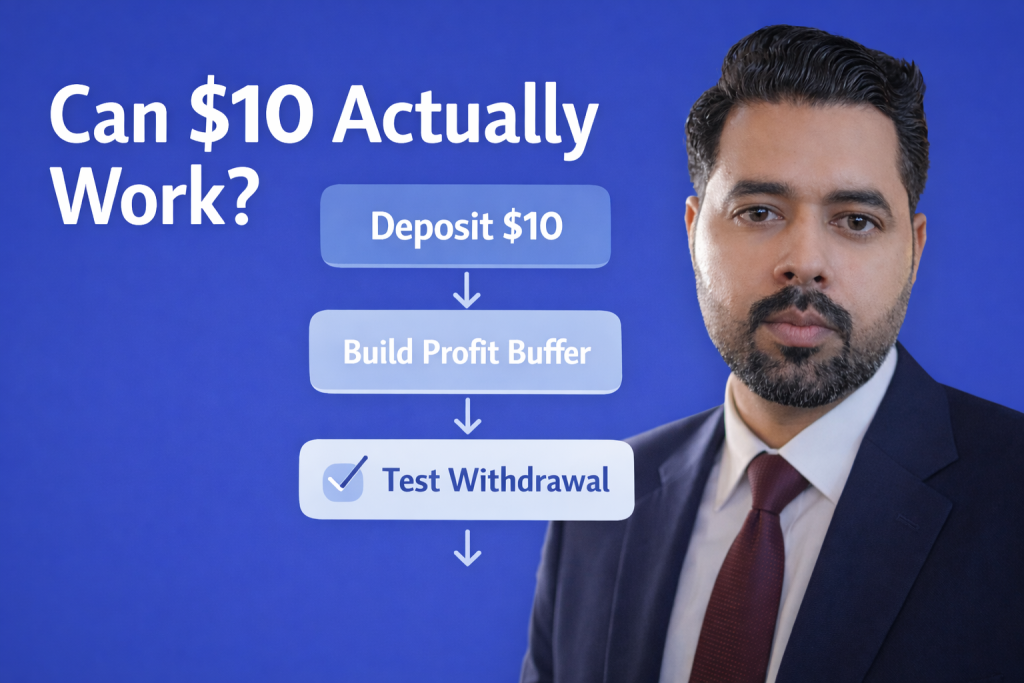
Capital Core Minimum Deposit Strategy: Can You Grow a Small $10 Account?
There’s something dangerously attractive about a broker that lets you start with just $10. It feels harmless. Low risk. Easy to test. Almost too easy. That’s exactly why I wanted to test the Capital Core minimum deposit strategy for myself. Not because I believed a $10 account could become life-changing money. Not because I wanted […]

$10 to $50 Trading Challenge – Strategy + Real Results (Case Study)
Turning $10 into $50 sounds easy until you actually try it. Small accounts expose every weakness in your trading. One bad decision can erase hours of progress, and emotional trading becomes much harder to control when every dollar matters. This case study breaks down how a $10 account was realistically grown to $50 using a […]

I Started with $10 on Quotex – Day 1 Results (Real Case Study)
Most beginner traders ask the same question:Can you actually grow a small account like $10? Instead of theory, I decided to test it in real conditions. This is a Day 1 case study of trading with $10 on Quotex, documenting everything from setup to execution, mistakes, emotions, and actual results. No hype, no fake screenshots, […]

Capital Core Verification Process Explained: KYC, Restrictions, and Withdrawal Delays
I learned something the hard way with offshore-style brokers: the smoothest part is usually opening the account, funding it, and placing the first few trades. The real test starts when you try to move money back out. That’s exactly why I wanted to document the Capital Core verification process from a trader’s perspective, not from […]

Capital Core Withdrawal Test: How Long Does It Really Take to Get Paid?
If you are thinking about using Capital Core, ignore the flashy payout claims for a minute. The only thing that really matters is whether the broker pays you when you request a withdrawal. That was the exact reason I decided to test it for myself. I wasn’t interested in another recycled broker review built around […]