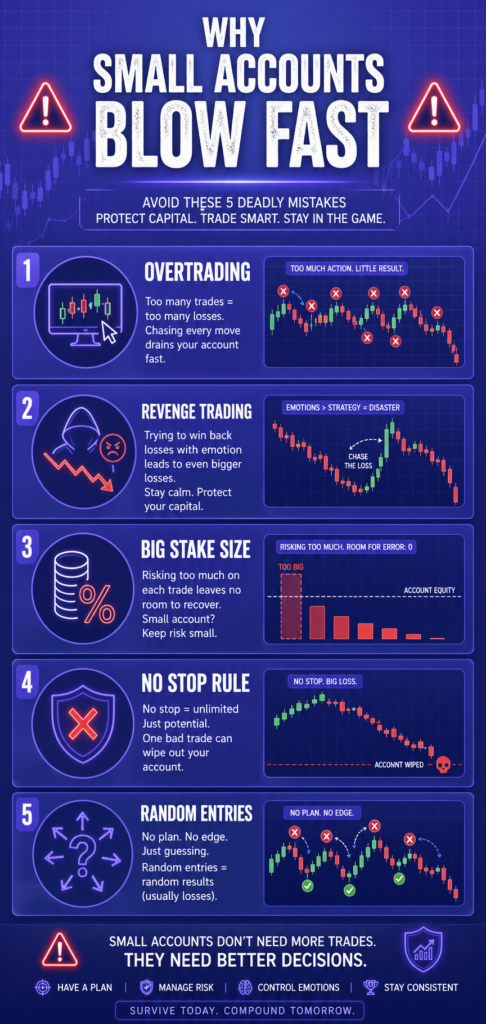
Short answer: The biggest beginner trading mistakes are about size, not entries.
Risking too much per trade, using high leverage, doubling down after losses and trading without a stop can each wipe out an account in a short losing streak.
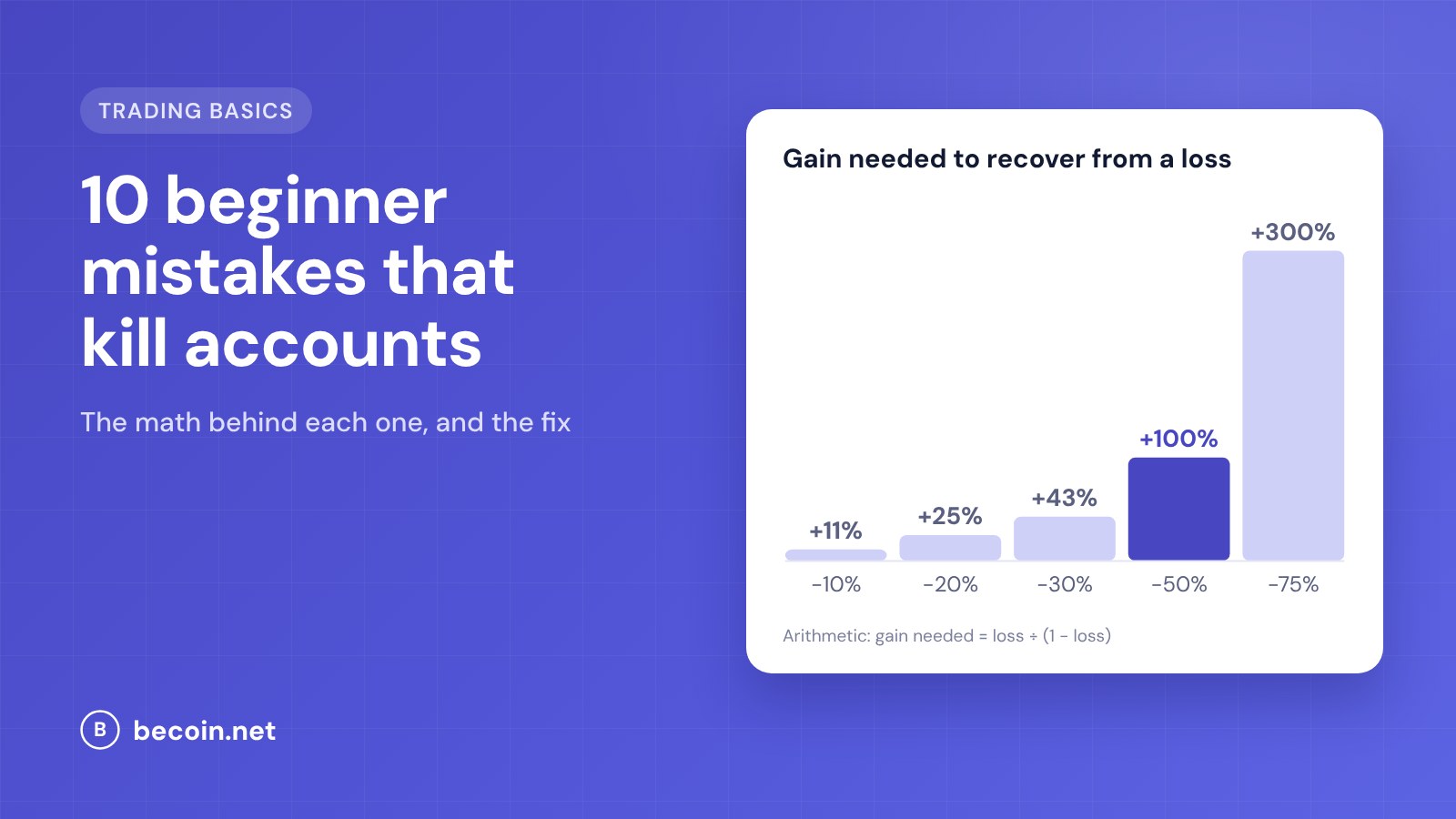
The math is harsh. A 50% loss needs a 100% gain to get back to even. Ten losses in a row at 10% risk per trade leave about 35% of the account; at 1% risk they leave about 90%.
The research is harsh too. European regulators found that 74–89% of retail CFD accounts typically lose money, and a study of Brazilian day traders who kept going for at least 300 days found that 97% lost money.
What the research says about beginner traders
Most "X% of traders lose money" claims online have no source. The numbers below come from a regulator and from peer-reviewed or working papers that tracked real accounts.
| Source | Who was studied | Finding |
|---|---|---|
| ESMA, 27 Mar 2018 | Retail CFD clients in the EU | "74-89% of retail accounts typically lose money", with average losses per client of €1,600 to €29,000 |
| Chague, De-Losso & Giovannetti, 2020 | Everyone who started day trading in Brazil's equity futures market in 2013–2015 and kept at it for at least 300 days | 97% lost money; only 0.4% earned more than a bank teller (about US$54 a day) |
| Barber, Lee, Liu & Odean, 2014 | Day traders in Taiwan, 1992–2006 | "Less than 1% of the day trader population is able to predictably and reliably earn positive abnormal returns net of fees" |
| Barber & Odean, 2000 | 66,465 US households at a discount broker, 1991–1996 | Households that traded most earned 11.4% a year while the market returned 17.9% |
These studies cover different markets and periods, so the numbers are not directly comparable. They point the same way: frequent, short-term retail trading loses money for most people who try it.
The US Securities and Exchange Commission puts it plainly in its day-trading guide: "Be prepared to suffer severe financial losses."
Below are ten mistakes that turn ordinary losses into a dead account. Each one has a worked example with simple numbers and a rule that fixes it.
Mistake 1: Risking too much on one trade
Why it kills accounts. Losing streaks happen to every strategy. If each trade risks a large share of the account, a normal streak becomes a deep hole that is hard to climb out of.
Worked example. Start with $10,000 and lose 10 trades in a row. Each trade risks a fixed percentage of the current balance.
| Risk per trade | Balance left | Drawdown |
|---|---|---|
| 1% | $9,044 | 9.6% |
| 2% | $8,171 | 18.3% |
| 5% | $5,987 | 40.1% |
| 10% | $3,487 | 65.1% |
| 25% | $563 | 94.4% |

Fix rule. Pick a fixed, small risk per trade before you trade, and size the position from it. There is no official number. Choose one, write it down and keep it fixed; the examples here use 1%.
Position size = (account × risk %) ÷ (entry − stop)
$5,000 × 1% = $50 risk
Entry $50, stop $48 → $50 ÷ $2 = 25 shares ($1,250 position)
The position size calculator does this for stocks, and the drawdown calculator shows how deep a streak can go at your risk level.
Mistake 2: No stop loss, or moving it further away
Why it kills accounts. Without an exit, one bad trade has no ceiling. Moving a stop further away "to give it room" does the same thing more slowly: the planned loss quietly doubles.
Worked example. Losses and gains are not symmetrical. The gain needed to recover is loss ÷ (1 − loss).

Now add a moved stop. A trader plans to lose $50 on a trade, then moves the stop to twice the distance. That trade now risks $100. Do it on three losing trades and the damage is $300 instead of the planned $150.
Fix rule. Set the stop when you enter, based on where the trade idea is wrong. You may move it closer to lock in gains; never move it further away.
Check any loss with the percentage gain/loss calculator and place stops with the stop loss calculator.
A stop is not a promise. In fast markets or over a price gap, the fill can be worse than the stop price. That is one more reason to keep size small.
Mistake 3: Using too much leverage
Why it kills accounts. Leverage multiplies the position, so a small price move becomes a large move in your account.
The SEC notes that day traders often use borrowed money and that "many day traders lose all their money and may end up in debt as well."
FINRA's required margin disclosure lists the risks every US margin customer must be told, including:
- "You can lose more funds than you deposit in the margin account"
- "The firm can sell your securities or other assets without contacting you."
Worked example. In 2018 the European Securities and Markets Authority (ESMA) capped retail CFD leverage.
The arithmetic below shows how small an adverse move uses up the margin at each cap, if the account holds only the required margin.
| Asset (ESMA cap) | Move that triggers a 50% margin close-out | Move that wipes the margin |
|---|---|---|
| Major currency pairs (30:1) | 1.67% | 3.33% |
| Non-major pairs, gold, major indices (20:1) | 2.5% | 5% |
| Other commodities, non-major indices (10:1) | 5% | 10% |
| Individual equities (5:1) | 10% | 20% |
| Cryptocurrencies (2:1) | 25% | 50% |
The math: a move that wipes the margin = 1 ÷ leverage. ESMA's rule closes positions when margin falls to 50% of the minimum required, so that happens at half the move. Any higher leverage shrinks these moves further.
Fix rule. Size from your stop (Mistake 1), not from the maximum leverage on offer. Check how much margin a position ties up with the margin calculator.
Mistake 4: Doubling down after losses
Why it kills accounts. Doubling the stake after each loss (a martingale) or adding to a losing position feels like it must work "eventually". It needs unlimited money. Real accounts run out first.
Worked example. Start with a $10 stake and double after every loss.

Each round, the possible gain stays $10, while the amount at risk keeps doubling.
With a 50/50 chance per trade, a run of seven or more losses shows up somewhere in 200 trades more often than not (about 54% of the time).
The risk of ruin calculator shows how quickly the odds of a wipe-out climb as risk per trade rises.
Fix rule. Never increase size after a loss. Position size comes from the account balance and the stop distance, not from the last result.
Mistake 5: Revenge trading with no daily loss limit
Why it kills accounts. After a loss, the urge is to win it back at once. The next trade is often unplanned and bigger. That is how a 1% loss becomes a 7% day: 1%, then 2%, then 4%.
Worked example. With a 3% daily loss limit and 1% risk per trade, three losses end the day. The account is down about 2.97% (0.99 × 0.99 × 0.99 = 0.9703). The next day starts from a small dent, not a crater.
Fix rule. Write a daily loss limit and a maximum number of trades per day into your plan. When either is hit, close the platform. A forced break after two losses in a row is another simple rule to add.
Mistake 6: Overtrading and ignoring costs
Why it kills accounts. Every trade pays a spread, a commission or both. More trades mean more costs, whether or not the trades are good.
In Barber and Odean's study of 66,465 households, those that traded most earned 11.4% a year against 17.9% for the market. The authors' summary: "trading is hazardous to your wealth."
Worked example. Assume every round trip costs a fixed share of the account in spread and commission. Over 250 trading days, before any profit or loss from the trades themselves:
| Cost per round trip | 1 trade a day | 5 trades a day | 20 trades a day |
|---|---|---|---|
| 0.02% | 4.9% | 22.1% | 63.2% |
| 0.05% | 11.8% | 46.5% | 91.8% |
| 0.10% | 22.1% | 71.4% | 99.3% |
The math: account left = (1 − cost)trades. The cost levels are examples, not quotes from any broker. Check your own spread and commission and plug them in.
Fix rule. Trade only setups listed in your plan, set a maximum number of trades per day, and log costs on every trade so you see the real total.
Mistake 7: Chasing win rate, ignoring reward-to-risk
Why it kills accounts. Beginners often take quick small profits and let losers run. The win rate looks great while the account shrinks.
Worked example. The win rate you need just to break even (before costs) is 1 ÷ (1 + reward-to-risk).
| Average win ÷ average loss | Break-even win rate |
|---|---|
| 0.5 (win $50, lose $100) | 66.7% |
| 1 (win $100, lose $100) | 50% |
| 2 (win $200, lose $100) | 33.3% |
| 3 (win $300, lose $100) | 25% |
A trader who wins 60% of the time but makes $50 on winners and loses $100 on losers is still below break-even (60% is less than 66.7%).
Fix rule. Know your average win and average loss, not just the win rate. Check each setup with the risk/reward calculator and the expectancy calculator. More detail: why win rate alone doesn't matter.
Mistake 8: No written plan and no journal
Why it kills accounts. Without written rules, every decision is made in the moment, under stress. Without a journal, there is no way to tell which mistakes repeat.
Worked example. Suppose a journal shows 40 trades in a month. 30 followed the plan and lost a net $120. 10 were impulse trades and lost a net $480.
The impulse trades were a quarter of the trades but 80% of the loss ($480 ÷ $600). Without the journal, that pattern stays hidden.
A short plan covers:
- Markets and setups you trade, and the time of day.
- Risk per trade, daily loss limit and maximum trades per day.
- Where the stop goes and how you exit winners.
- What makes you stop trading for the week.
Fix rule. Write the plan before the next trade, and log every trade: setup, entry, stop, size, result, costs and whether you followed the plan. Start from the free trading plan template and the trading journal.
Mistake 9: Trading money you cannot afford to lose
Why it kills accounts. Rent money or borrowed money adds pressure. Pressure leads to bigger size, moved stops and revenge trades. The SEC's advice is that "day traders should only risk money they can afford to lose."
Expectations matter too. In the Brazilian study, people who day traded for 300 days or more almost all lost money, and only 0.4% earned more than a bank teller.
The SEC also calls day trading "an extremely stressful and expensive full-time job."
Worked example. A trader needs $500 a month from a $5,000 account. That is 10% a month. Compounded, 1.1012 = 3.14, or about a 214% return a year. A target like that pushes risk per trade far above the levels in Mistake 1.
Fix rule. Fund the account only with money that would not change your life if it went to zero. Keep emergency savings separate, and do not use borrowed money to start.
Mistake 10: Following hot tips and signal sellers
Why it kills accounts. A tip gives you an entry but not the size, stop, timeframe or full record of the person sending it.
The SEC warns: "Watch out for "hot tips" and "expert advice" from newsletters and websites catering to day traders," and notes that "educational" seminars, classes and books "may not be objective."
Worked example. A channel shows 8 winning trades of +$100 each and stays quiet about 4 losers of −$300 each. What you see is +$800. The full record is $800 − $1,200 = −$400.
Fix rule. Do not trade any idea you cannot explain, size and exit on your own. If a seller will not show every trade, with dates, assume the record is incomplete.
Checklist: the fix for each mistake
| Mistake | Rule | Check with |
|---|---|---|
| Too much risk per trade | Fixed small % risk; size from stop distance | Position size calculator |
| No stop, or moving it | Stop set at entry; only ever moved closer | Stop loss calculator |
| Too much leverage | Leverage is a result of sizing, not a target | Margin calculator |
| Doubling down | Never raise size after a loss | Risk of ruin calculator |
| Revenge trading | Daily loss limit and max trades per day | Trading checklist |
| Overtrading | Only planned setups; log costs | Trading journal |
| Win rate over reward-to-risk | Track average win, average loss, expectancy | Risk/reward calculator |
| No plan, no journal | Written plan; every trade logged | Trading plan template |
| Money you cannot afford to lose | Only spare money; no borrowing to start | Drawdown calculator |
| Hot tips and signals | Trade only what you can explain, size and exit | Your own plan |
FAQ
What is the biggest mistake beginner traders make?
Risking too much on each trade. Every other mistake does more damage when size is large. At 10% risk per trade, 10 losses in a row cut an account by about 65%; at 1% risk, by about 10%.
Why do most beginner traders lose money?
Costs, leverage and large position sizes work against them, and few have a measurable edge.
ESMA found 74–89% of retail CFD accounts typically lose money, and Barber, Lee, Liu and Odean found that less than 1% of Taiwanese day traders could predictably earn positive returns after fees.
How much should a beginner risk per trade?
There is no official number. The table above shows the trade-off: 10 losses in a row cost about 10% of the account at 1% risk and about 18% at 2%. Whatever you choose, fix it in advance and size each position from it.
Is the $25,000 day trading minimum still required in the US?
FINRA replaced the pattern day trader rules, including the $25,000 minimum equity requirement, with new intraday margin standards effective 4 June 2026.
Firms may phase the change in until 20 October 2027, so ask your broker which rules apply to your account.
How do you stop revenge trading?
Set a daily loss limit and a maximum number of trades before the session starts. When either is hit, stop for the day. A journal entry for every trade makes impulse trades visible.
Is it possible to recover from a 50% loss?
It needs a 100% gain on what is left. That is why small losses matter: a 10% loss needs only an 11.1% gain.
Is day trading a realistic way to make a living?
For most people, the evidence says no. Of Brazilian futures day traders who kept going for at least 300 days, 97% lost money and only 0.4% earned more than a bank teller.
Bottom line
Beginner accounts rarely die from one bad idea. They die from size: too much risk per trade, too much leverage, doubling after losses and no exit. The loss-recovery math makes deep drawdowns very hard to repair.
The fixes are simple rules written in advance: a small fixed risk per trade, a stop set at entry, a daily loss limit, a cap on trades and a journal.
They do not make trading profitable, but they keep mistakes small enough to learn from.