
Why 90% of Traders Lose Money (Real Reasons Beginners Don’t Realize)
Most Traders Don’t Lose Because of Strategy — They Lose Because of Behavior
If you ask most beginners why traders fail, you’ll hear answers like:
- “Bad strategy”
- “Wrong indicator”
- “Market manipulation”
- “Need better signals”
But after observing thousands of beginner trading behaviors, the truth is much simpler and more uncomfortable:
“Most traders lose money because of how they behave, not what they use.”
Even profitable strategies fail in the hands of emotional, impatient, and unprepared traders.
The market does not punish beginners for being new, it punishes them for being undisciplined.

Why 90% of Traders Lose Money (The Real Breakdown)
There is no single reason. It is a chain reaction of mistakes that starts before the first trade.
Let’s break it down properly.
1. They Enter Trading With a “Fast Money” Mindset
Most beginners do not enter trading thinking about skill development. They enter thinking:
- “How fast can I double this?”
- “Can I turn $50 into $500?”
- “How quickly can I withdraw profit?”
This mindset immediately creates pressure.
Instead of waiting for good setups, they start forcing trades.
When trades are forced, logic disappears. And when logic disappears, losses become predictable.
Successful traders do not start with speed. They start with survival.
Check out our guide on KYC verification so you don’t find any issues in withdrawals.
2. They Risk Too Much on Every Trade
This is one of the most destructive habits in trading.
A beginner with a small account often thinks:
“If I risk more, I can grow faster.”
So instead of risking 1–3%, they risk 10%, 20%, or even more per trade.
At first, it feels exciting. One win feels powerful. But the problem shows up immediately after a few losses.
A short losing streak doesn’t just hurt — it destroys the entire account psychologically and financially.
Once emotion enters, recovery trading begins, and that usually finishes the account completely.
Professional traders survive because they treat risk like a rule, not a choice.

3. They Trade Emotionally Instead of Logically
Emotional trading is the silent account killer.
It usually starts after one bad trade:
- “I need to recover this loss”
- “That trade was unlucky”
- “One more trade to fix it”
This is where discipline breaks.
A trader who was calm suddenly becomes reactive. And reactive decisions are almost always wrong in trading environments.
In most cases, traders don’t lose in one bad trade — they lose in the emotional recovery phase after it.
4. They Have No Real Trading Plan
Most beginners believe watching signals or indicators is a “plan.”
It is not.
A real trading plan answers:
- When to trade
- When NOT to trade
- How much to risk
- How many trades per day
- When to stop
Without these rules, every decision becomes random.
And randomness in trading usually leads to inconsistency — and inconsistency leads to losses.
Even a simple rule-based system beats emotional guessing.
5. They Switch Strategies Too Often
A very common beginner cycle looks like this:
Week 1: RSI strategy
Week 2: Moving average crossover
Week 3: Signals group
Week 4: New “winning system” on YouTube
Nothing is given enough time to be tested properly.
So instead of improving one system, they keep restarting from zero.
Professional traders don’t chase new methods constantly. They refine one approach and master it through repetition.

6. They Ignore Risk Control Because They Focus on Profits
Beginners usually obsess over:
- Winning trades
- Profit percentage
- Fast growth
But ignore:
- Maximum loss per day
- Drawdown control
- Capital protection
Here is the reality:
Profit is a result. Risk control is the system.
Without risk control, even a good winning streak cannot save the account long-term.
This is where most traders fail silently — not in losing trades, but in uncontrolled losing streaks.
7. They Don’t Understand Platform Behavior
This is often overlooked but important.
Some traders lose not because of strategy alone, but because:
- They start live trading too early
- They don’t understand execution timing
- They don’t test withdrawals
- They choose overly complex interfaces
- They get distracted by bonuses or features
A confusing environment creates confusion in decisions.
That is why simplicity matters in the beginning — not complexity.
Why Small Accounts Fail Faster
Small accounts fail quickly for one main reason:
Pressure.
When capital is small, traders feel forced to grow it fast.
Instead of building consistency, they chase multiplication.
This leads to:
- Oversized trades
- Revenge trading
- Overtrading
- Emotional breakdown after losses
Ironically, small accounts don’t fail because they are small — they fail because traders treat them like lottery tickets.
What Actually Separates Winners From Losers
Successful traders are not smarter.
They are not lucky.
They simply behave differently.
Losing Traders:
- Trade emotionally
- Focus on profit first
- Overrisk
- Switch systems often
- React to losses
Winning Traders:
- Focus on survival first
- Use fixed risk rules
- Stay consistent
- Follow structured plans
- Accept losses as part of the process
The difference is not technical. It is behavioral.
A Simple Beginner Framework That Actually Works
If you are new, ignore complexity.
Start with this structure:
Step 1: Demo First
Understand execution, timing, and platform behavior.
Step 2: Start Small
Risk minimal capital to remove emotional pressure.
Step 3: Use Fixed Risk
Never increase trade size emotionally.
Step 4: Limit Daily Trades
Fewer trades = better decisions.
Step 5: Review Mistakes Weekly
Focus on patterns, not individual trades.
This alone puts you ahead of most beginners.
Mid-Page Insight
Before choosing any trading approach or platform, it’s important to understand how execution, psychology, and risk exposure actually shape outcomes.
That’s why I developed the Becoin trading framework, a structured system designed to help traders make disciplined decisions instead of emotional ones.
If You Still Want to Trade, Understand This First
The platform you use will not make you profitable.
But it can either support discipline or destroy it.
Beginners should prioritize:
- Simple execution
- Clear interface
- Demo availability
- Low deposit entry
- Stable withdrawal behavior
Many users compare platforms like Quotex, Pocket Option, or Deriv depending on simplicity and goals but the real focus should always be discipline first, platform second.
Final Truth: Trading Fails Are Predictable
The reason 90% of traders lose is not a mystery.
It is repetition:
- Same emotional mistakes
- Same risk behavior
- Same impatience
- Same lack of structure
If you fix behavior, results naturally improve.
If you don’t, no strategy will save you.
Join Becoin Premium for deeper broker analysis, risk systems, and real testing insights designed for safer trading decisions.
FAQ
Why do most traders lose money?
Because they overrisk, trade emotionally, and lack discipline and structure.
Is trading actually profitable for beginners?
Yes, but only after developing risk control and consistent behavior.
What is the biggest mistake beginners make?
Trying to grow money too fast.
Can strategy alone make me profitable?
No. Psychology and risk control matter more than strategy.
How do I stop losing money in trading?
Reduce risk, stop emotional trading, and follow a structured plan.
Which Broker Has Faster Withdrawals? Real 2026 Comparison for Traders
When most beginners choose a broker, they focus on bonuses, signals, or flashy interfaces. But after trading for a while, you realize one thing matters more than almost anything else: How fast can you actually withdraw your money? A broker can look perfect until your first withdrawal request gets stuck in “processing” for three days. […]

Best Day Trading Brokers for Beginners (2026) — Fast Decision Guide
If you’re searching for the best day trading brokers for beginners, the real problem isn’t lack of options, it’s choosing the wrong platform and learning that mistake after you deposit. Most beginners don’t fail because of strategy. They fail because they start on a broker that has unclear execution, weak withdrawal behavior, or confusing conditions. […]
Chasing Safety in a High-Stakes World: My Quest for the Best Low-Risk Trading Platforms
I still remember the sinking feeling in my stomach when I lost my first tiny trading account. It wasn’t a massive fortune, but it was mine. That night, I realized a brutal truth about this industry: most beginners fail not because they lack passion, but because they dive into high-risk environments without a life jacket. […]

Which Broker Has the Cleanest Interface? Real Comparison for Beginners in 2026
Looking for the cleanest trading interface in 2026? Compare Binomo, IQ Option, Quotex, Deriv, and more based on speed, layout, usability, mobile experience, and beginner friendliness. When most beginners choose a broker, they focus on bonuses, payouts, or deposit methods. But after testing multiple platforms for months, I realized something surprising: A messy interface can […]
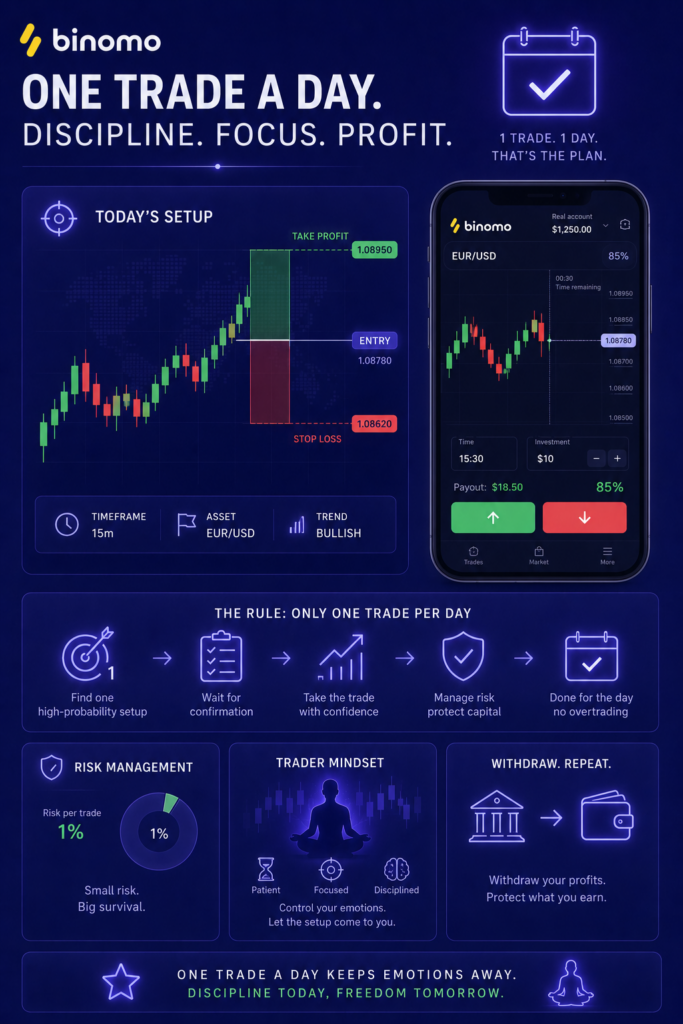
Best Broker for One Trade a Day Strategy in 2026
Most traders lose money because they trade too much. They enter random setups, chase candles, overreact emotionally, and turn a simple strategy into pure gambling. That is exactly why the one trade a day strategy is becoming more popular among smart traders in 2026. Instead of sitting in front of charts all day, this approach […]