Black-Scholes Options Pricing: Find Overpriced and Underpriced Contracts
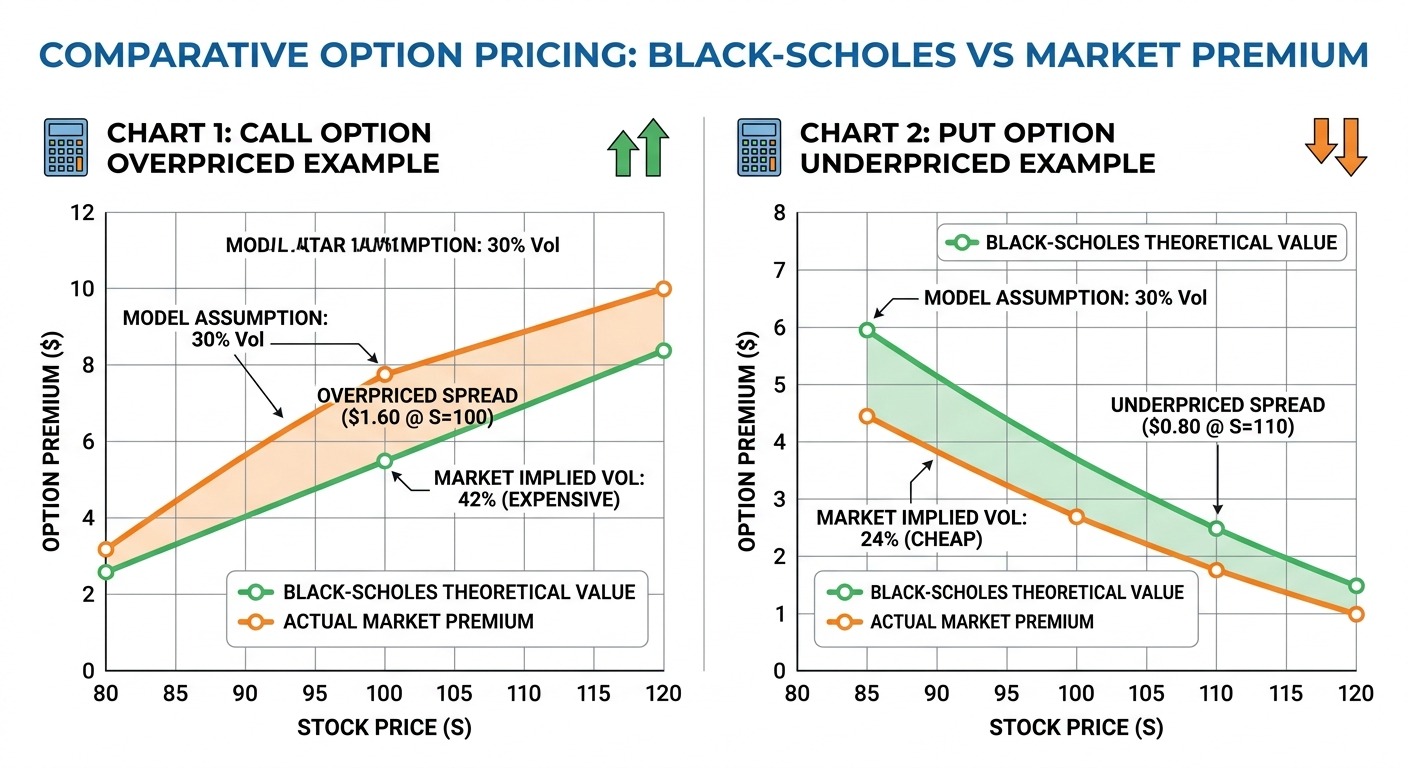
Quick Verdict: The Black-Scholes model gives you an objective, fair price for currency and stock options by evaluating the stock price, strike price, time to expiration, interest rates, and volatility. If live market premiums trade significantly above model fair value, the contract is likely overpriced (sell candidate); if below, it is underpriced (buy candidate). Use it to eliminate guesswork and spot real pricing edges before entering trades.
For traders entering the options market, contract pricing can initially appear complex. With prices moving continuously, a fundamental question arises: how can a trader determine whether an option contract is overpriced or underpriced?
The Black-Scholes model addresses this challenge by providing a framework to estimate theoretical fair value rather than relying on market sentiment. Whether analyzing equity options or currency options in the forex market, calculating fair value offers a clear quantitative baseline. For comprehensive market analysis and strategy development, explore Becoin Premium to refine your trading strategy.
 What Is the Black-Scholes Options Pricing Model?
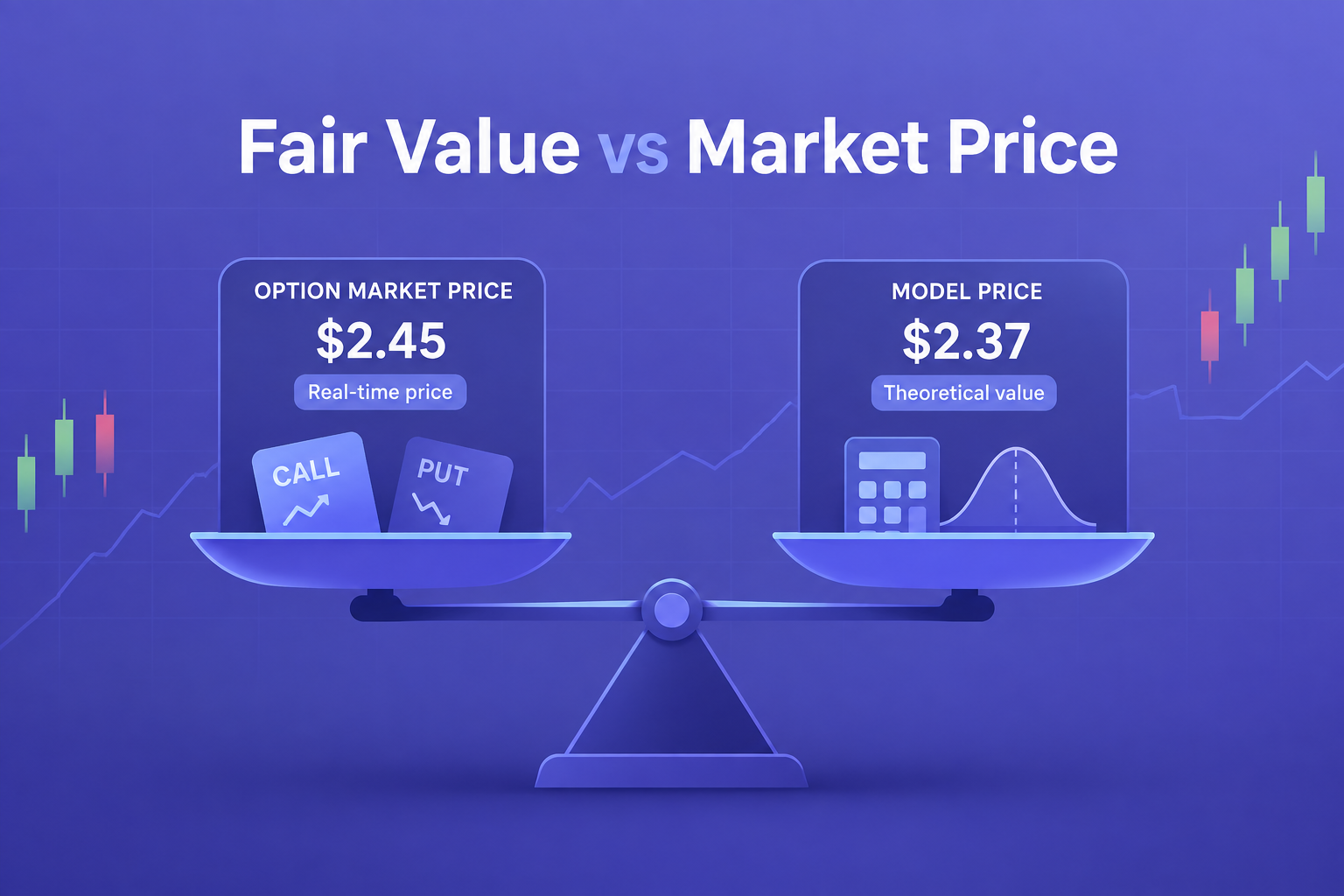
While market prices reflect real-time supply and demand, they can temporarily deviate from fair value due to sentiment or sudden news. The Black-Scholes model provides an objective benchmark for valuation.
Fischer Black and Myron Scholes created this famous model back in 1973. It calculates an option’s theoretical fair value. Think of it as a math-based price tag. It tells you what a contract should cost in a balanced market without panic or greed.
The model works for two basic trade types:
- Call Options: Contracts that give you the right to buy an asset at a set price.
- Put Options: Contracts that give you the right to sell an asset at a set price.
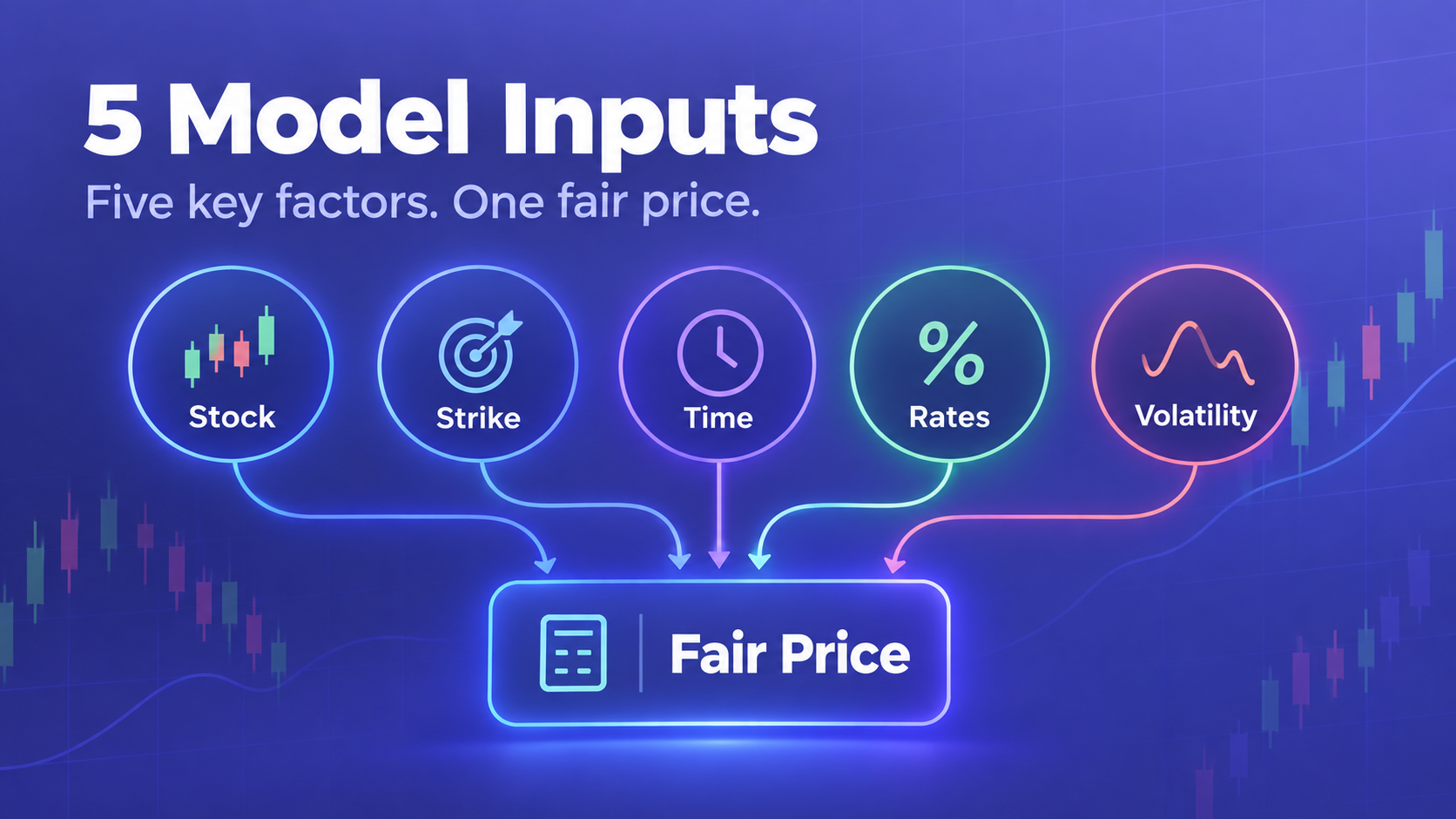
To determine fair price, five standard market inputs are used:
| Input Variable | Symbol | Plain Meaning |
|---|---|---|
| Stock Price | S | Current market price of the underlying asset |
| Strike Price | K | The target price where you exercise the option |
| Time to Expiration | T | Days left until the contract expires |
| Risk-Free Rate | r | Standard interest rate like treasury yields |
| Volatility | σ | Expected market movement and swings |
By comparing the calculated theoretical value with real-time market quotes, traders can identify potential pricing discrepancies and evaluate potential trading opportunities across equities or currency pairs.
How Black-Scholes Calculates an Option's Value
Call and Put Formulas
Below are the core mathematical expressions used to price European-style call and put options:
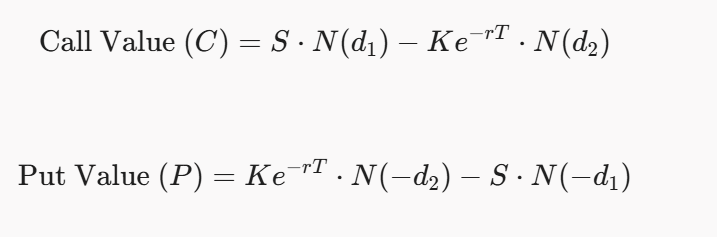
We calculate the terms d1 and d2 using these steps:
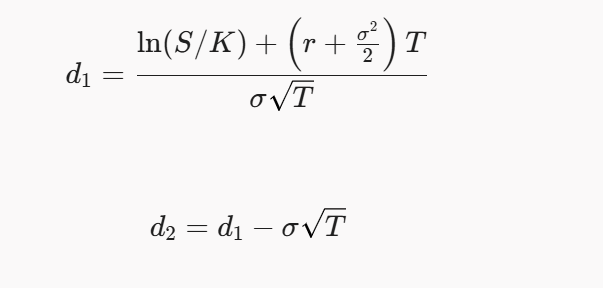
In plain terms, N(d1) and N(d2) help measure the chance that your option ends up in profit. They also show how sensitive the option price is when the underlying asset moves.
A Practical Worked Example
Let us look at a trade I calculated recently:
- Stock Price (S): $100.00
- Strike Price (K): $105.00
- Time to Expiration (T): 30 days (0.0822 years)
- Risk-Free Rate (r): 4.0% (0.04)
- Volatility (σ): 30% (0.30)
When I run these inputs through the formula, d1 comes out to -0.4859 and d2 comes out to -0.5719. Looking up the probability values gives us:

The theoretical fair value for this call option is $1.66. This value serves as the reference point when evaluating live broker quotes.
How I Find Potentially Overpriced and Underpriced Options
Identifying mispriced options involves a systematic three-step workflow:
- Calculate Fair Value: Run the formula to find the baseline price.
- Check Market Quotes: Look at the live market price.
- Compare Both Numbers: Spot price gaps and plan your trade.
| Model Value | Market Price | What It Means | Trading Action |
|---|---|---|---|
| $1.66 | $2.50 | Expensive / Overpriced | Look to sell or short the option |
| $1.66 | $1.65 | Fairly Priced | Hold off or trade neutral setups |
| $1.66 | $1.05 | Cheap / Underpriced | Look for buying opportunities |
A Practical Trading Example
For example, if a call option has a model fair value of $1.66 while the live quote trades at $2.50 due to short-term market demand or an upcoming economic release, the contract may be overpriced. Traders might avoid purchasing at elevated premiums or consider strategies that capitalize on premium contraction.
Note that price gaps between theoretical models and market quotes do not guarantee risk-free returns, as live markets continuously adjust to breaking information.
Why Volatility Can Change Your Answer
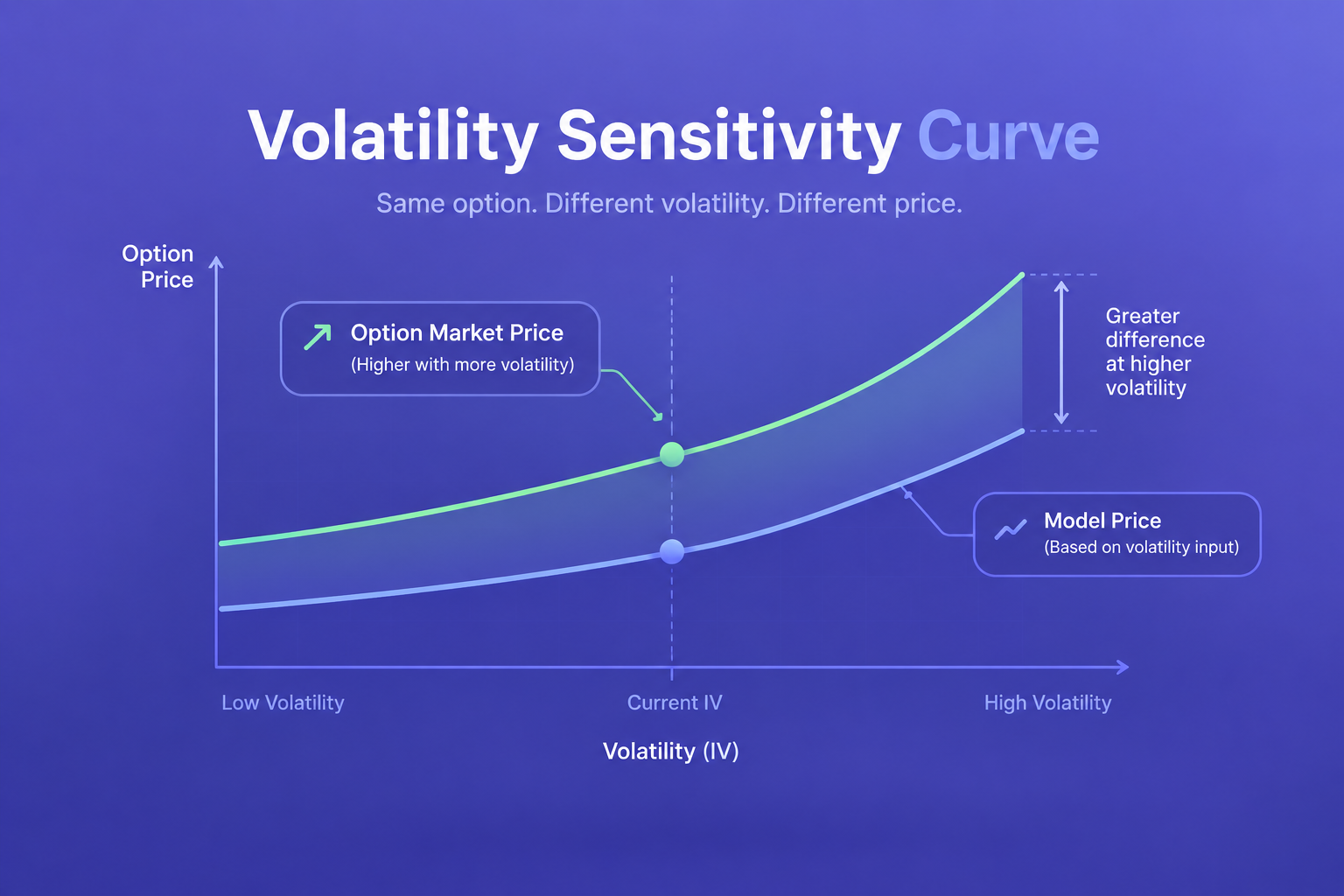
Volatility is a key variable in option pricing. While asset price, strike price, time to expiration, and interest rates are observable inputs, volatility represents expected future price fluctuation.
Sensitivity Example
The table below illustrates how changing the volatility parameter impacts the calculated value of a $1.66 call option:
| Volatility Input (σ) | Model Call Value | Impact on Price |
|---|---|---|
| 20% | $0.61 | Lower swings reduce option value |
| 30% | $1.66 | Standard baseline |
| 40% | $2.81 | Higher swings increase option value |
When expected market swings increase, options become more expensive because the chance of a big win goes up.
Implied Volatility
Traders often reverse the calculation by plugging the current market price into the formula to solve for Implied Volatility (IV).
In forex and equity markets alike, a significantly elevated IV indicates that traders expect heightened price movement, such as around central bank interest rate decisions or major economic data releases.
When Black-Scholes Can Mislead You
The Black-Scholes model uses smooth mathematical assumptions. Real financial markets are often chaotic.
- Changing Volatility: The model assumes volatility stays flat. In real life, market swings change constantly.
- Volatility Skew: Traders pay extra for downside put options to protect their stock portfolios.
- Early Exercise: American options let you exercise anytime before expiration, which adds extra value that basic formulas miss.
- Dividends & Fees: Stock dividends drop the share price on ex-dates. Spreads and broker fees can also swallow tiny pricing edges.
Academic research confirms these real-world limits. A published study on Google Scholar titledEmpirical Examination of the Black-Scholes Model shows that while the model works well for call options, real-world pricing gaps often occur in put options and volatile markets.
If you trade short-term trends or digital options across modern platforms, testing your setup on live charts is essential. You can practice strategies and check price movement on platforms likeIQ Option, test execution speeds onDeriv, or practice setups onPocket Option.
My Simple Options Screening Checklist
Before executing options trades, traders should consider the following evaluation steps:
- Calculate Model Value: Find the baseline fair price.
- Check Live Premiums: Find the middle price between bid and ask quotes.
- Review Implied Volatility: Compare IV against past movement.
- Test Volatility Ranges: Recalculate prices under high and low market swings.
- Check Spreads: Make sure buying and selling costs are low.
- Watch News & Earnings: Look out for dividend dates or major reports.
- Place the Trade: Execute only when you have a clear edge.
Traders testing fast price movements across different platforms often compare tools onQuotex, evaluate accounts onExpertOption, trade assets onOlymp Trade, practice setups onBinomo, or refine risk limits usingCapitalCore.
Black-Scholes Options Pricing FAQs
Can Black-Scholes identify overpriced options?
Yes. If the market price is much higher than the model fair value, the option may be overpriced relative to past market swings.
Can Black-Scholes identify underpriced options?
Yes. When the market price sits below the model value, the contract may be underpriced if your volatility settings are accurate.
What if market price is higher than model value?
It usually means traders expect a big price move soon due to upcoming company news or earnings reports.
Why is implied volatility important?
Implied volatility shows what the market expects for future price moves. It helps you see if an option price is cheap or expensive right now.
Is Black-Scholes accurate for live trading?
It gives a reliable baseline for standard European options. For complex strategies, explore our detailed guides on theBecoin Blog to sharpen your trading performance.
Ready to take your trading to the next level? JoinBecoin Premium today to get market predictions, deep analysis, and an edge in every trade!

Best Broker for Pakistani Traders in 2026
Finding the best broker in Pakistan is not as simple as choosing the platform with the biggest ads or the highest payout percentage. Pakistani traders face unique challenges including payment method limitations, withdrawal delays, unstable strategies, and brokers that look attractive at first but become difficult to use later. Many beginners deposit money into the […]

How Much Money Do You Really Need to Start Trading? A Realistic Beginner’s Guide for 2026
One of the most common questions beginners ask is: How much money do I need to start trading? It sounds like a simple question, but the answer depends on what you actually mean by start trading. Are you trying to learn? Are you hoping to grow savings over time? Are you trying to create a […]
Capital Core 40% Deposit Bonus Explained: Worth It or Risky?
The first time I saw the Capital Core 40% deposit bonus, I reacted exactly the way most traders do. I saw the extra credit, did the quick math in my head, and immediately thought, “That’s more room to trade.” That’s how these offers are designed to feel. They look simple. Deposit money, get 40% more, […]
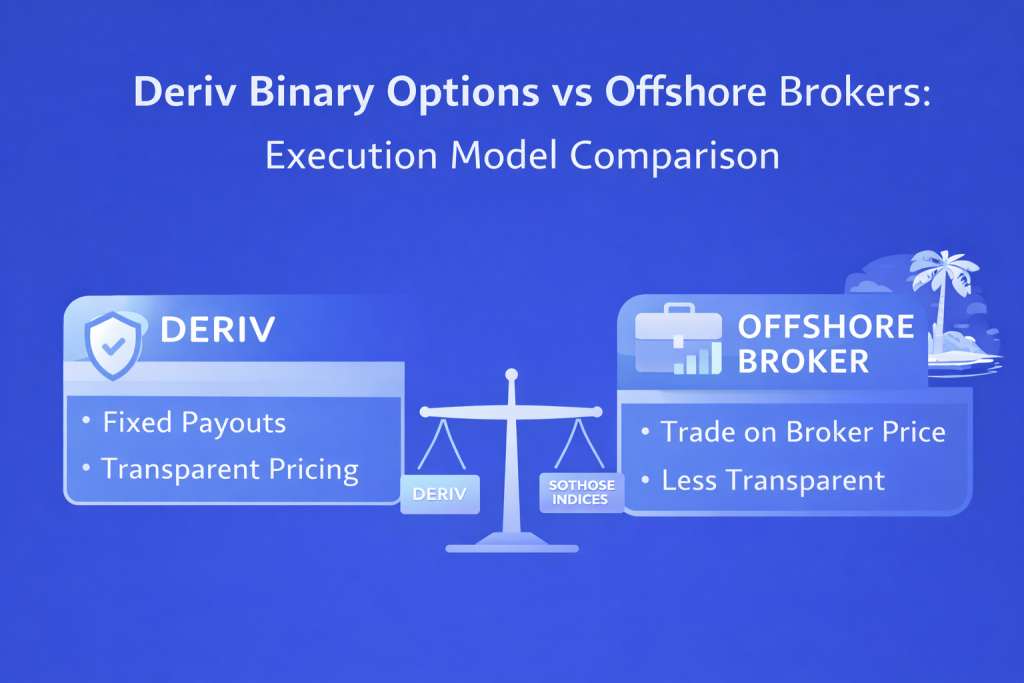
Deriv Day Trading vs Offshore Brokers: Execution Model Comparison
I did not start my trading journey thinking about execution models. Like most beginners, I started with charts, indicators, and the belief that if I could just find the right entry signal, profits would follow. My early trading notebook was full of screenshots of RSI signals, candlestick patterns, and support levels. What it did not […]
How Liquidity Affects Day Trading Results
When I first started trading day trading, I believed success was all about finding the perfect indicator. I spent weeks testing moving averages, RSI settings, support and resistance levels, and dozens of YouTube strategies that promised easy wins. Some worked for a few trades, but most failed. What confused me was that the same setup […]

Which Broker Has Better Risk Management Tools?
The burning smell of my own account blowing up is a scent I will never forget. It was a rainy Tuesday afternoon a few years back. I sat huddled over my laptop, watching a currency pair oscillate. Confident, arrogant, and entirely unprotected, I clicked buy. Minutes later, a sudden market spike completely wiped out my […]