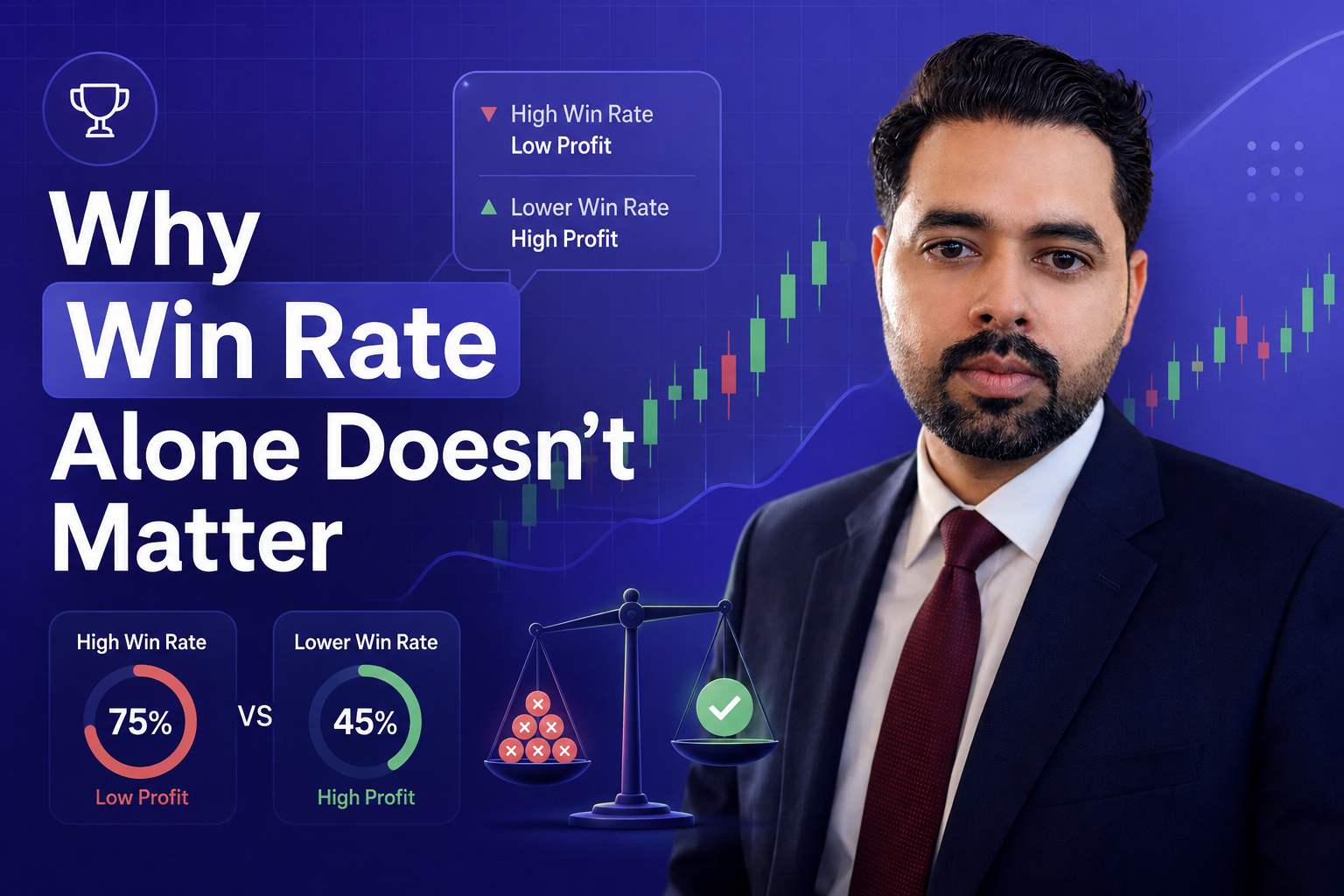
Why Win Rate Alone Doesn't Matter
It was a rainy Tuesday night when I stared at my screen in total disbelief.
My trading journal recorded sixteen consecutive winning trades. According to my platform's dashboard, my win rate stood at an enviable 85%. On paper, I looked like an absolute market wizard. In reality, my account balance had just suffered a devastating 35% drawdown.
How could someone win eight out of every ten trades and still bleed capital at an alarming rate?
Like millions of retail traders starting out, I had fallen into the win-rate trap. I believed the grand illusion that trading success was a simple game of being right as often as possible. I was fixated on validation rather than value, prioritizing the psychological dopamine hit of green closing notifications over the mechanical reality of net expectancy.
The journey out of that statistical graveyard forced me to rethink everything I knew about market mechanics. It completely reframed how I evaluate platforms, setup structures, and market dynamics.
The Psychological Trap of Being Right
Human brains are wired to despise being wrong. From early schooling through corporate careers, society conditions us to view high accuracy as the primary measure of competence. When beginners step into modern financial markets—whether trading micro-contracts, options, or exploring Deriv for synthetic indices—they carry this exact psychological baggage with them.
To protect my fragile ego back then, I began subtly sabotaging my execution:
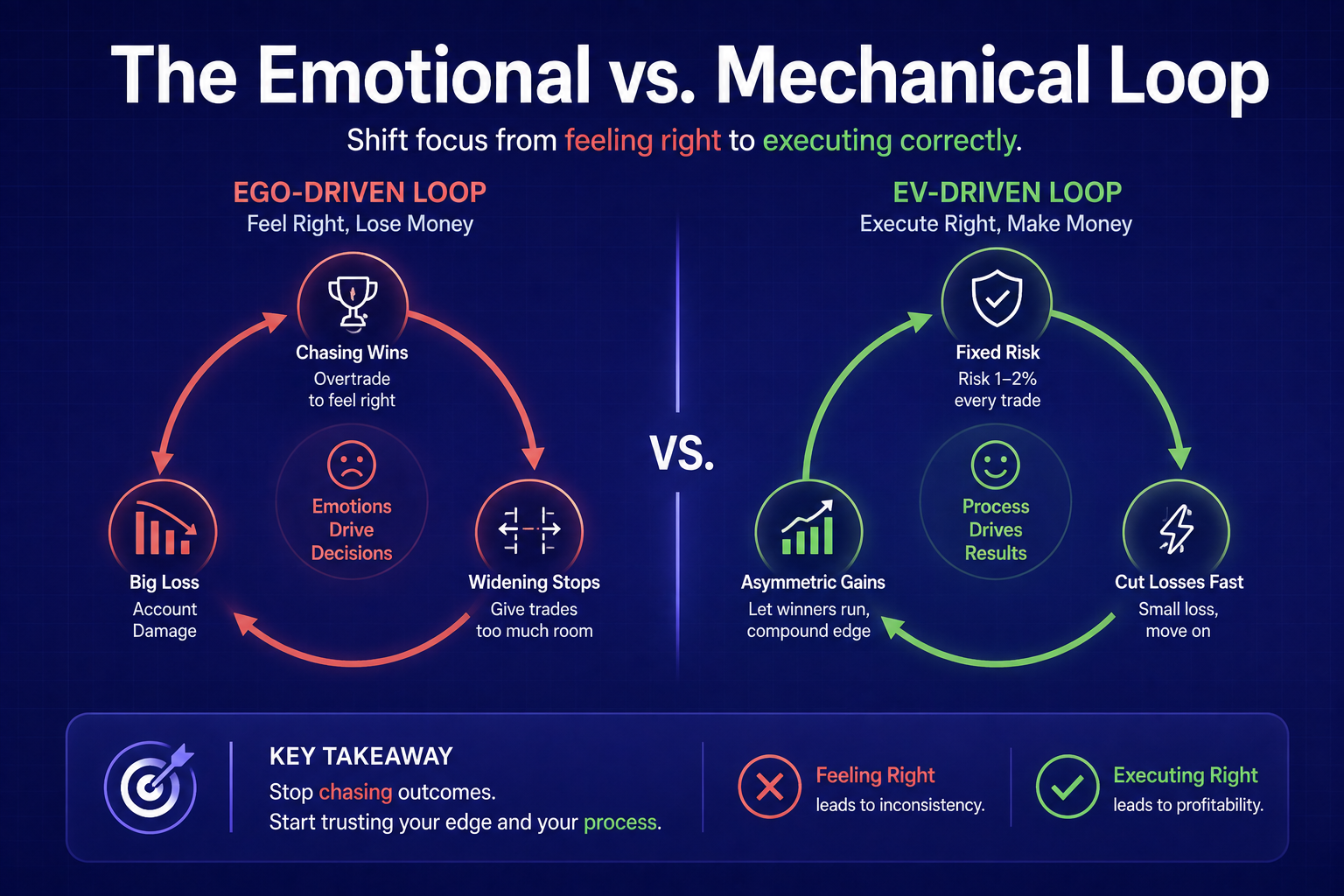
- I cut winning trades prematurely: The moment a trade went $20 into profit, I closed it out just to record another "win."
- I let losing trades run indefinitely: When price moved against me, I removed my stop loss, holding on and praying for a bounce so I wouldn't have to realize a loss.
- I doubled down on bad positions: I added size to failing trades to pull my average entry price closer, turning small errors into massive account threats.
My high win rate wasn't proof of an elite trading system; it was a symptom of terrible risk management. I was taking tiny profits on fifteen trades, only to let the sixteenth trade destroy my entire week's progress.
The Cold Hard Math: Expected Value over Accuracy
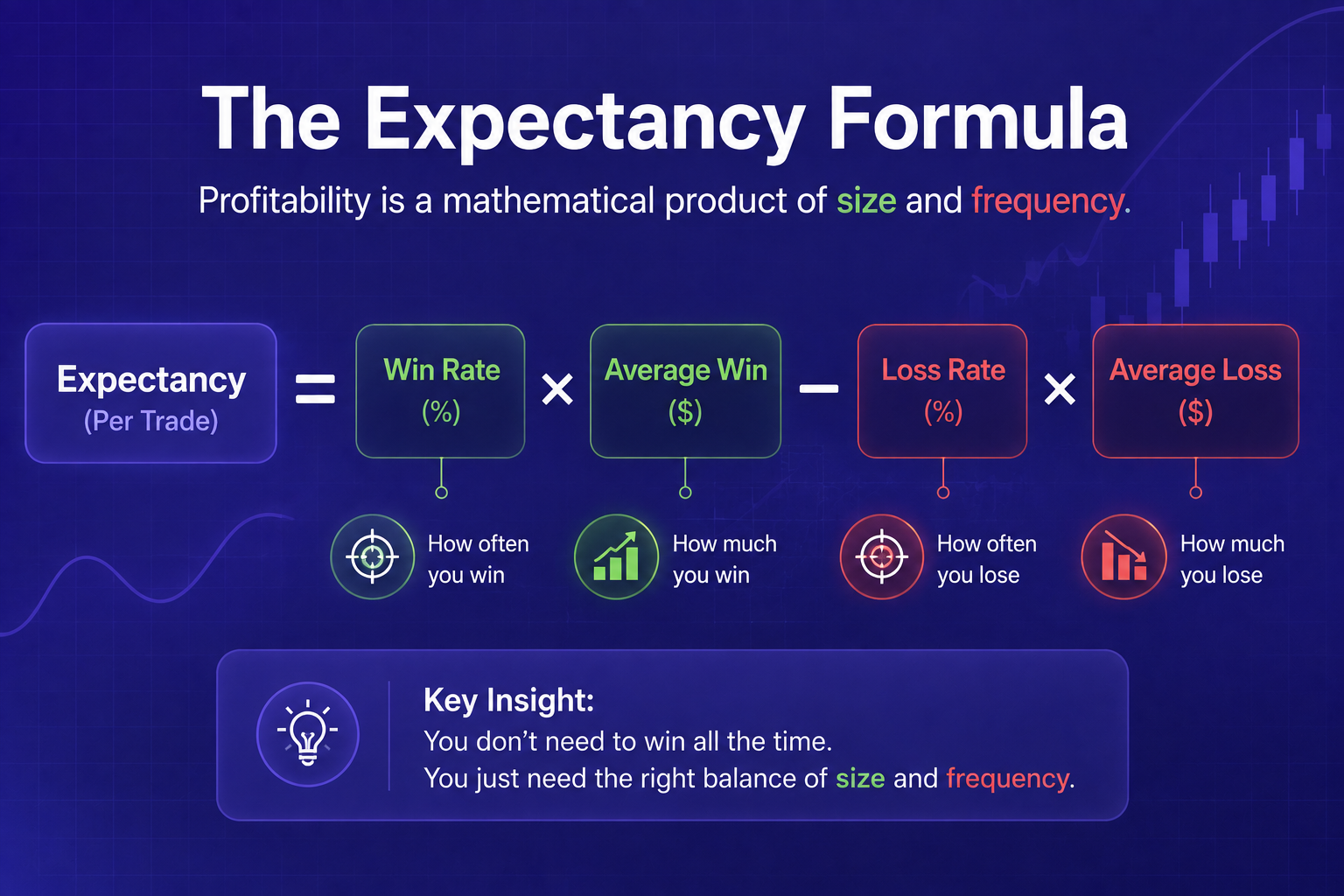
Profitability in financial trading isn't an accuracy contest; it's a mathematical game of Expected Value (EV). Your mathematical expectancy dictates how much money you can expect to make per dollar risked over a large sample size.
Mathematically, Expectancy is calculated as:
Expectancy=(WinRateAverageWin)-(LossRateAverageLoss)
Let's look at two hypothetical traders to see how this plays out in the real world.
Trader A (The High Win-Rate Illusion)
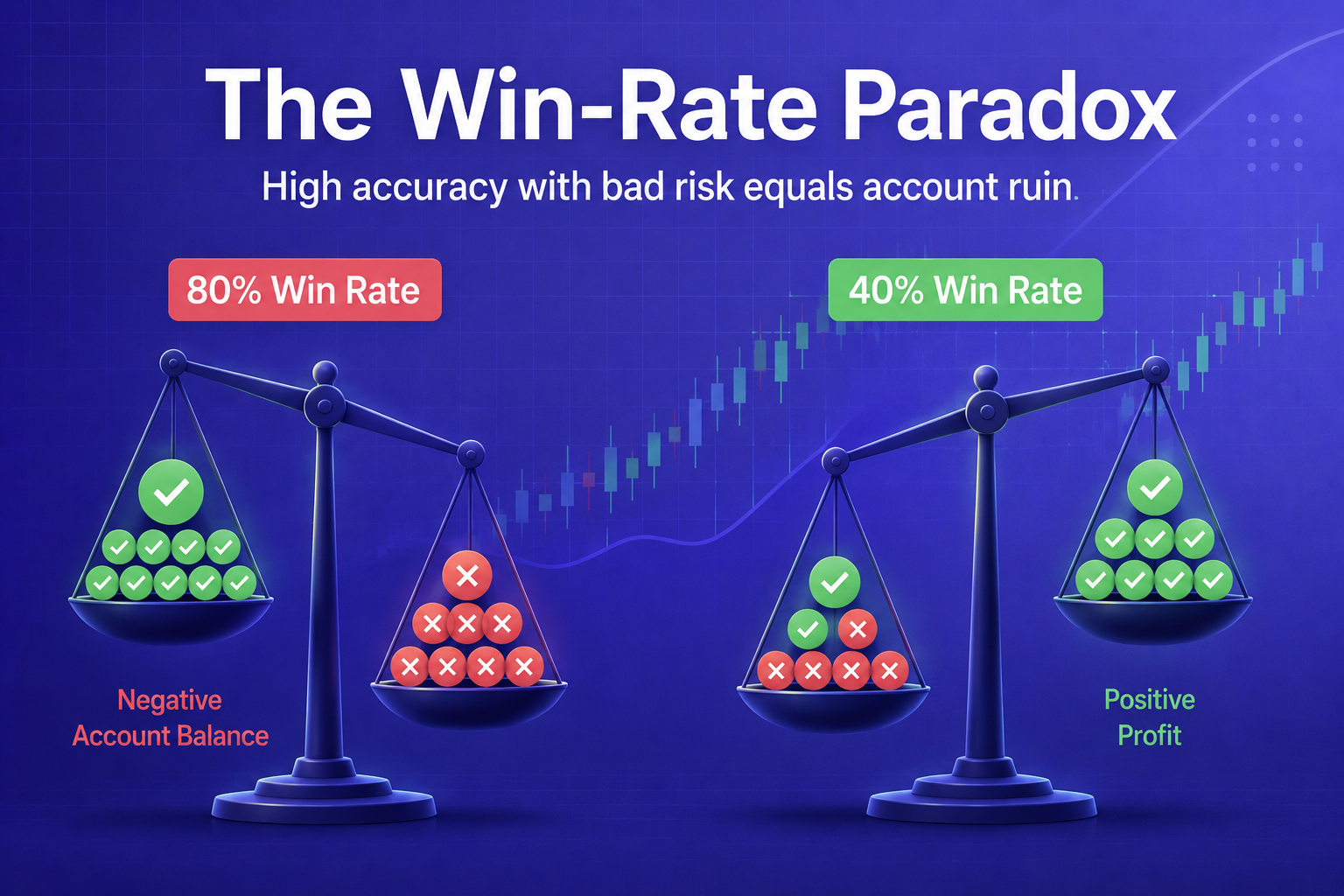
- Win Rate: 80%
- Average Win: $100
- Average Loss: $500
- Out of 10 trades: (8 wins $100) - (2 losses $500) = $800 - $1,000 = -$200 Net Loss
Trader B (The Asymmetric Risk Master)
- Win Rate: 40%
- Average Win: $400
- Average Loss: $100
- Out of 10 trades: (4 wins $400) - (6 losses $100) = $1,600 - $600 = +$1,000 Net Profit
Trader B loses more than half of their trades, yet ends up wildly profitable. Trader A wins 80% of the time and steadily goes broke.
When you test strategies on flexible platforms like IQ Option or analyze price action across high-volume assets on Binomo, you quickly realize that sustainable edge comes entirely from asymmetric risk-to-reward profiles, not high-frequency wins.
If you are interested in diving deeper into statistical frameworks and system evaluation, check out our comprehensive guide on building a mechanical trading strategy to master these mechanics.
The Three Pillars That Actually Determine Trader Survival
Once you stop chasing the high-win-rate high, you can focus on the three operational pillars that actually protect and build trading accounts.
1. Risk-to-Reward Ratio (R:R)
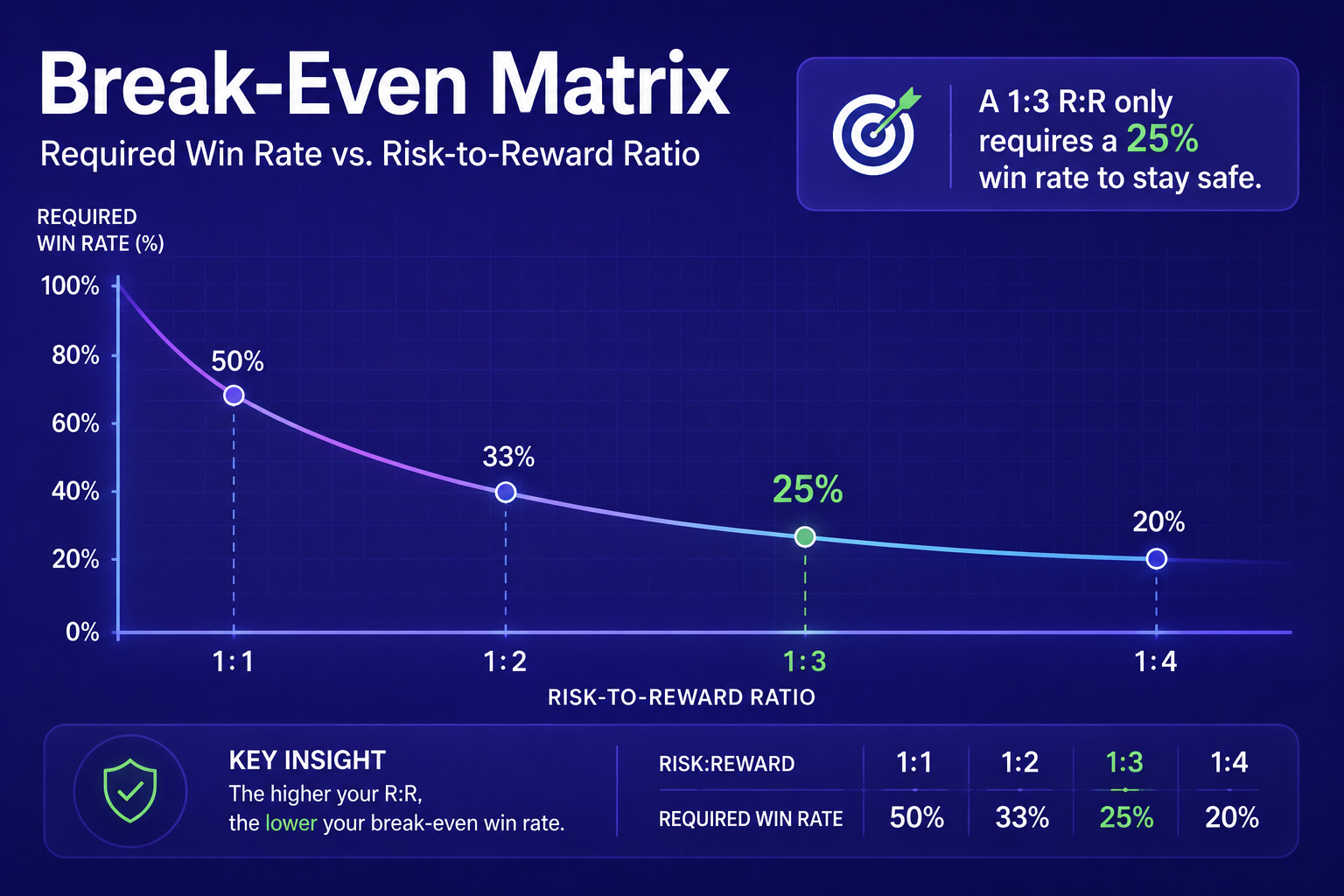
Your Risk-to-Reward ratio determines your break-even win rate threshold. If you risk $100 to make $300 (a 1:3 R:R), you only need to be right 26% of the time to break even. Any win rate above 30% yields long-term profitability.
2. Position Sizing and Drawdown Control
Even with a positive mathematical expectancy, aggressive position sizing can destroy your account during an inevitable streak of bad luck. A system with a 60% win rate can easily produce 7 or 8 consecutive losses over a 100-trade sample. If you risk 10% of your account per trade, an 8-trade losing streak leaves you down over 50%, requiring a 100% gain just to get back to even.
3. Execution Quality and Platform Mechanics
Order execution speed, spread tightness, and payout structures vary heavily across different market venues. Whether you execute short-term setups via Quotex or analyze global macro trends on ExpertOption, understanding how your broker handles slippage and contract fulfillment directly affects your net expectancy.
For a detailed look at selecting execution environments that match your strategy style, read our analysis on evaluating platform execution speed and liquidity.
Visualizing Strategy Profiling and Expectancy
Different trading styles naturally produce vastly different win-rate profiles. Understanding where your strategy fits helps eliminate the emotional stress of taking consecutive losses.
| Strategy Type | Typical Win Rate | Target Risk-Reward Ratio | Primary Profit Driver |
|---|---|---|---|
| Scalping / Short-Term | 60% – 70% | 1:0.8 to 1:1.5 | High frequency, tight stop discipline |
| Swing Trading | 40% – 50% | 1:2 to 1:3 | Balanced accuracy and asymmetric wins |
| Trend Following | 30% – 40% | 1:3 to 1:5+ | Catching massive multi-week directional runs |
| Mean Reversion | 65% – 75% | 1:0.5 to 1:1 | High win frequency, strict loss limits |
Traders taking fast-paced entries on platforms like Olymp Trade or leveraging multi-asset instruments on CapitalCore often swing between high win-rate scalping and wider trend-following models. The critical mistake is expecting trend-following rewards while panicking over scalper-level loss frequencies.
To explore how position sizing directly impacts portfolio equity curves, take a look at our breakdown of advanced position sizing and risk management models.
How to Shift Your Mindset Today
Unlearning the obsession with win rate requires a systematic overhaul of your daily routine. Here is how I restructured my approach to build a sustainable trading operation:
Step 1: Redefine What a "Good Trade" Means
A good trade is no longer a trade that makes money, and a bad trade is no longer a trade that loses money. A good trade is one where you adhered strictly to your risk management rules, entered at a valid setup, and maintained your pre-planned risk-to-reward ratio—regardless of the financial outcome.
Step 2: Track Your Net Expectancy Weekly
Stop looking at your daily win percentage. Instead, log your trades in a journal and calculate your rolling expectancy over 20-trade sample blocks. Track your average winner versus your average loser. If your average winner is expanding while your average loser stays flat, your system is improving, even if your win rate drops.
Step 3: Utilize High-Probability Market Forecasts
Instead of trying to predict every minor tick, rely on high-level market structure, institutional liquidity zones, and probabilistic modeling. Accessing curated market intelligence, such as real-time bias models through the Becoin Forecast Hub, helps align your execution with high-probability directional flows.
Stop Trading for Validation—Start Trading for Growth
The day I stopped caring about whether my next trade was going to be a win or a loss was the day my equity curve finally turned around. Trading isn't about protecting your pride or bragging about an unbroken winning streak; it is about running a probabilistic business where losses are simply the cost of goods sold.
When you master position sizing, enforce positive risk-to-reward ratios, and execute on reliable platforms, a losing trade stops feeling like a personal failure—it simply becomes a routine statistical datapoint.
If you are ready to stop guessing and start operating with institutional-grade precision, upgrade your analytical framework today. Get access to detailed strategy breakdowns, live signal metrics, and full market intelligence by joining our elite community through the Becoin Tariff Plan. Gain the actual edge you need to stay consistently profitable in any market environment.
Binomo Deposit/Withdrawal: Why Using Different Payment Methods Causes Delays
The first time I hit a decent withdrawal on Binomo, I thought the hard part was over. I had done the trades. I had managed the risk better than usual. I had finally resisted the urge to overtrade after a win streak. So when I clicked withdraw, I expected the money to move as smoothly […]

How Understanding Market Structure Saved My Day Trading
I remember the exact moment my trading account hit zero for the third time in a single month. It was a rainy Tuesday evening, and I was staring at a 1-minute chart on my laptop screen. The price had been moving up aggressively. It looked like a flawless rocket ship to the moon. I clicked […]

How I Learned to Sit on My Hands During Choppy Markets
I remember the morning vividly. It was a Tuesday. The coffee on my desk was still piping hot, the charts on my screen were blinking, and I was feeling incredibly confident. I had just finished reading about how market open hours create the best trading opportunities, and I was ready to hunt for a clean […]

Why Market Open Hours Create the Best Trading Opportunities
I used to think trading was a 24-hour conveyor belt of endless cash. In my earliest days, armed with a laptop, a hot cup of coffee, and far too much unearned confidence, I would stare at charts at 11:00 PM on a Tuesday. The candles barely moved. They crawled across my screen like snails on […]
The Clock and the Cash: My Journey into the Hidden Rhythm of Session-Based Trading
There was a time when I thought the global financial market was a single, monstrous wave that never stopped moving. I believed that if I sat in front of my monitors long enough, clicking buttons whenever a pretty pattern appeared on my charts, the market would eventually reward my sheer endurance. I was dead wrong. […]