The Clock and the Cash: My Journey into the Hidden Rhythm of Session-Based Trading
There was a time when I thought the global financial market was a single, monstrous wave that never stopped moving. I believed that if I sat in front of my monitors long enough, clicking buttons whenever a pretty pattern appeared on my charts, the market would eventually reward my sheer endurance.
I was dead wrong.
During my first year, I spent thousands of hours staring at candles, completely blind to the macro reality that the market is not a singular entity. Instead, it is a sequential passing of the torch from Tokyo to London, and finally to New York. Each region has its own personality, its own traps, and its own unique rhythm.
If you are currently struggling to find consistency, let me ask you a question that completely shifted my career: Are you trading a strategy that actually fits the specific hour on your clock?
When I finally stopped treating the market like a 24-hour casino and started adjusting my execution to match the Asian, London, and New York sessions, my results completely transformed. This is the raw story of how I learned to navigate the specific micro-climates of the trading day, and how you can use these rhythms to stop blowing accounts.
The Sleepless Traps of a 24-Hour Market
My journey into session-based trading started out of absolute desperation. I remember sitting at my desk at 2:00 AM, exhausted, watching the price of EUR/USD move by a mere three pips over the course of two hours. Frustrated by the lack of movement, I would artificially increase my position size just to make the trade “interesting.” Inevitably, the market would experience a tiny spike, hunt my over-leveraged stop loss, and leave me sitting in the dark with less money than I had at midnight.
That period of my life taught me a brutal lesson. If you do not understand who is controlling the order flow at any given minute, you are essentially trading with a blindfold on. I was falling directly into the traps that wipe out most newcomers. If you want to know more about those early structural errors, you should read about why 90 percent of traders lose money. It took me a long time to realize that success is not about trading more often; it is about trading when the odds are stacked in your favor.
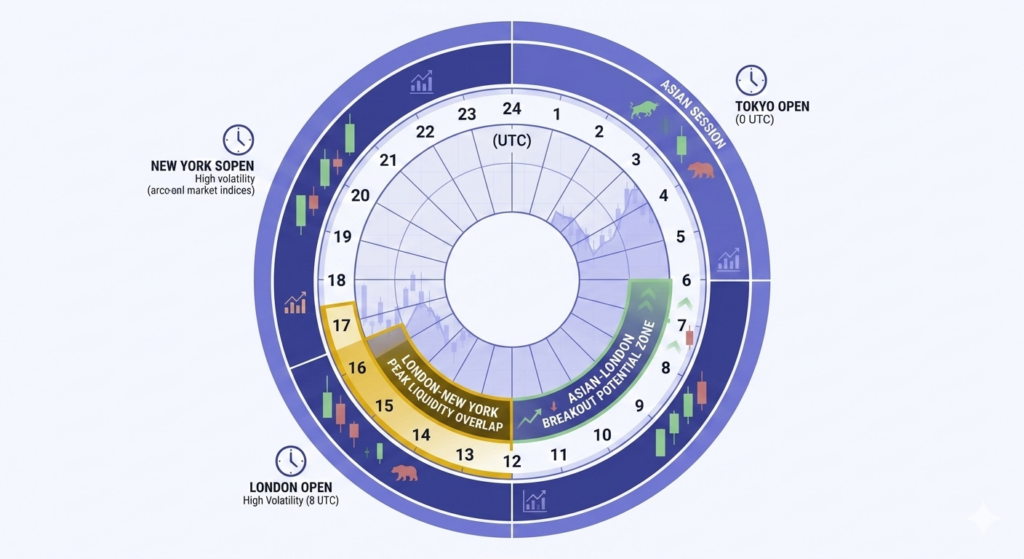
The global market runs on structural liquidity. Central banks, commercial conglomerates, and institutional hedge funds do not operate at random times. They follow standard business hours. When Tokyo opens, Asian corporations manage their capital. When London wakes up, the massive European institutions flood the market with volume. When New York enters the fray, the highest concentration of financial capital on earth collides with Europe.
Once I mapped out these specific transitions, my perspective changed completely. I stopped hunting for trades during dead hours and started waiting for the structural expansions that define the major shifts in the global clock.
The Silent Architect: Mastering the Asian Session
The Asian session is often treated as an afterthought by retail traders because it lacks the explosive, chaotic volume of the Western sessions. For the longest time, I completely ignored it. I assumed nothing of value happened while Europe and America slept.
I was missing the entire foundation of the trading day.
The Asian market, primarily anchored by Tokyo, Sydney, and Singapore, behaves like a consolidation machine. Because institutional volume is significantly lower during these hours, prices tend to stay contained within tight, predictable structural ranges. Instead of massive, sweeping trends, you see orderly support and resistance levels holding firm.
When I started practicing on clean setups, I realized that this specific time window is a fantastic environment for anyone focusing on highly disciplined, lower-vulnerability strategies. If you want to refine your execution without getting whipped out by sudden news events, it helps to use platforms designed for clean data delivery. For instance, you can test these steady ranges by starting a practice account on IQ Option or exploring the streamlined layout of Binomo.
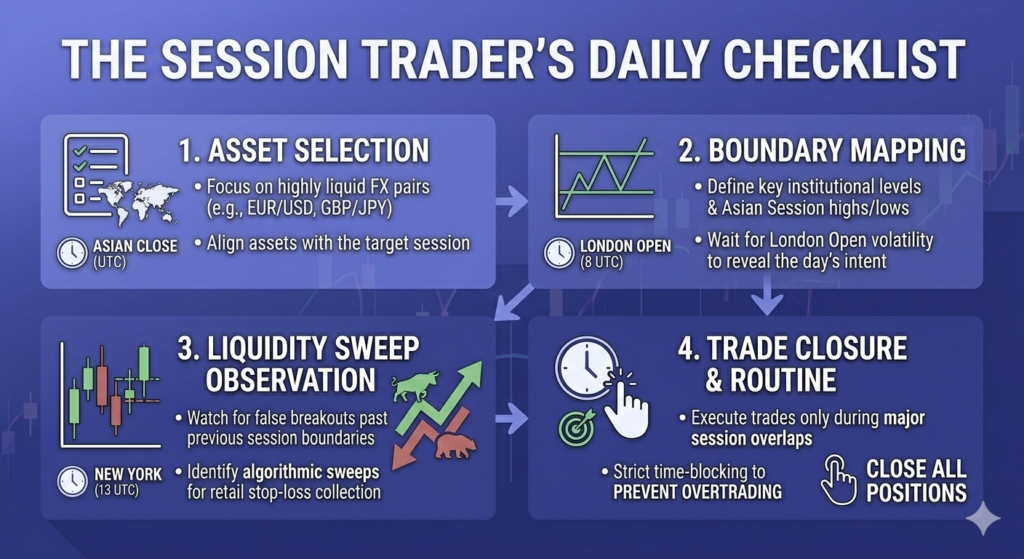
The real secret of the Asian session is not just about trading inside the range; it is about realizing that this range defines the landscape for the rest of the day. The highs and lows set during the Asian hours become massive targets for institutional algorithms when London opens. Institutional money loves to sweep the liquidity resting just outside the Asian boundaries. By observing how price behaves inside this initial block, I learned to anticipate exactly where the market would hunt for liquidity later in the morning.
The Volatility Explosion: Navigating the London Open
If the Asian session is the silent architect, the London open is the wrecking ball. The shift between these two periods was the hardest transition for me to learn, and it cost me a significant amount of capital before I finally understood its mechanics.
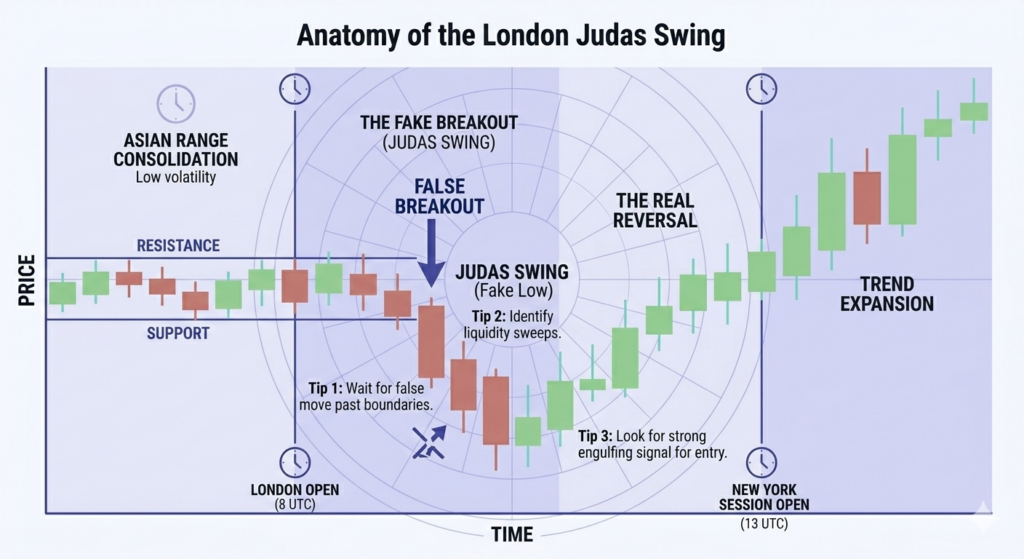
Picture this: London traders sit down at their desks, look at the tight range formed during the Asian hours, and immediately begin executing massive blocks of orders. Within minutes, volume surges exponentially. Price aggressively breaks out of the Asian range, making it look like a massive trend is forming.
Early in my career, I would eagerly jump onto these initial breakouts, convinced I was catching the wave of the day. Without fail, the price would violently reverse, clear out my stop, and accelerate in the completely opposite direction.
I was falling victim to the classic London Judgments Trap, frequently referred to as the “Judas Swing.” Institutional algorithms deliberately push price past the Asian highs or lows to trigger retail stop losses and collect liquidity. Once those stops are cleared, the true trend of the London session begins.
Once I understood this manipulation, my strategy flipped. I stopped buying the immediate breakout. Instead, I waited for London to sweep the Asian session boundaries, watched for a clear structural failure, and then entered the market alongside the real institutional flow.
This specific window requires split-second execution and deeply reliable order fills. When you are navigating that level of rapid price movement, having a platform with a seamless UI is non-negotiable. If you are analyzing these rapid breakouts, finding a setup with a highly responsive workspace is essential for your sanity. I spent a long time looking for the right fit, which I detailed in my personal journey toward finding my perfect trading workspace.
The Crossover Chaos: When London Meets New York
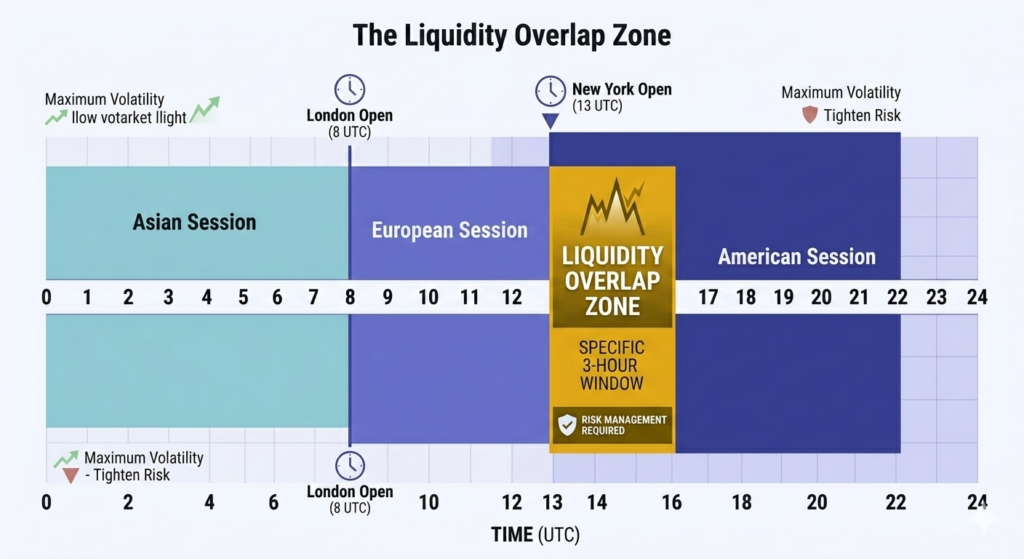
The absolute peak of the trading day occurs during the London and New York overlap. This window represents the highest concentration of financial liquidity on earth. For roughly four hours, the world’s two largest financial centers are operating simultaneously.
The market during the overlap is a different beast entirely. Volume skyrockets, trends become highly aggressive, and macroeconomic news releases out of Washington dump massive amounts of volatility into the charts within milliseconds.
During this phase, any structural weakness in your execution or your broker will be instantly exposed. Slippage can widen, spreads can fluctuate, and emotional decisions will destroy an account faster than you can blink. I quickly realized that attempting to trade the crossover without a concrete, tested strategy is financial suicide.
To survive this period, I had to develop absolute clarity on my risk limits. I learned to identify my key institutional levels before the overlap even started. If the market did not hit my specific entries, I simply stood aside.
Because the crossover moves so quickly, having an optimized technical environment is just as important as your analytical skills. If your charts lag or your platform hitches for even a second during a major New York data release, your trade is compromised. For high-volume environments, choosing a system built for low-latency data processing is critical. You can look into specialized options like Deriv for synthetic or underlying assets, or utilize reliable standard environments like Pocket Option and Quotex to manage your active trade execution.
Designing a Sustainable Daily Trading Routine
The ultimate goal of understanding session-based trading is to build a lifestyle that does not require you to sit in front of a computer screen for twelve hours a day. When I stopped trying to trade every single session and picked a single timezone to master, my profitability stabilized, and my mental health returned.
Today, my routine is highly structured. I wake up during the latter half of the Asian session to observe the established structural boundaries. I do not take trades here; I simply map out the sandbox. When the London session opens, I watch for the inevitable liquidity sweeps. If a clear price action model presents itself, I take my trade, manage my risk aggressively, and close my laptop.
If you are a student or balancing a full-time corporate job, this session-based approach is the only way to trade without losing your mind. You do not need to watch the screen all day. You simply need to allocate one or two hours of focused attention during a major session open. For those trying to balance limited hours and capital, selecting a highly accessible partner is a great first step. You can read my breakdown on which broker is better for students to see how to align your lifestyle with your chosen market hours.
Your Next Steps in the Markets
Mastering the clock requires patience, intentional practice, and the right environment to execute your ideas without unnecessary friction. Do not try to conquer all three sessions tomorrow morning. Pick the one that naturally aligns with your waking hours, study its unique structural traps, and focus on mastering that single window of time.
If you are currently looking for a place to practice these session transitions with real-time data, you can set up a basic profile on ExpertOption or look into the alternative features provided by CapitalCore. Take the time to find an interface that keeps your analysis clean and clear.
The market will always be there, but your capital will not if you continue to trade at random hours without a structural plan. Stop treating the market like an unpredictable wall of noise. Respect the global clock, map out your sessions, and protect your capital at all costs.
If you are tired of guessing where the next institutional liquidity sweep will occur and want to fast-track your path to consistency, you need a deeper layer of market analysis. Join our private community at BeCoin Premium Tariff Plan to gain access to comprehensive daily session breakdowns, real-time institutional volume tracking, and advanced price action strategies that give you a definitive edge in the markets. Let’s stop guessing and start trading with professional precision.
The Clock and the Candle: How I Stopped Guessing the Best Time to Trade Day Trading
I still remember the night I blew my third trading account. It was 11:30 PM. The house was completely quiet, the market charts on my screen were barely crawling, and I was forcing trades out of pure impatience. I kept staring at a flatline asset, placing one-minute positions, convinced that the market owed me a […]

Finding My Perfect Workspace: The Search for the Best Broker for My Daily Trading Routine
The alarm goes off at 6:00 AM. By 6:30 AM, I am sitting in front of my monitors with a steaming mug of black coffee. The house is completely quiet, the market is preparing its next major move, and my charts are completely bare. This is my daily sanctuary. For a long time, this morning […]
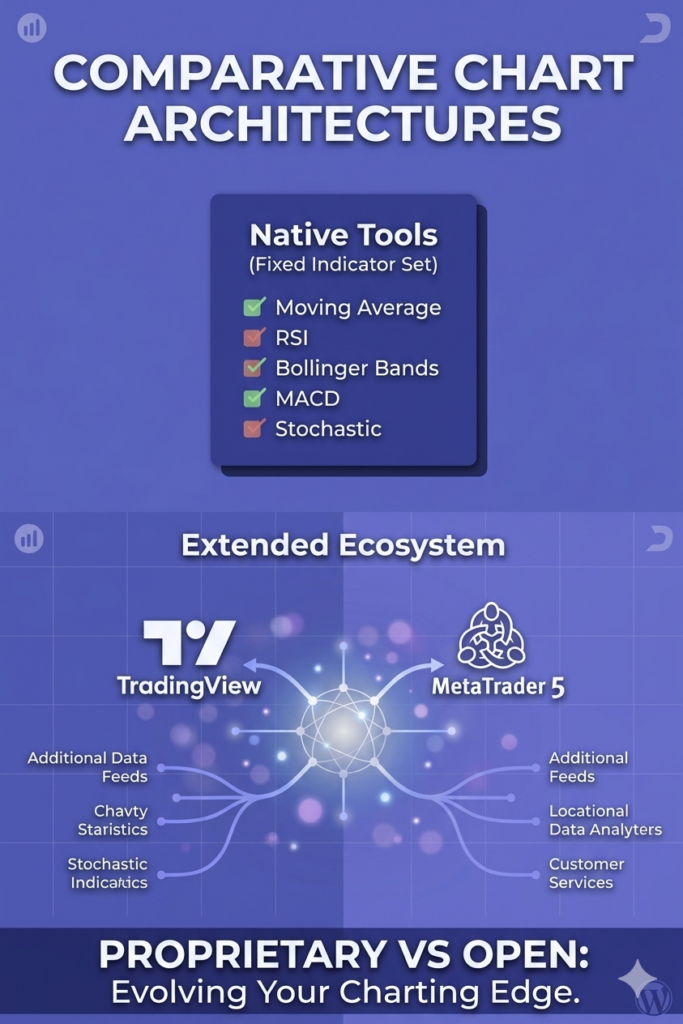
IQ Option vs Deriv Chart Comparison
The Night I Realized My Charts Were Lying to Me It was three in the morning, the exact hour when the market looks either like a goldmine or a psychological hazard. I was sitting in front of two monitors, a lukewarm mug of coffee in hand, watching a critical support level on EUR/USD. On my […]

Why Most Deriv Traders Blow Accounts: A Data-Driven Post-Mortem Analysis
The first time I blew a trading account on Deriv, it didn’t happen dramatically. There was no single catastrophic trade. It happened quietly. One loss turned into another. Then I increased the stake to recover the loss. Then the market moved again. Before I realized what had happened, an account balance that took weeks to […]
Deriv Copy Trading (DBot & Signal Services): Can Automation Beat Manual Trading?
When I first started trading on Deriv, everything I did was manual. Every entry, every exit, every mistake. I would sit in front of charts watching price ticks move on synthetic indices, trying to time trades perfectly. Some days I would catch a streak of wins and feel like I had finally figured it out. […]

Trading Currency Strength Instead of Single Pairs
It was a Tuesday afternoon when I realized I was fighting a losing battle against a ghost. My screen was a chaotic web of indicators. I had the EUR/USD chart open, a moving average crossing over here, a relative strength index flashing oversold there, and a price action setup that looked textbook perfect. I clicked […]