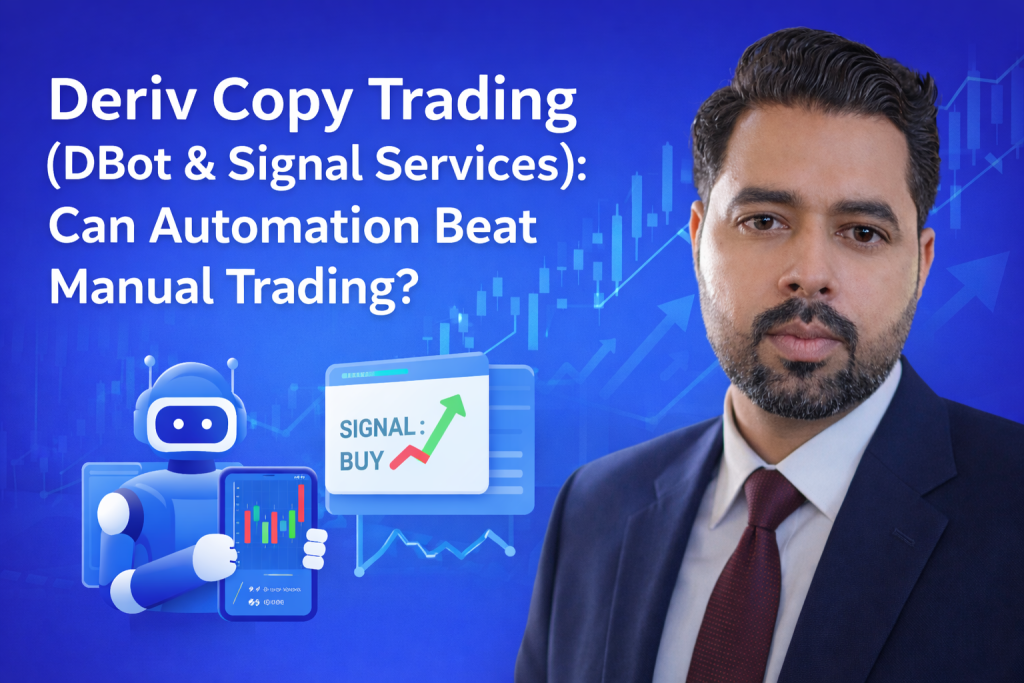
Deriv Copy Trading (DBot & Signal Services): Can Automation Beat Manual Trading?
When I first started trading on Deriv, everything I did was manual.
Every entry, every exit, every mistake.
I would sit in front of charts watching price ticks move on synthetic indices, trying to time trades perfectly. Some days I would catch a streak of wins and feel like I had finally figured it out. Other days I would give everything back within an hour.
Eventually I started asking a question that many traders reach sooner or later.

What if the computer could do the trading instead?
That question led me into the world of Deriv copy trading, DBot automation, and signal services. I spent several months testing automated strategies, copying traders, and comparing the results against my own manual trades.
Some experiments worked better than expected. Others failed quickly and taught expensive lessons.
This article is essentially my trading journal from that period. I will walk through what I tested, the trades I observed, the mistakes I made, and the honest conclusion I reached about whether automation can actually outperform manual trading.
If you are considering automated trading on Deriv, this may save you some painful trial and error.
If you want to follow along with the strategies I discuss, you can open a trading account on Deriv and experiment with DBot or signal services yourself.
Why I Started Exploring Deriv Copy Trading
My shift toward automation did not come from laziness. It came from frustration.
Manual trading had three recurring problems for me.
- Emotional decisions during losing streaks
- Missing trades because I was not at the screen
- Inconsistent rule execution
I might follow a strategy perfectly for three trades and then break the rules on the fourth trade.
Automation promised something attractive.
Consistency.
Instead of relying on discipline, the system would simply execute rules exactly as programmed.
That promise is what pushed me to test Deriv copy trading tools and automated bots.
But before diving into results, it is important to understand how automation actually works on Deriv.
Understanding Deriv Copy Trading and Automation Tools
There are two main ways traders automate strategies on Deriv.
| Method | Description | Skill Level |
| DBot | Visual strategy builder that creates automated trading bots | Beginner–Intermediate |
| Signal Services | Copying trades from external signal providers | Beginner |
Each method approaches automation differently.
DBot gives you full control over the strategy. Signal services outsource the decision making to another trader.
I decided to test both.

My First Experiment With DBot
My first encounter with DBot felt surprisingly simple.
DBot is essentially a visual programming tool where you build trading strategies using blocks instead of code.
You choose conditions such as:
- Trade type
- Stake amount
- Market
- Entry conditions
- Stop loss rules
Once activated, the bot begins trading automatically.
At first this sounded almost too easy.
But simplicity can be deceptive in trading.
The First Strategy I Built
My initial DBot experiment was extremely basic.
Market: Synthetic Volatility 75
Contract: Rise/Fall
Trade duration: 5 ticks
Entry rule was based on consecutive ticks.
| Condition | Action |
| 3 red ticks in a row | Buy Rise |
| 3 green ticks in a row | Buy Fall |
The idea was simple mean reversion. Short tick trends often reverse quickly.
I started with a $5 stake per trade.
The bot began trading immediately.
At first I watched every trade carefully.
Then something interesting happened.
The bot kept trading even when I stopped watching.
Results After the First 200 Trades
After running the bot for a few hours, I exported the results.
| Metric | Result |
| Total trades | 214 |
| Winning trades | 118 |
| Losing trades | 96 |
| Win rate | 55% |
| Net profit | $18 |
The result surprised me.
The strategy was crude, yet the bot produced a small profit.
But something else became clear.
Automation did not remove risk.
A single losing streak erased most gains.
The Problem With Simple Bots
After several days of running the strategy, I noticed a pattern.
Bots tend to struggle during market regime changes.
Synthetic indices often shift from random behavior into short-term trends. When that happened, my mean-reversion bot began losing repeatedly.
One streak wiped out nearly two days of gains.
That experience forced me to rethink automation.
A bot that works only in one condition is fragile.
My Second DBot Experiment: Adding Risk Controls
Instead of focusing on entry signals, I shifted focus toward risk management.
This is where many discussions of Deriv copy trading fall short. Most guides talk about signals but ignore money management.
My second bot introduced three key controls.
Risk controls I implemented:
- Maximum 3 consecutive losses
- Daily stop loss
- Reduced stake after losing streaks
Here is how it looked in practice.
| Rule | Logic |
| After 3 losses | Pause trading for 30 minutes |
| Daily loss limit | Stop bot after -$50 |
| Winning streak | Increase stake slightly |
The goal was not to maximize profit. The goal was survival.
And surprisingly, that made the biggest difference.
Results From the Second Bot
Over roughly 1,000 trades, the results looked very different.
| Metric | Result |
| Total trades | 1,042 |
| Win rate | 53% |
| Max losing streak | 6 |
| Net result | +$96 |
The win rate was slightly lower.
But drawdowns were significantly smaller.
Automation worked best when paired with strict risk control.
Testing Deriv Copy Trading Through Signal Services
After experimenting with bots, I became curious about another form of automation.
Signal copying.
Instead of building strategies, traders simply mirror the trades of another trader.
This is often advertised as Deriv copy trading, although many signals come from external Telegram groups or signal platforms.
So I decided to test a few.
My Experience Following Signal Providers
I joined three signal groups.
Each claimed impressive win rates.
Most signals looked like this:
Buy Rise Volatility 75
Stake: $10
Duration: 5 ticks
The problem appeared quickly.
Signal timing.
Signals often arrived a few seconds late. In tick trading, that delay matters.
After following signals for two weeks, my results looked like this.
| Signal Provider | Trades Taken | Result |
| Provider A | 82 | -$37 |
| Provider B | 64 | +$12 |
| Provider C | 101 | -$58 |
Overall outcome was negative.
That experiment taught me something important.
Signal services depend heavily on execution speed.
If the signal arrives late, the trade setup may already be gone.
The Hidden Problem With Deriv Copy Trading Signals
Many online reviews talk about win rates.
But they ignore execution differences.
Two traders can follow the same signal and get completely different results.
Reasons include:
- Entry price differences
- Latency delays
- Different stake management
This is why Deriv copy trading through signal groups is far less reliable than it appears.
Automation through bots, on the other hand, executes trades instantly.
Comparing Manual Trading vs Automated Trading
After several months of testing, I compared my manual results against automated ones.
Here is a simplified breakdown.
| Method | Profit Consistency | Emotional Stress | Time Required |
| Manual trading | Medium | High | High |
| DBot automation | Medium–High | Low | Low |
| Signal copying | Low | Medium | Medium |
Manual trading gave me flexibility but also emotional pressure.
Signal copying felt unreliable.
DBot automation sat somewhere in the middle.

Where Automation Actually Helped My Trading
Automation did not magically increase profits.
But it improved three aspects of my trading process.
1. Consistency
Bots follow rules without hesitation.
2. Backtesting strategies
I could run hundreds of trades quickly.
3. Removing emotional mistakes
No revenge trading.
No impulsive entries.
That alone improved my overall performance.
Where Automation Still Struggles
Automation also revealed its limits.
Bots cannot adapt easily.
When markets change behavior, strategies stop working.
This is especially true for synthetic indices, which I explored in detail in my article explaining how synthetic volatility indices really work behind the algorithm.
Understanding the underlying structure helped me design better bots later.
My Current Hybrid Trading Approach
After months of experimentation, I settled on a hybrid approach.
I combine manual analysis with automation.
Here is the workflow I currently use.
| Step | Action |
| Market observation | Identify favorable conditions |
| Activate DBot | Run automation only during specific sessions |
| Risk control | Stop bot after profit target or loss limit |
Instead of letting bots run all day, I treat them as tools.
This approach dramatically reduced random losses.
The Biggest Mistakes I Made With Deriv Copy Trading
Looking back, several mistakes stand out.
Mistake 1: Believing automation guarantees profit
Bots only execute strategies. They do not create them.
Mistake 2: Ignoring risk management
Without stop rules, even profitable bots eventually collapse.
Mistake 3: Trusting signal providers blindly
Signals are often optimized for marketing rather than real trading.
These lessons changed how I evaluate automation.
How I Now Evaluate Automated Strategies
Before running any bot, I ask three questions.
- What market condition does the strategy depend on?
- What is the maximum drawdown?
- What stops the bot from overtrading?
If those answers are unclear, the strategy is not ready.
This simple checklist has saved me from many bad experiments.
Another Useful Comparison: Deriv vs Offshore Brokers
During my research, I also compared automation possibilities between Deriv and offshore day trading brokers.
Execution models differ significantly.
If you want a deeper look at this, I wrote a full analysis explaining the execution model comparison between Deriv and offshore brokers.
Understanding execution mechanics helps explain why bots behave differently across platforms.
Can Automation Actually Beat Manual Trading?
After months of testing, my answer is nuanced.
Automation can outperform manual trading in certain situations.
But not for the reasons most people think.
Bots are not smarter.
They are simply more disciplined.
When a strategy has a small statistical edge, automation helps capture it consistently.
Manual traders often sabotage that edge through emotional decisions.
Who Should Use Deriv Copy Trading Automation?
From my experience, automation works best for traders who:
- Already understand basic strategy logic
- Want to remove emotional mistakes
- Prefer systematic approaches
It works poorly for traders looking for passive income without effort.
Automation still requires monitoring and strategy updates.
Final Thoughts From My Trading Journal
My journey with Deriv copy trading completely changed how I view trading systems.
At first I thought automation would replace manual trading.
It did not.
Instead it became a tool that complements manual analysis.
Today my bots handle repetitive execution, while I focus on strategy development and risk management.
That balance works far better than either approach alone.
If you plan to experiment with automated trading, start small.

Run bots with minimal stakes. Observe how they behave during different market conditions. Treat every strategy like an experiment rather than a guaranteed income stream.
That mindset will save you money and frustration.
If you want to build your own trading bots or test Deriv copy trading strategies, you can open an account on Deriv and start experimenting with DBot.
Automation will not make you rich overnight.
But if used carefully, it can make your trading far more consistent.
Binomo Deposit/Withdrawal: Why Using Different Payment Methods Causes Delays
The first time I hit a decent withdrawal on Binomo, I thought the hard part was over. I had done the trades. I had managed the risk better than usual. I had finally resisted the urge to overtrade after a win streak. So when I clicked withdraw, I expected the money to move as smoothly […]
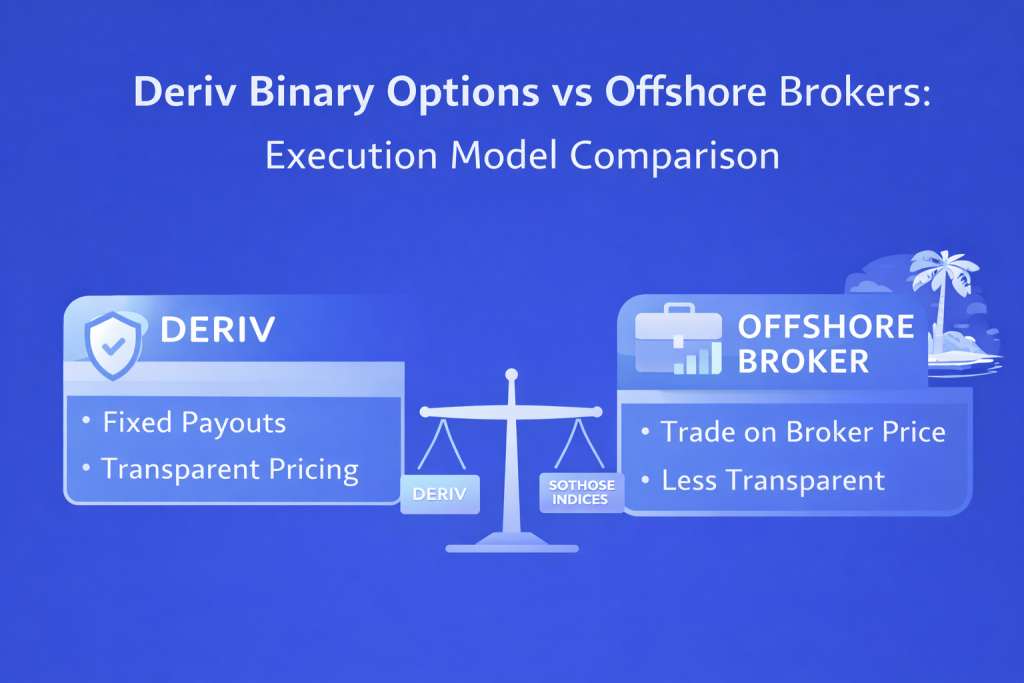
Deriv Day Trading vs Offshore Brokers: Execution Model Comparison
I did not start my trading journey thinking about execution models. Like most beginners, I started with charts, indicators, and the belief that if I could just find the right entry signal, profits would follow. My early trading notebook was full of screenshots of RSI signals, candlestick patterns, and support levels. What it did not […]
Binomo Bonus Terms Explained: When a Deposit Bonus Can Delay or Block Your Withdrawal
The first time I accepted a bonus on Binomo, I thought I was making a smart move. I had just made a small deposit, saw the extra balance appear, and immediately felt more confident. More funds meant more trades, more flexibility, and maybe faster progress. At least that’s how it looked on the screen. What […]

How Liquidity Affects Day Trading Results
When I first started trading day trading, I believed success was all about finding the perfect indicator. I spent weeks testing moving averages, RSI settings, support and resistance levels, and dozens of YouTube strategies that promised easy wins. Some worked for a few trades, but most failed. What confused me was that the same setup […]

The Day I Stopped Trading and Finally Started Making Money
It was a rainy Tuesday morning, and I was staring at my screen with a familiar knot in my stomach. The previous three days had been a slow, agonizing slide into the red. I had given back two weeks of hard-earned profits in less than seventy-two hours. Every asset I clicked on looked like a […]