
How I Learned to Sit on My Hands During Choppy Markets
I remember the morning vividly. It was a Tuesday. The coffee on my desk was still piping hot, the charts on my screen were blinking, and I was feeling incredibly confident. I had just finished reading about how market open hours create the best trading opportunities, and I was ready to hunt for a clean setup.
My favorite currency pair had been in a beautiful, clean uptrend for three consecutive days. It was a textbook setup. I expected a minor pullback to a key support level, followed by a strong bounce back to the skies.
Instead, I stepped directly into a meat grinder.
The price hit my level, and I bought. Almost instantly, the market reversed and knocked out my stop-loss. I shook it off. It happens. Loss is part of the game. I waited a few minutes, noticed a massive bearish engulfing candle, and decided to flip my bias. I went short. Two minutes later, the market aggressively spiked upward, taking out my second stop-loss.
Frustration started to warm up the back of my neck. I adjusted my indicators, looked closely at the screen, and placed a third trade. Wipeout. Within forty-five minutes, I had lost two weeks’ worth of hard-earned profits. The market wasn’t trending up, and it wasn’t trending down. It was violently jerking back and forth in a tight, unpredictable twenty-pips range. It was a choppy market.
That day, I didn’t just lose money. I lost my emotional balance. It took me months to realize that the problem wasn’t my technical strategy or my indicators. The problem was my lack of situational awareness. I was trying to use a map meant for a highway while driving through a swamp.
Here is what I learned from that painful experience, and how you can save your account from the slow, agonizing death of a thousand cuts that sideways markets love to inflict.
Understanding the Beast: What is a Choppy Market?
Before you can avoid a choppy market, you have to recognize it. In simple terms, a choppy market occurs when the price moves sideways in a highly erratic fashion without any clear direction. Unlike a healthy ranging market, where the price bounces smoothly between a defined support floor and a resistance ceiling, a choppy market breaks minor levels constantly, prints long wicks on both sides of the candles, and mimics breakouts only to fail immediately.
It is a state of equilibrium driven by indecision. Big institutional players are either sitting on the sidelines or actively accumulating positions without pushing the price out of its current zone.
When you look at your dashboard during these times, everything looks messy. If you are using a platform known for having the cleanest interface real comparison for beginners in 2026, the messiness becomes even more glaringly obvious because the candles will look fragmented and chaotic.
The primary trap here is psychological. As retail traders, we are conditioned to believe that more activity equals more profit. We look at the moving tickers and feel an overwhelming urge to participate. But in a choppy environment, participation is exactly what the market wants because it feeds on your transaction fees and your stop-losses.

The Signs I Missed: Identifying Choppiness Early
I used to think that identifying a choppy market was something you could only do in hindsight. I was wrong. The market leaves subtle clues at the very beginning of a sideways phase.
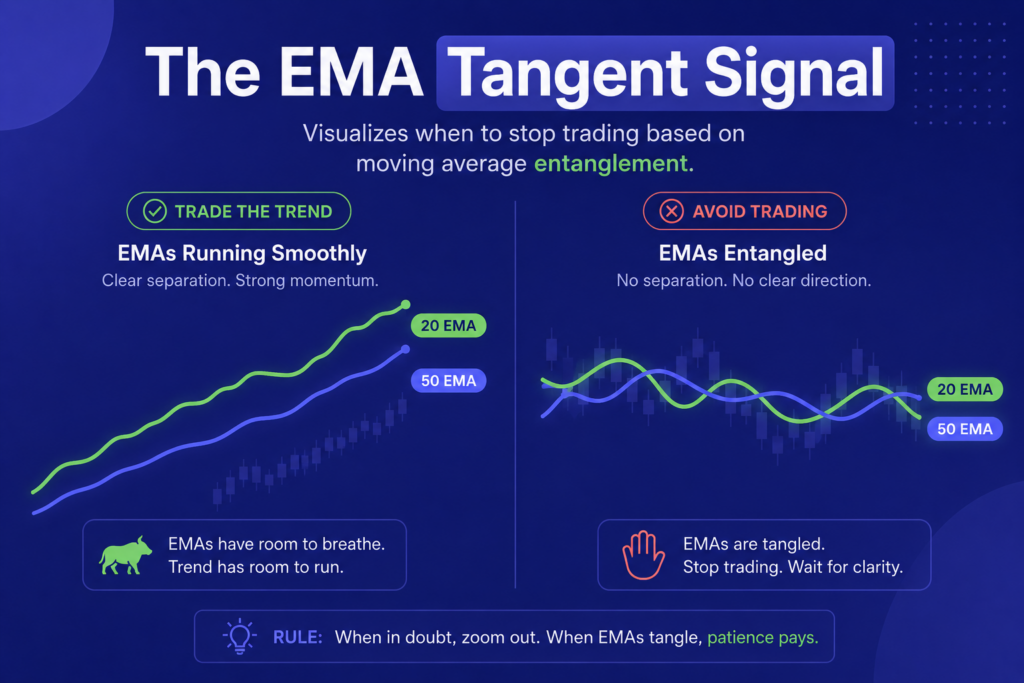
First, watch the moving averages. If you use a simple tool like a 20-period and a 50-period exponential moving average (EMA), look at how they interact. In a strong trend, they run parallel to each other, acting as dynamic support or resistance. In a choppy market, they start to flatten out and repeatedly cross over one another like a tangled ball of yarn. When the price begins to weave through your moving averages like a slalom skier, step away from the order button.
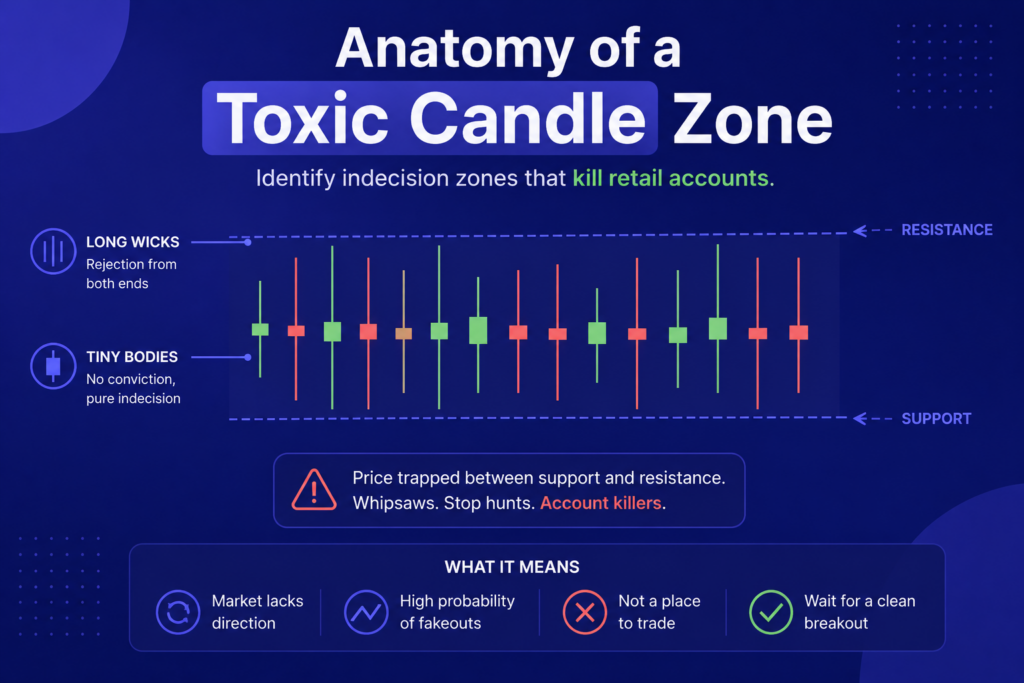
Second, pay close attention to candle wicks. If you see consecutive candles with small bodies and long wicks pointing both up and down, it means neither buyers nor sellers are controlling the narrative. It is a violent tug-of-war where both sides are losing strength.
If you want to practice spotting these structural shifts without risking a large sum of money, it is highly recommended to use a platform that accommodates micro-investments. You can read my breakdown on the best broker for $10 deposit tested platforms 2026 to see where you can safely test your market-reading skills.
The Mental Trap of “Recouping Losses”
The most dangerous part of a choppy market isn’t the initial loss. It is the emotional spiral that follows. When I lost those first two trades on that fateful Tuesday, my logical brain went completely dark. A dark, vengeful entity took over my hands. I wanted my money back, and I wanted it immediately.
This is why 90% of traders lose money real reasons beginners don’t realize. They don’t understand that the market doesn’t owe them a single dime. When you lose money in a sideways market, your immediate instinct is to tighten your stops or increase your lot size to win it back in one single shot. In a choppy environment, a tighter stop-loss just means you will get stopped out even faster.
I remember staring at my screen, watching the balance drop, and wondering if my execution app was lagging. I even questioned if my internet connection was causing bad fills. If you ever feel like your technical setup is working against you, it helps to check if you are using the best trading platform for slow internet in 2026 to eliminate technical variables from your frustrations. But let me be entirely honest with you: most of the time, it isn’t the internet. It is the choppy price action playing tricks on your mind.
Your Survival Guide: Concrete Rules for a Sideways Market
Over the years, I developed a strict set of personal rules that keep me safe when the charts start looking erratic.
First, I implemented a “Two Strikes and Out” rule. If I take two consecutive losses in a single trading session, I close my charts immediately. I don’t look at my phone, I don’t check my open PnL, and I don’t try to find a “perfect” setup to break even. Two losses mean either my analysis is wrong, or the market conditions are completely unplayable. In both scenarios, staying active is a losing proposition.
Second, I learned to track session volume. Choppiness often occurs during the transition periods between major global financial sessions. If you study the clock and the cash my journey into the hidden rhythm of session based trading, you will notice that the market frequently dries up right after the London session closes and before the New York afternoon volume kicks in. Trading during these dead zones is an absolute recipe for account destruction.
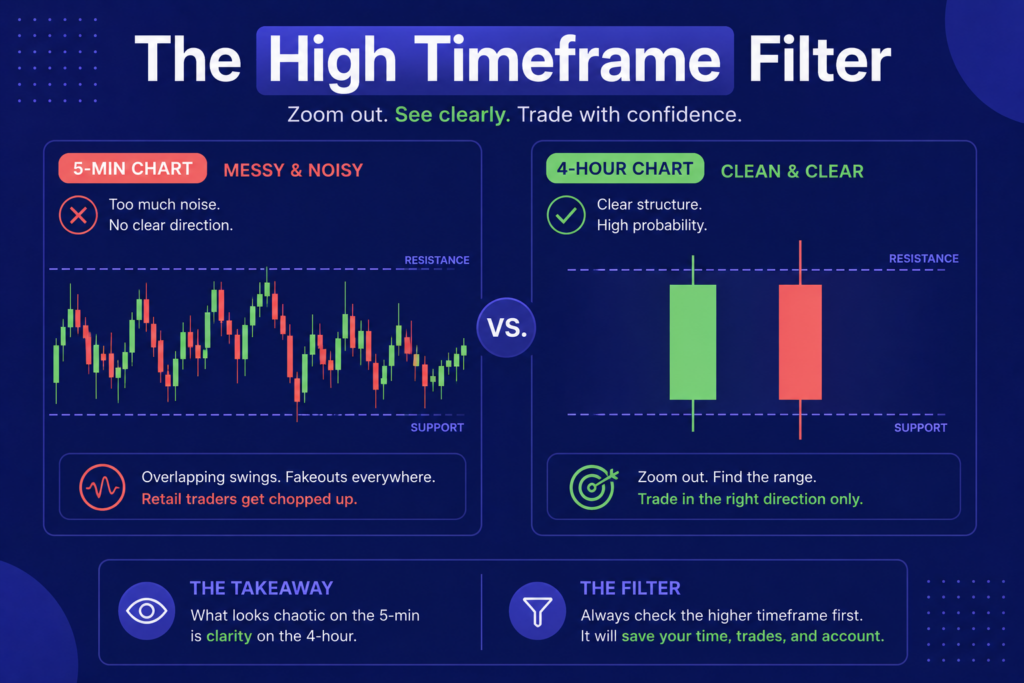
Third, change your perspective by shifting to a higher timeframe. If the 5-minute chart looks like an irregular heartbeat, zoom out to the 1-hour or the 4-hour chart. Frequently, you will realize that what looked like a massive breakout attempt on the lower timeframe is actually just a tiny, insignificant wick on a higher timeframe candle. Zooming out grounds your perspective and prevents you from chasing ghosts.
For those who prefer a highly systematic approach, choosing platforms that offer robust analytical layouts can make a massive difference. You can read a direct head-to-head analysis on the IQ Option vs Deriv chart comparison to see which interface gives you a clearer view of high-level trends versus low-level noise.
The Power of Doing Absolutely Nothing
It takes a massive amount of discipline to look at a live chart and decide to do absolutely nothing. We live in a world that rewards constant hustle and endless productivity. In trading, the opposite is frequently true. Sometimes, the most profitable action you can take is to close your laptop, walk outside, and preserve your capital for a day when the market is ready to cooperate.
When you protect your capital during bad market conditions, you ensure that you still have money to trade when beautiful, high-probability trends return. Think of your account balance as your ammunition. If you waste all your bullets shooting at shadows in the dark, you will have nothing left when the target finally walks out into the clear daylight.
If you are currently looking for a reliable, heavily tested environment to build your skills and manage your trades during clean market conditions, it is vital to pick platforms with a proven track record. For beginners starting out with smaller balances, exploring the options available via the IQ Option platform can provide a highly stable starting ground. Alternatively, you can explore the features of the Binomo trading portal to see if its execution flow aligns better with your personal pace. For a detailed breakdown of how these specific ecosystems stack up against each other regarding execution speed and entry requirements, don’t miss my analysis on which is easier for beginners Binomo or IQ Option.
Upgrading Your Edge
Learning to sit on your hands during low-volume, erratic environments changed my career entirely. It was the day I stopped trading and finally started making money. But discipline is only half the battle. The other half is access to institutional-grade insights that help you anticipate these bad market phases before they destroy your balance.
If you are tired of guessing whether the market is starting a clean breakout or entering a deadly trap, you need to elevate your analytical toolkit. By joining the BeCoin Premium Membership, you gain access to institutional-grade, predictive data streams and direct access to the BeCoin Forecast Hub. Stop gambling against algorithms in the dark. Protect your capital, master your emotional baseline, and trade with a definitive structural edge.

Why Market Open Hours Create the Best Trading Opportunities
I used to think trading was a 24-hour conveyor belt of endless cash. In my earliest days, armed with a laptop, a hot cup of coffee, and far too much unearned confidence, I would stare at charts at 11:00 PM on a Tuesday. The candles barely moved. They crawled across my screen like snails on […]

The Day I Lost My First Ten Dollars: My Hunt for the Best Mobile Trading App for Beginners
I still remember the exact shape of the cloud outside my window when my first live trade ended in the red. It was a crisp morning, and I was sitting on my couch with a lukewarm cup of coffee, staring at a flashing line on my smartphone screen. I had just deposited ten bucks, convinced […]
The Clock and the Candle: How I Stopped Guessing the Best Time to Trade Day Trading
I still remember the night I blew my third trading account. It was 11:30 PM. The house was completely quiet, the market charts on my screen were barely crawling, and I was forcing trades out of pure impatience. I kept staring at a flatline asset, placing one-minute positions, convinced that the market owed me a […]

The Rookie Dashboard: My Raw Hunt for the Best Beginner Broker in 2026
We have all been there. It is late at night, your morning coffee is hours away, and you are staring at a screen pulsing with bright green and red lines. You have twenty dollars burning a hole in your digital wallet and a sudden, burning desire to conquer the financial markets. That was me exactly […]

How Understanding Market Structure Saved My Day Trading
I remember the exact moment my trading account hit zero for the third time in a single month. It was a rainy Tuesday evening, and I was staring at a 1-minute chart on my laptop screen. The price had been moving up aggressively. It looked like a flawless rocket ship to the moon. I clicked […]
The Day I Stopped Trading and Finally Started Making Money
It was a rainy Tuesday morning, and I was staring at my screen with a familiar knot in my stomach. The previous three days had been a slow, agonizing slide into the red. I had given back two weeks of hard-earned profits in less than seventy-two hours. Every asset I clicked on looked like a […]