Tax-equivalent yield for investors: compare bonds, cash, and dividend income
Quick Summary
- Tax-free interest and qualified dividend tax rates can leave you with more spendable cash than a higher advertised taxable yield.
- Tax-Equivalent Yield (TEY) shows the exact taxable rate required to match tax-exempt municipal bonds or preferential dividend yields.
- Higher federal and state tax brackets along with the Alternative Minimum Tax (AMT) significantly impact your real earnings across fixed-income and equity assets.
- Evaluating credit ratings, duration risk, and net after-tax returns prevents costly mistakes when building a diversified income portfolio.
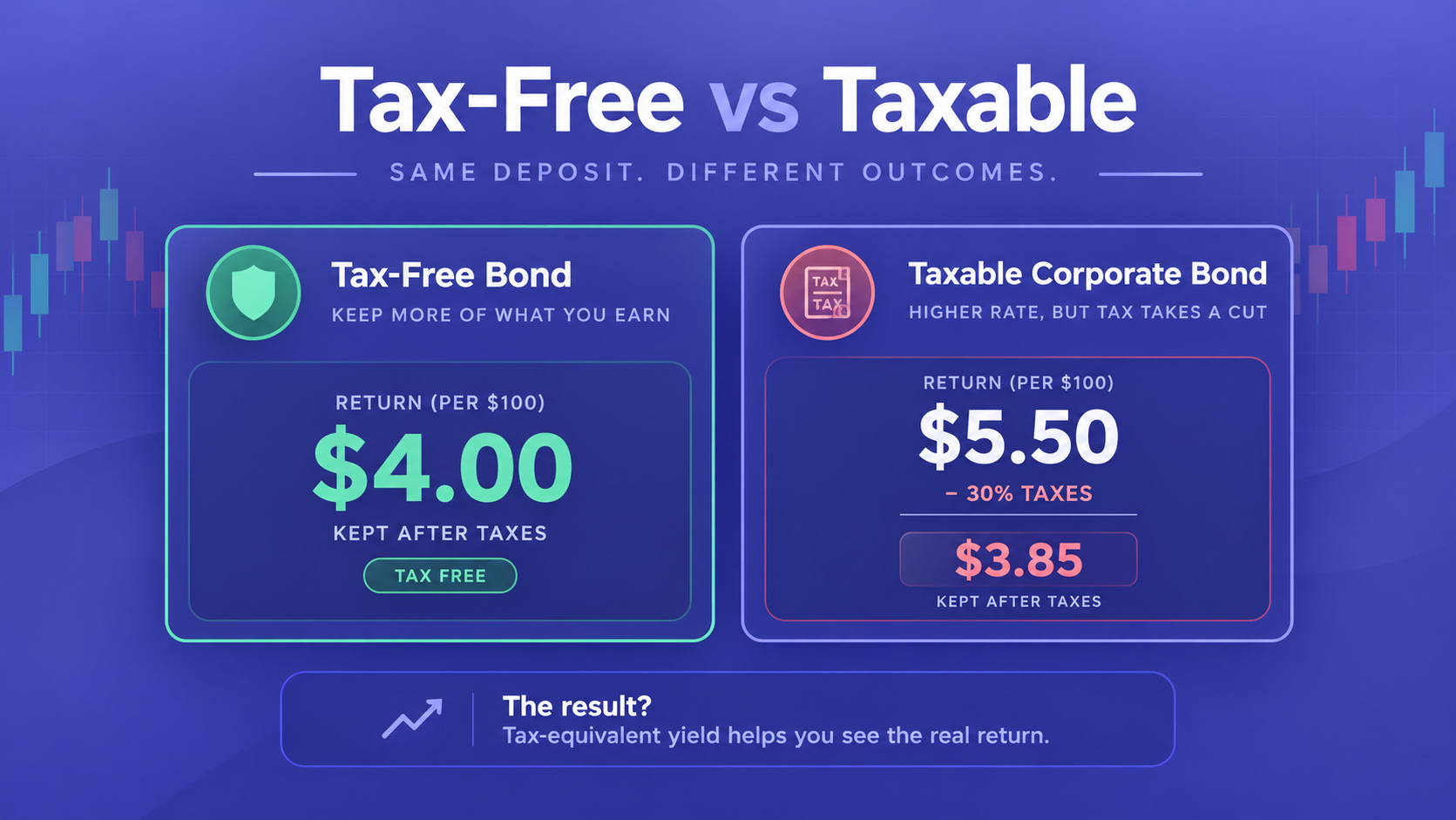
Imagine you’re comparing two savings options at a bank. The first pays $4.00 for every $100 you deposit, while the second pays $5.50. On the surface, the second option looks like the obvious choice because it offers a higher return.
But there’s another factor to consider: taxes. If the $5.50 payment is taxable, part of that interest may go to the tax collector. The first option, however, may qualify for a tax exemption, allowing you to keep the full $4.00.
So which option actually puts more money in your pocket at the end of the year?
This is the kind of comparison investors face when choosing between taxable corporate bonds and tax-free municipal bonds. The advertised yield is only part of the picture, your tax rate can significantly change the return you actually keep. To gain a clearer edge in trading and access deeper financial analysis for your portfolio, join Becoin Premium.
What Is Tax-Equivalent Yield?
Tax-Equivalent Yield (TEY) is a straightforward financial tool that helps you compare two very different investments fairly. It converts a tax-exempt interest rate into a fully taxable equivalent rate.
When state or local governments fund new schools, parks, or highways, they raise capital by issuing municipal bonds. To encourage investment in community projects, federal tax laws generally exempt municipal interest payments from federal income tax.
Because municipal bonds offer this tax shelter, they usually advertise a lower annual yield than corporate bonds. Corporate issuers must offer higher rates to compensate for the fact that every dollar of interest they pay is taxed. TEY helps you look past advertised coupon rates so you can measure actual net spendable income.
How to Calculate Tax-Equivalent Yield
Finding your tax-adjusted return takes just a simple formula: take the tax-free yield and divide it by one minus your marginal tax rate.
The Standard TEY Formula

Step-by-Step Example
Suppose you evaluate a municipal bond offering a 4.0% annual yield, and your income places you in the 24% federal tax bracket.
- Start with the tax-free yield of 0.04.
- Subtract your tax rate from 1, which equals 0.76 (1 minus 0.24).
- Divide 0.04 by 0.76, which gives 0.0526.
- Multiply by 100 to convert to a percentage: 5.26%.
A taxable corporate bond must pay at least 5.26% just to match the real cash output of a 4.0% tax-free municipal bond.
Calculating After-Tax Yield
You can also flip the formula to calculate what a taxable bond yields after taxes are withheld:

If a corporate bond pays 5.5% and your tax bracket is 24%, multiply 5.5% by 0.76. Your true net return drops to 4.18%.
TEY for Qualified Dividend Income
Dividend income receives favorable tax treatment compared to interest from ordinary bonds or bank accounts. Qualified dividends are taxed at capital gains rates (typically 0%, 15%, or 20%) rather than standard income tax brackets.
To compare a qualified dividend yield to ordinary taxable interest (like bond interest or savings yields), adjust for the tax rate differential using the dividend TEY formula:
Dividend TEY = Qualified Dividend Yield × (1 - Dividend Tax Rate) / (1 - Marginal Ordinary Income Tax Rate)
For example, if you receive a 4.5% qualified dividend yield, pay a 15% dividend tax rate, and fall into the 32% ordinary income tax bracket:
- Multiply 4.5% by (1 - 0.15 = 0.85) to find the net yield: 3.825%.
- Divide 3.825% by (1 - 0.32 = 0.68) to obtain the ordinary taxable equivalent yield: 5.63%.
Thus, a 4.5% dividend yield provides the same after-tax cash flow as a fully taxable bond paying 5.63% for an investor in the 32% tax bracket.
Based on the study by Lawrence I. Gould and Stanley N. Laiken:
Evaluating multiperiod after-tax investment returns requires a systematic framework that accounts for individual tax constraints and escalating tax brackets to effectively maximize long-term wealth.
When practicing trade execution across global markets, you can test chart setups on IQ Option or analyze fast volatility trends on Deriv.
How Tax Rates Change Your Real Earnings
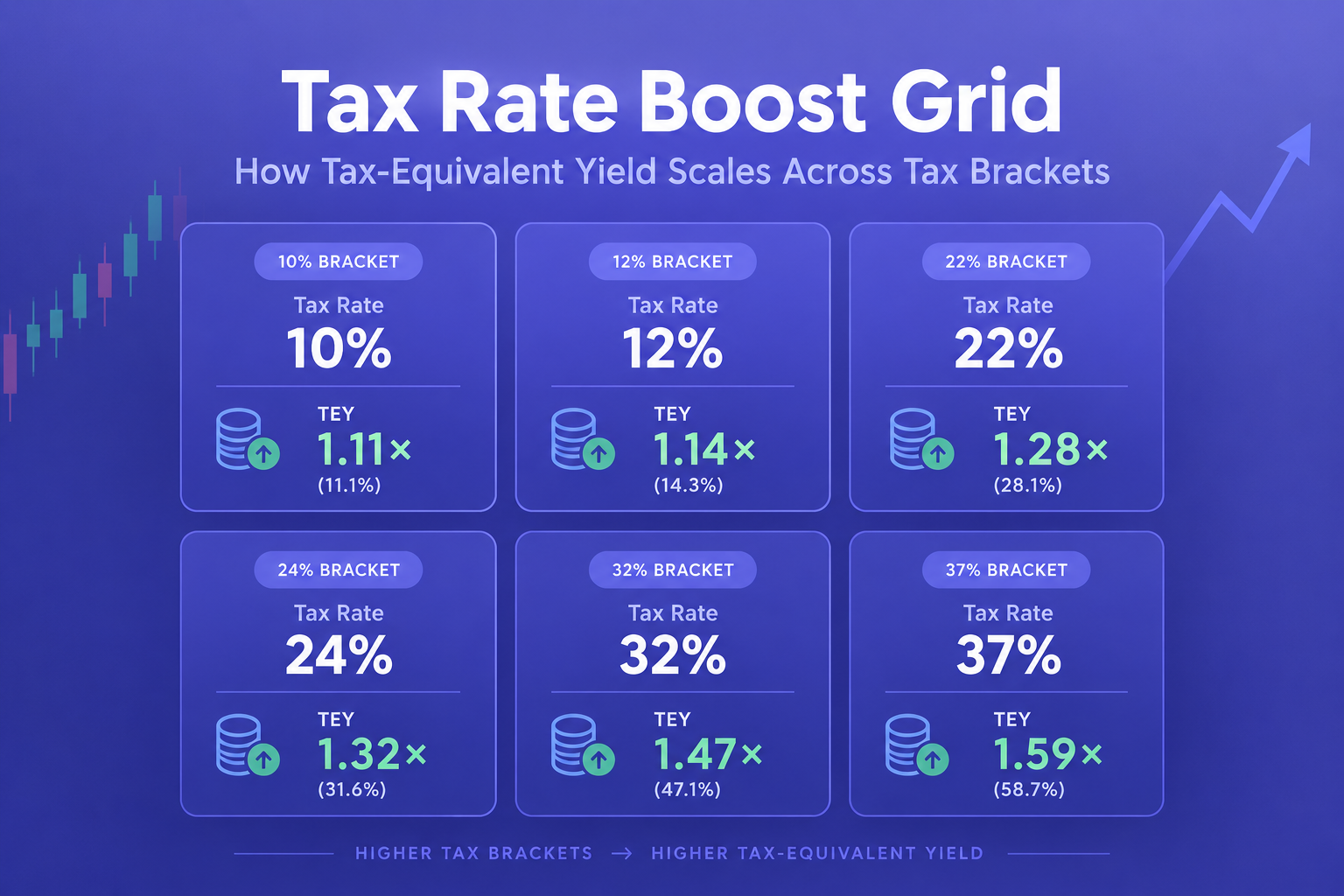
Your income tax bracket plays a massive role in determining your true return. The higher your tax rate, the more valuable tax-free interest becomes.
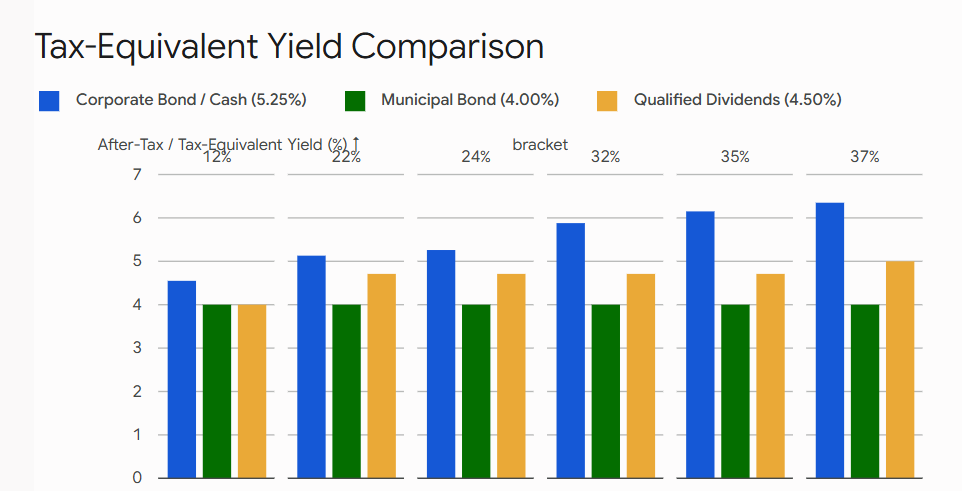
The table below shows how a 4.0% tax-free yield translates across federal tax brackets:
| Your Tax Bracket | 4.0% Tax-Free Yield Equal | Effective Yield Boost |
|---|---|---|
| 10% Tax Rate | 4.44% Taxable Rate | +0.44% Boost |
| 12% Tax Rate | 4.55% Taxable Rate | +0.55% Boost |
| 22% Tax Rate | 5.13% Taxable Rate | +1.13% Boost |
| 24% Tax Rate | 5.26% Taxable Rate | +1.26% Boost |
| 32% Tax Rate | 5.88% Taxable Rate | +1.88% Boost |
| 37% Tax Rate | 6.35% Taxable Rate | +2.35% Boost |
If you live in a state with high local income taxes, purchasing in-state municipal bonds can shield your earnings from state taxes as well. That double exemption boosts your net return even further.
State/Local Taxes & Alternative Minimum Tax (AMT)
A complete tax-equivalent yield calculation must account for state, local, and special tax rules:
- Double/Triple Tax Exemption:In-state municipal bonds are frequently exempt from federal, state, and local income taxes. When combining state and federal tax brackets, the combined formula becomes: TEY = Municipal Yield / (1 - (Federal Tax Rate + State Tax Rate × (1 - Federal Tax Rate))).
- Alternative Minimum Tax (AMT):Interest from private activity municipal bonds (used to fund airports, industrial development, or housing) may be subject to the federal Alternative Minimum Tax (AMT). If you are subject to AMT, these bonds lose their tax-exempt status, lowering your effective return.
Comparing Fixed-Income Choices
It is common to hold savings in bank CDs, cash accounts, or corporate bonds without checking after-tax returns.
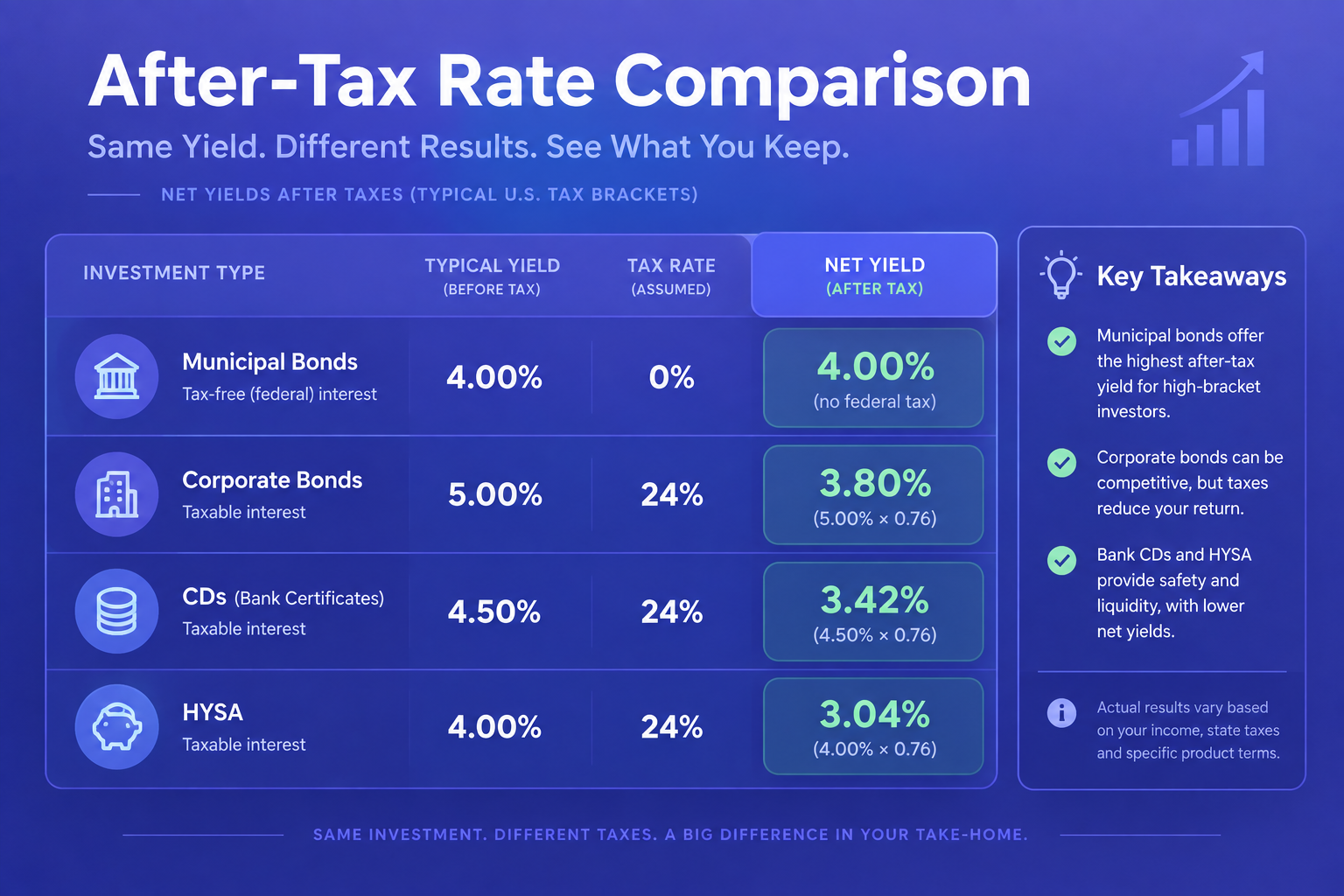
The table below compares four common fixed-income options for an investor in the 24% tax bracket allocating $100,000:
| Investment Option | Stated Rate | Tax Status | 24% Net Rate / TEY | Net Cash Retained ($100k) |
|---|---|---|---|---|
| Municipal Bond | 4.00% | Tax-Exempt | 5.26% (TEY) | $4,000 Net |
| Corporate Bond | 5.50% | Fully Taxable | 4.18% (Net) | $4,180 Net |
| Bank CD | 5.00% | Fully Taxable | 3.80% (Net) | $3,800 Net |
| Savings Account | 4.50% | Fully Taxable | 3.42% (Net) | $3,420 Net |
Bank CDs and high-yield savings accounts generate interest taxed as ordinary income. A 5.0% CD looks attractive initially, but after federal taxes, the net yield drops to 3.80%.
Traders testing multi-asset strategy models can explore charting tools on Pocket Option, practice order timing on Quotex, or examine account options on ExpertOption.
You can also test platform execution speeds on Olymp Trade, track volatility models on Binomo, or analyze risk metrics on CapitalCore.
How to Build Your Bond Strategy
When deciding where to allocate capital, follow this 5-step decision framework:
- Check Your Marginal Tax Bracket: Identify your combined federal and state income tax rates.
- Calculate Equivalent Yield: Use the TEY formula to convert tax-free offers into taxable equivalents.
- Evaluate Credit Ratings & Duration Risk: TEY measures tax efficiency, not safety. Thoroughly analyze creditworthiness and interest rate sensitivity before investing.
- Choose Account Placement: Hold tax-free bonds in taxable brokerage accounts. Placing tax-free bonds in an IRA eliminates their primary tax benefit.
- Review Net Cash Output: Select the asset that delivers the highest net spendable cash after accounting for all taxes.
FAQs
Is tax-equivalent yield the same as after-tax yield?
No. TEY adjusts a tax-free yield upward to show its taxable equivalent. After-tax yield adjusts a taxable rate downward to show net earnings after taxes are deducted.
Are municipal bonds completely tax-free for all investors?
Most municipal interest is exempt from federal tax. However, purchasing out-of-state bonds may incur state income taxes in your home jurisdiction.
Does tax-equivalent yield indicate investment risk?
No. TEY measures tax efficiency only. It does not account for credit risk, default probability, or price sensitivity to interest rate changes.
To read more stop loss to breakeven, visit our latest articles on the Becoin Blog to refine your investment approach.
Ready to enhance your trading strategies and access in-depth analysis? Unlock your full market potential by joining Becoin Premium today!

Can You Start Trading with $10 on Deriv?
A lot of beginners enter trading with the same question: “Is $10 actually enough to start trading on Deriv?” The short answer is yes. But the real answer is more complicated. You can start with $10 on Deriv, but whether you can survive, learn, and grow that account depends entirely on your expectations, discipline, and […]

Which Broker Has the Cleanest Interface? Real Comparison for Beginners in 2026
Looking for the cleanest trading interface in 2026? Compare Binomo, IQ Option, Quotex, Deriv, and more based on speed, layout, usability, mobile experience, and beginner friendliness. When most beginners choose a broker, they focus on bonuses, payouts, or deposit methods. But after testing multiple platforms for months, I realized something surprising: A messy interface can […]

Safest Broker for Small Deposits in 2026
Looking for the safest broker for small deposits in 2026? Discover beginner-friendly trading platforms with low minimum deposits, reliable withdrawals, risk controls, and the best options for starting safely with limited capital. Starting trading with a small amount of money sounds easy until you actually deposit real funds. Most beginners quickly realize that choosing the […]

Best Broker for One Trade a Day Strategy in 2026
Most traders lose money because they trade too much. They enter random setups, chase candles, overreact emotionally, and turn a simple strategy into pure gambling. That is exactly why the one trade a day strategy is becoming more popular among smart traders in 2026. Instead of sitting in front of charts all day, this approach […]

How Much Money Do You Really Need to Start Trading? A Realistic Beginner’s Guide for 2026
One of the most common questions beginners ask is: How much money do I need to start trading? It sounds like a simple question, but the answer depends on what you actually mean by start trading. Are you trying to learn? Are you hoping to grow savings over time? Are you trying to create a […]

Safest Trading Platforms (Risk Breakdown) – Real Comparison for 2026
Choosing a trading platform isn’t about features — it’s about avoiding hidden risk. Most traders compare brokers like Quotex vs Pocket Option vs Deriv vs Olymp Trade expecting a clear winner. Instead, they find conflicting reviews, promotional claims, and no real explanation of how these platforms behave when money is on the line. The real […]