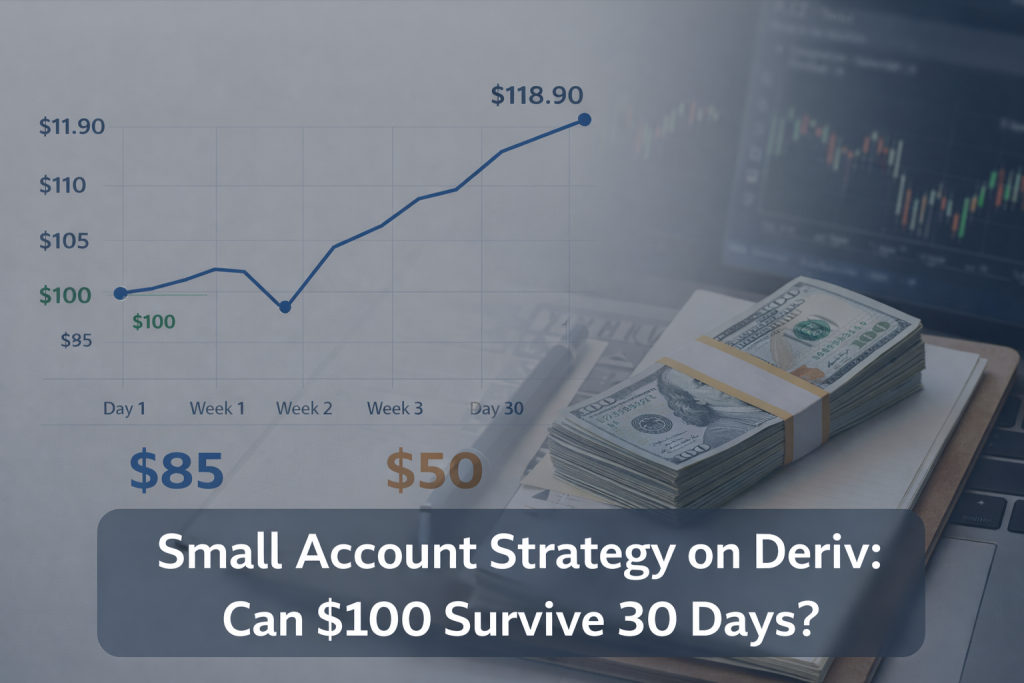
Small Account Strategy on Deriv: Can $100 Survive 30 Days?
I started this experiment with a simple question: can a Small Account Strategy on Deriv realistically keep a $100 account alive for 30 days?
Not double it. Not turn it into $1,000. Just survive.
I have seen too many YouTube thumbnails promising 10x returns and “risk-free” bots. That is not trading. That is marketing. What I wanted was proof that discipline, structure, and patience could stretch $100 across an entire month.

If you are thinking about opening an account and testing a small capital approach, you can start here using my affiliate link:
👉 Open your Deriv account here
This is not a hype piece. This is my actual 30-day breakdown.
Why I Chose Deriv for a $100 Challenge
I picked Deriv for three reasons:
- Low minimum deposit
- Flexible contract sizes
- Access to synthetic indices for 24/7 testing
For a Small Account Strategy on Deriv, flexibility matters. With $100, position sizing is everything. You cannot afford large swings.
Most articles online stop at “use 1–2% risk per trade.” That advice is correct but incomplete. What nobody explains is how psychology shifts when your entire account is the size of one grocery bill.
That was my real test.
Ground Rules: My 30-Day Framework
Before placing my first trade, I wrote these rules in my notebook:
- Starting balance: $100
- Max risk per trade: 3% ($3)
- Daily max loss: 6% ($6)
- Weekly target: 5–8%
- Stop trading after 3 consecutive losses
- No revenge trades
- No martingale
- No compounding until account crosses $120
Most “Small Account Strategy on Deriv” guides online ignore loss limits. That is the missing piece. Survival depends more on drawdown control than win rate.

What I Traded
I avoided random hopping between markets. I focused on:
- Volatility 75 Index
- Volatility 10 Index
- EUR/USD during London session
I used simple setups:
- Break and retest on 5-minute charts
- RSI divergence confirmation
- 1:1.5 to 1:2 risk-reward ratio
Nothing fancy. No indicators stacking.
Week 1: Reality Check
Balance: $100
End of Week 1: $103.40
Week one humbled me.
I took 18 trades:
- 9 wins
- 9 losses
Here is the breakdown:
| Metric | Value |
| Total Trades | 18 |
| Win Rate | 50% |
| Avg Risk | $3 |
| Avg Reward | $4.50 |
| Net Result | +$3.40 |
I felt frustrated. Eighteen trades for just $3.40?
But then I realized something powerful. I survived week one without emotional damage.
That is when the Small Account Strategy on Deriv started to make sense. The goal was not excitement. The goal was stability.
Emotional Lessons from Week One
The hardest part was not losing money. It was resisting the urge to increase lot size.
On Day 3, after two losses, I wanted to double my stake to “recover faster.” If I had done that, I would have broken my system before it had time to prove itself.
Small accounts magnify impatience.
Week 2: The First Drawdown
Starting balance: $103.40
Lowest balance during week: $96.80
End of Week 2: $101.20
Yes, I dipped below $100.
This is the part most bloggers hide. Survival is not linear.
Here’s what happened:
| Day | Trades | Result |
| Monday | 4 | -$6 |
| Tuesday | 3 | +$4.50 |
| Wednesday | 2 | -$3 |
| Thursday | 3 | +$5 |
| Friday | 2 | +$0.30 |
Monday hurt. I hit my daily max loss within 90 minutes.
Normally, I would continue trading. But I stopped.
That decision alone protected the account.
If you want deeper insight into risk management psychology, I wrote more about position control in my guide on how to manage drawdown in small trading accounts.
What Most “$100 Challenges” Get Wrong
Here is the content gap I noticed while researching top results:
Most articles focus on:
- Win rate
- Indicators
- Fast compounding
Almost none discuss:
- Liquidity timing
- Emotional fatigue after small gains
- Micro-sizing consistency
- When not to trade
The Small Account Strategy on Deriv only works if inactivity is part of the strategy.
Some days I placed zero trades.
Week 3: Stability Over Speed
Starting balance: $101.20
End of Week 3: $112.75
Week three was smooth.
- 14 trades
- 9 wins
- 5 losses
- Average RR: 1:1.8
This was the first time the system felt mechanical.
I stopped watching profit. I started watching execution quality.
Here’s the weekly summary:
| Metric | Value |
| Win Rate | 64% |
| Risk Per Trade | $3 |
| Net Profit | +$11.55 |
| Max Drawdown | 4.2% |
The biggest change? I reduced trading frequency.
Fewer trades, better focus.
If you are new to Deriv and still learning the interface, I recommend reading my step-by-step breakdown of how to place smart trades on Deriv synthetic indices.
Midway through the month, I realized something important. If you are serious about testing a Small Account Strategy on Deriv, do it with a clean structure from day one. You can create your account here and start tracking properly from the start:
👉 Start your Deriv account here
Week 4: The Psychological Test
Starting balance: $112.75
End balance Day 30: $118.90
Final profit: $18.90
Total return: 18.9%
Not life-changing. But powerful.
Week four was psychologically harder than week two.
Why?
Because now I had something to protect.
I noticed fear creeping in. I hesitated on valid setups. I closed trades early.
Here is the final 30-day summary:
| Category | Value |
| Starting Balance | $100 |
| Ending Balance | $118.90 |
| Total Trades | 57 |
| Win Rate | 56% |
| Max Drawdown | 6.2% |
| Largest Winning Streak | 4 |
| Largest Losing Streak | 3 |
The Small Account Strategy on Deriv worked, but not because of high accuracy.
It worked because losses were controlled.

What Actually Made the $100 Survive
After 30 days, I identified five survival factors:
- Strict daily loss cap
- Small fixed risk per trade
- Trading only specific sessions
- No emotional lot increase
- Accepting slow growth
No secret indicators.
The Math Behind Survival
Let’s compare two traders:
| Scenario | Risk Per Trade | 5 Losses | Account Impact |
| Disciplined | 3% | -15% | $85 |
| Aggressive | 10% | -50% | $50 |
Five bad trades can cut your account in half if risk is uncontrolled.
This is why most small accounts disappear within weeks.

Is 18.9% Realistic Every Month?
No.
Some months will be flat. Some negative.
The point of this Small Account Strategy on Deriv experiment was survival, not scaling.
Consistency comes before growth.
Who This Strategy Is For
This approach suits:
- Beginners with limited capital
- Traders rebuilding after losses
- People testing discipline
It is not for:
- Anyone expecting daily income from $100
- Anyone relying on martingale
- Anyone uncomfortable with slow growth
What I Would Improve Next Month
If I repeat this challenge:
- Reduce risk to 2% after drawdown
- Track emotional state daily
- Avoid Monday trading
- Increase RR target to 1:2 consistently
Also, I would document trades visually.
For readers who want to explore platform comparisons, I recently analyzed trading structure differences in my detailed Deriv vs other platforms breakdown.
Can a Small Account Strategy on Deriv Be Scaled?
Yes, but slowly.
Once the account crosses $150–$200, risk percentage matters more than dollar size.
The same discipline must apply.
The mistake most traders make is increasing risk percentage when capital grows.
That destroys stability.
Final Verdict: Did $100 Survive?
Yes.
It survived.
It did not explode. It did not crash. It grew modestly.
That modest growth is what makes this experiment meaningful.
The Small Account Strategy on Deriv is not about chasing huge returns. It is about proving you can control risk for 30 days straight.
If you can protect $100, you can protect $1,000.
If you are ready to test your own 30-day survival challenge, you can open your Deriv account using my link below and follow the same framework:
👉 Open your Deriv account and start your $100 test
Start small. Track everything. Respect losses.
Survival is the first victory in trading.
If you follow the structure above, your Small Account Strategy on Deriv becomes a structured experiment, not a gamble.

Biggest Beginner Mistakes That Kill Trading Accounts
Trading looks simple from the outside. Open an account, place a few trades, and grow your balance. But reality is different. Most beginners do not lose because markets are impossible. They lose because they repeat the same avoidable mistakes. A small account can survive bad market conditions. What usually kills it is poor decision-making, emotional […]

Capital Core Account Types Explained: Which One Fits Your Trading Budget?
When I first started looking at Capital Core account types, I made the same mistake most traders make. I looked at the bonus first. Then I looked at the leverage. And only after that did I start asking the question that actually matters: Which account can I realistically manage without forcing trades just because I […]
Capital Core Minimum Deposit Strategy: Can You Grow a Small $10 Account?
There’s something dangerously attractive about a broker that lets you start with just $10. It feels harmless. Low risk. Easy to test. Almost too easy. That’s exactly why I wanted to test the Capital Core minimum deposit strategy for myself. Not because I believed a $10 account could become life-changing money. Not because I wanted […]

Can You Start Trading with $10 on Deriv?
A lot of beginners enter trading with the same question: “Is $10 actually enough to start trading on Deriv?” The short answer is yes. But the real answer is more complicated. You can start with $10 on Deriv, but whether you can survive, learn, and grow that account depends entirely on your expectations, discipline, and […]

$10 to $50 Trading Challenge – Strategy + Real Results (Case Study)
Turning $10 into $50 sounds easy until you actually try it. Small accounts expose every weakness in your trading. One bad decision can erase hours of progress, and emotional trading becomes much harder to control when every dollar matters. This case study breaks down how a $10 account was realistically grown to $50 using a […]

I Started with $10 on Quotex – Day 1 Results (Real Case Study)
Most beginner traders ask the same question:Can you actually grow a small account like $10? Instead of theory, I decided to test it in real conditions. This is a Day 1 case study of trading with $10 on Quotex, documenting everything from setup to execution, mistakes, emotions, and actual results. No hype, no fake screenshots, […]