
Deriv Day Trading Payout Math: Calculating True Break-Even Win Rate
The day I stopped guessing and started calculating was the day my trading changed.
For months, I was trading binaries on Deriv thinking I needed a 60 percent win rate to survive. I did not know why 60 percent felt like the magic number. I just heard it repeated in forums and YouTube comments.
Then I lost money with a 58 percent win rate.
That was the moment I realized I did not understand the math behind my own trades.

If you are trading binaries and have never calculated your actual break-even level, you are trading blind. If you want to test the numbers yourself while reading, you can open a live account here and follow along with small stakes:
👉 Open your Deriv account here!
What I am about to share is not theory. It is pulled directly from my trading journal, screenshots, and equity curves.
Why Most Traders Misunderstand Day Trading Payouts
The biggest gap I noticed in Google search results about Deriv Day Trading Payout Math is this:
People explain the formula.
They do not explain what it feels like in real trading conditions.
Day trading are simple in structure:
- You risk a fixed amount.
- You either win a fixed payout percentage.
- Or you lose your full stake.
That payout percentage is everything.
On Deriv, I regularly saw payouts between 65 percent and 95 percent depending on market and duration. Most of my trades averaged around 80 percent.
I assumed 50 percent win rate was enough.
It was not.
The Core of Deriv Day Trading Payout Math
The break-even win rate formula is straightforward:
Where payout ratio is expressed as decimal.
If payout is 80 percent, payout ratio = 0.8.
So:
Break-even = 1 / (1 + 0.8)
Break-even = 1 / 1.8
Break-even ≈ 55.56 percent
That means if you are trading 80 percent payouts, you must win more than 55.56 percent of your trades just to not lose money.
This was the number that hit me hard.
I was averaging 54 percent at that time.
That 1.5 percent difference was quietly draining my account.

My First 100 Trade Audit
I went back and analyzed 100 consecutive trades.
Here were my raw numbers:
| Metric | Value |
| Total Trades | 100 |
| Wins | 54 |
| Losses | 46 |
| Payout Average | 80% |
| Net Result | -$64 |
At first glance, 54 wins out of 100 felt decent.
But the math did not care about feelings.
Let’s calculate expected return:
Expected value formula:
Where:
W = win probability
R = payout ratio
L = loss probability
Plugging my data:
E = (0.54 × 0.8) − (0.46 × 1)
E = 0.432 − 0.46
E = -0.028 per dollar risked
That means I was losing 2.8 cents per dollar long term.
Now it made sense.

The Psychological Trap of “Almost Winning”
The hardest part about binary trading is emotional math.
You can feel successful while slowly losing.
A 54 percent win rate feels like progress. But if payout is 80 percent, it is not enough.
This is where Deriv Day Trading Payout Math becomes non-negotiable.
Here is what different payout levels demand:
| Payout | Break-Even Win Rate |
| 70% | 58.82% |
| 75% | 57.14% |
| 80% | 55.56% |
| 85% | 54.05% |
| 90% | 52.63% |
| 95% | 51.28% |
The higher the payout, the lower the required accuracy.
I stopped trading anything below 75 percent after seeing this table.
The Real-World Problem No One Talks About
Online guides stop at formulas.
They do not address dynamic payout changes.
On Deriv, payouts shift constantly depending on volatility and duration. That means your break-even win rate shifts too.
This was the silent killer in my strategy.
One session:
- Trade 1 payout = 85%
- Trade 2 payout = 78%
- Trade 3 payout = 72%
Same strategy. Different math.
So I built a rule:
Only take trades above 80 percent payout.
That single filter improved my expectancy.
If you want to apply structured filtering like this, you can practice directly here with small position sizes:
👉 Start trading with controlled risk on Deriv
Fixed Stake vs Compounding
Another content gap I noticed in Deriv Day Trading Payout Math discussions is compounding distortion.
Most break-even examples assume fixed stake.
But most traders compound emotionally.
Example:
Start with $1000.
Risk 5 percent per trade.
After losses, position size shrinks. After wins, it grows.
Compounding amplifies both edge and negative expectancy.
I tested both models.
Fixed $10 per trade
After 200 trades with 56 percent win rate and 80 percent payout:
Small profit. Stable curve.
5 percent compounding
Same stats.
Higher volatility. Larger drawdowns. Slightly higher net profit.
Compounding works only when edge is real.
Without edge, it accelerates failure.
My Breakthrough Moment
I remember the day clearly.
I hit 60 percent win rate over 50 trades. I thought I cracked the code.
Then I checked payouts.
Average payout was 72 percent.
Break-even at 72 percent payout is 58.14 percent.
My edge was 1.86 percent.
That margin was razor thin.
One bad week erased two weeks of gains.
That was the moment I understood Deriv Day Trading Payout Math at a practical level. Small statistical edges demand strict discipline.
Why Martingale Fails Under Payout Math
This deserves direct attention.
Martingale assumes even-money payout.
Day trading rarely offer 100 percent payout.
Example:
Stake $10
Lose
Double to $20
Win at 80 percent payout
Return = $20 × 0.8 = $16 profit
But total risked = $30
Net result = -$14
The math does not support traditional martingale.
This is one of the most ignored realities in search results.

My 6-Month Data Summary
I tracked 1,246 trades.
Here is the simplified summary:
| Metric | Value |
| Average Payout | 81.3% |
| Win Rate | 57.4% |
| Net Return | +6.2% |
| Max Drawdown | 14.7% |
My real edge was only about 1.8 percent above break-even.
That is how tight binary trading margins are.
What Actually Improved My Win Rate
It was not indicators.
It was filtering low payout trades and trading fewer setups.
Key changes:
- Minimum 80 percent payout rule
- Maximum 3 trades per session
- No trading during payout compression periods
- Strict journaling
I explain how this discipline evolved in my risk management framework and how it compares with synthetic markets in my synthetic indices vs forex breakdown. I also documented my early mistakes in my trading psychology journal.
Those pieces connect directly to what I learned here.
The Hard Truth About Binary Trading
Day trading are mathematically unforgiving.
Even a small miscalculation in win rate assumptions leads to consistent losses.
Deriv Day Trading Payout Math is not complex. It is strict.
If your win rate is below break-even, you will lose.
If it is barely above, growth will be slow and volatile.
There is no shortcut around probability.
How I Calculate Before Every Session
Before trading, I now do this:
- Check average payout for chosen market.
- Calculate break-even win rate.
- Compare with my historical win rate for that setup.
- Trade only if margin is at least 2 percent above break-even.
This keeps me grounded in numbers, not emotion.
Final Thoughts: The Only Edge That Matters
Understanding Deriv Day Trading Payout Math forced me to become honest with myself.
It stripped away illusion.
It showed me that 55 percent is not always enough.
It showed me that payout percentage controls survival.
It showed me that math is the only consistent referee.
If you want to apply these calculations in real market conditions with controlled position sizes, you can start here:
👉 Open your Deriv account and test the numbers yourself.
Trade small. Calculate everything. Respect probability.
That is the difference between gambling and structured binary trading.
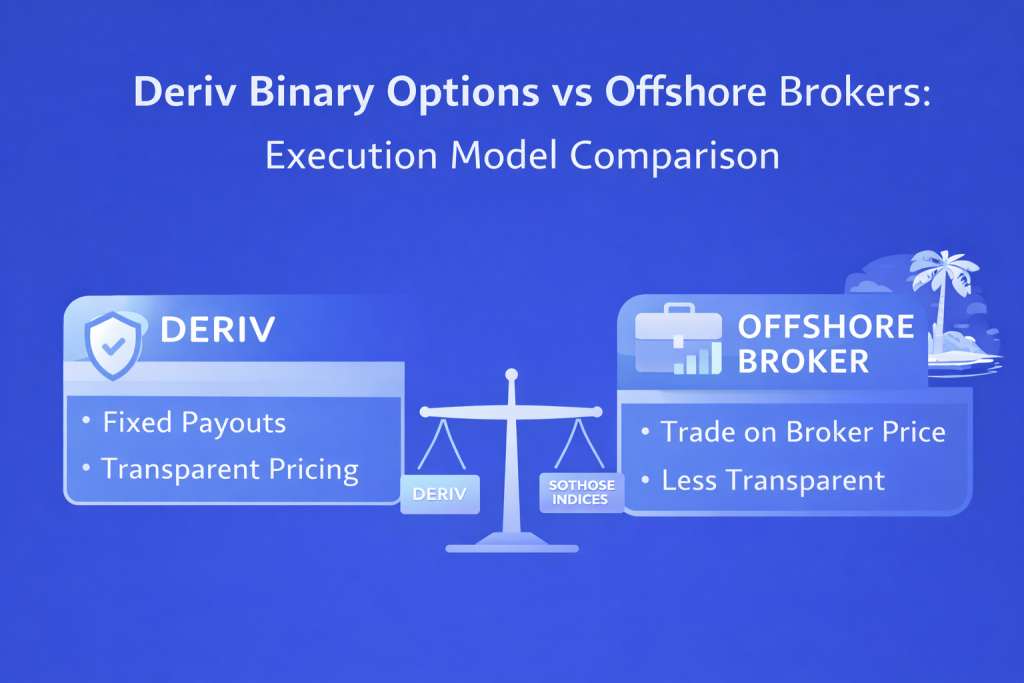
Deriv Day Trading vs Offshore Brokers: Execution Model Comparison
I did not start my trading journey thinking about execution models. Like most beginners, I started with charts, indicators, and the belief that if I could just find the right entry signal, profits would follow. My early trading notebook was full of screenshots of RSI signals, candlestick patterns, and support levels. What it did not […]

The Day I Stopped Trading and Finally Started Making Money
It was a rainy Tuesday morning, and I was staring at my screen with a familiar knot in my stomach. The previous three days had been a slow, agonizing slide into the red. I had given back two weeks of hard-earned profits in less than seventy-two hours. Every asset I clicked on looked like a […]

Deriv vs Binomo Deposit Methods: My 2026 Real Money Comparison Guide
I sat in the corner of a crowded coffee shop, my eyes fixed on my phone screen. After months of testing strategies on a demo account, I had finally saved up a small pocket of risk capital. I felt ready to trade live. A high-probability setup was forming on my charts, and my heart rate […]

Fastest Withdrawal Brokers (Real Test Results)
The first time I made a profitable trade, I wasn’t thinking about strategy anymore. I was thinking about one thing. Can I actually withdraw this? I requested my payout and waited. And waited. That “processing” label stayed there longer than my trade itself. That moment changed how I evaluate brokers. Since then, I’ve made it […]

Binomo Demo vs Real Account: What Changes After You Deposit (KYC, Payout, Support, Limits)
I spent far too long thinking my Binomo demo results meant I was “ready.” On demo, everything felt clean. My entries looked sharp. My timing looked better than it probably was. I could reset virtual balance, test ideas, and convince myself I had control. Then I made my first real deposit, and that’s when I […]
Binomo Withdrawal Pending: Real Reasons, Timelines, and What to Do at Each Hour Mark
The first time I saw Binomo withdrawal pending on my screen, I stopped caring about my trades for the day. Not because the amount was huge. It wasn’t. What bothered me was the uncertainty. When you trade on a platform like Binomo, the real test isn’t the deposit button. It’s the withdrawal button. Depositing is […]