
Nadex Minimum Capital Strategy: How to Grow a Small $100–$500 Account
When I first funded my Nadex account with $250, I did not feel like a trader. I felt like someone experimenting with rent money I could afford to lose.
Most guides about small accounts either promise fast compounding or warn you not to bother. Neither helped me. What I needed was a realistic Nadex minimum capital strategy that respected how tight $100–$500 really is.

If you are starting small and want a structured way to approach it, you can open a Nadex account here and follow along with the exact framework I use.
This article is not theory. It is based on my own trade logs, mistakes, and adjustments. I will show you how I approached position sizing, which contracts I traded, how I managed drawdowns, and what actually worked when growing a small account.
Why Most Small Nadex Accounts Fail
Before I talk about what worked, I need to be honest about what did not.
My first week on Nadex, I treated a $250 account like a $25,000 account. I overtraded. I chased volatility. I bought contracts at $70–$80 thinking they were “high probability.” One losing streak and I was down 35%.
The problem was not Nadex. It was my misunderstanding of how capital efficiency works on this exchange.
On Nadex, you are trading defined-risk contracts. Every contract has:
- A maximum risk
- A maximum payout
- A fixed expiration
That structure is powerful for small accounts. But only if you use it properly.
The key shift in my Nadex minimum capital strategy was this:
I stopped thinking about how much I could make.
I started thinking about how little I could lose per trade.
Understanding the Nadex Cost Structure (What Nobody Explains Clearly)
Most articles mention fees but do not show how they impact small accounts.
Here is how it actually affected me.
Nadex charges:
- $1 per contract to enter
- $1 per contract to exit
- Max $50 per side
- No fee if a contract expires worthless
On a $250 account, fees matter. If I traded 5 contracts at a time, I was giving up $10 per round trip in fees alone. That is 4% of my account.
So I built my Nadex minimum capital strategy around this rule:
I trade 1–2 contracts per position until the account is over $1,000.
That single adjustment dramatically slowed my drawdowns.
My Capital Tiers: How I Structured Growth
Instead of randomly increasing size, I created tiers.
| Account Size | Contracts Per Trade | Max Risk Per Trade | Daily Loss Limit |
| $100–$300 | 1 | $15–$25 | $30 |
| $300–$500 | 1–2 | $25–$40 | $50 |
| $500–$1,000 | 2–3 | $40–$75 | $75 |
This structure prevented emotional scaling.
When I started with $250:
- I only bought contracts priced between $20 and $40
- I avoided $70+ contracts completely
- I never risked more than 10–12% of account equity on a single trade
That is the backbone of my Nadex minimum capital strategy.

What I Actually Traded With $100–$500
I tested several markets:
- Forex binaries
- Stock index binaries
- Call spreads
- Knockouts
Here is what I discovered.
1. Forex Binaries Were the Most Capital Efficient
Pairs I focused on:
- EUR/USD
- GBP/USD
- USD/JPY
These contracts often had pricing between $20–$50 depending on distance from strike.
That allowed:
- Defined risk
- Clear profit potential
- Controlled exposure
When I tried trading index contracts like US 500, the pricing moved too aggressively for my small account tolerance.
2. Call Spreads Were Better After $400+
Below $300, spreads required too much buying power relative to my balance.
After crossing $400, I started experimenting with defined-range spreads. They provided smoother P&L swings compared to binaries.
If you are brand new to contract types, I broke down binaries vs spreads in detail in my guide on day trading basics (link to your internal article here).
My Exact Entry Framework (Documented From My Journal)
This is where most articles stay vague. I will not.
I traded only:
- 5-minute and 15-minute expirations
- During London and early New York session
- On pullbacks within a clear trend
I used:
- 20 EMA
- 50 EMA
- Previous session high/low
No complicated indicators.
Example from my journal:
Date: Tuesday
Pair: EUR/USD
Trend: Bullish on 15-min
Setup: Pullback to 20 EMA
Contract bought at $32
Max risk: $32
Max payout: $68
Result: Expired at 100
Profit before fees: $68
After fees, net was slightly lower, but it was still a 2:1 reward relative to risk.
The key was patience. I sometimes waited 45 minutes for one setup.

The Compounding Myth (What Really Happens)
Many articles talk about compounding small accounts aggressively.
Here is what actually happened for me:
Week 1: $250 → $220
Week 2: $220 → $310
Week 3: $310 → $290
Week 4: $290 → $380
It was uneven. Slow. Frustrating.
But the drawdowns became smaller as my discipline improved.
The biggest turning point in my Nadex minimum capital strategy was adding a daily loss limit.
If I hit:
- 2 full losses
- Or 1 full loss + 1 half loss
I stopped trading for the day.
That single rule protected my capital more than any indicator.
Real Risk Management Rules I Follow
These are written exactly as they appear in my trading notebook:
- Never average down
- Never revenge trade
- Stop after two losses
- Reduce size after red day
- Increase size only after 10% equity growth
Simple. But powerful.
A Sample 5-Day Trading Log
Here is one actual sample week structure (simplified):
| Day | Trades Taken | Wins | Losses | Net P/L |
| Mon | 2 | 1 | 1 | +$18 |
| Tue | 1 | 1 | 0 | +$34 |
| Wed | 2 | 0 | 2 | -$52 |
| Thu | 1 | 1 | 0 | +$29 |
| Fri | 2 | 1 | 1 | +$16 |
Weekly Net: +$45
On a $300 account, that is meaningful growth without reckless exposure.

The Psychological Shift Required
Small accounts magnify emotion.
When you lose $40 on a $250 account, it feels catastrophic.
What helped me:
- Viewing trades as business expenses
- Tracking stats instead of balance
- Measuring execution quality, not outcome
I discuss more about trading psychology in my breakdown of how I handle losing streaks in my article on managing drawdowns in active trading (link internally).
What I Stopped Doing (Critical)
The growth in my Nadex minimum capital strategy came from elimination:
- I stopped trading during news
- I stopped trading low liquidity hours
- I stopped trying to recover losses same day
- I stopped increasing size after one big win
Most progress came from what I removed.
Scaling From $500 to $1,000
Once I crossed $500, I made two adjustments:
- Allowed 2-contract positions on A+ setups
- Slightly extended expiration to 15 minutes more often
That reduced noise and increased consistency.
Growth became steadier, not explosive.
If you are ready to start applying this structure step by step, you can open your Nadex account here and use the same capital tiers I described.
The Hard Truth About a $100 Account
Can you grow $100?
Yes.
Can you double it in a week consistently?
No.
With $100:
- Trade 1 contract only
- Look for $15–$25 risk entries
- Accept slow growth
If you aim for 5%–10% weekly growth, you are already ahead of most retail traders.
I wish someone told me that earlier.
Where This Strategy Fits in a Bigger Plan
This Nadex minimum capital strategy is not a get-rich framework.
It is:
- A discipline builder
- A risk management training ground
- A confidence stabilizer
If you eventually plan to scale into futures or options, this environment teaches defined risk thinking.
For readers comparing platforms, I also shared my experience reviewing different day trading platforms in my in-depth platform comparison guide (link internally).
Final Thoughts: What Actually Makes It Work
After months of tracking data, I realized something simple.
Edge matters.
But risk control matters more.
With $100–$500:
- Survival is priority
- Consistency is secondary
- Scaling is earned
My account did not grow because I found a magic setup.
It grew because I protected downside better than before.
If you want to implement this exact Nadex minimum capital strategy, start small, follow the capital tiers, and track every trade. Open your account here and treat it like a business from day one.
Trade small. Trade structured. Let growth come as a byproduct of discipline.
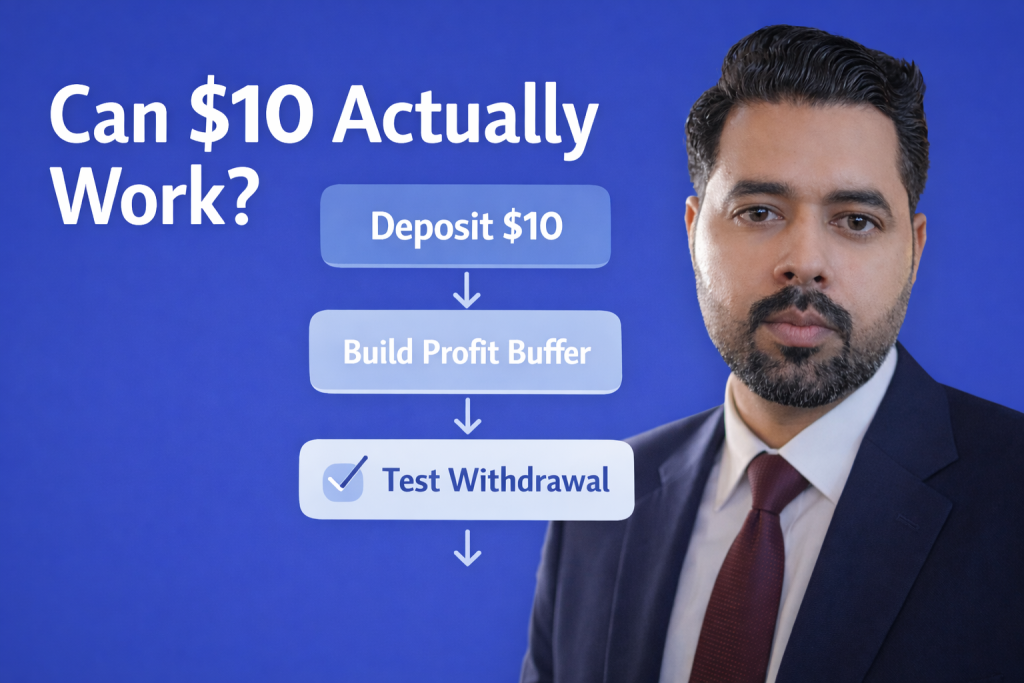
Capital Core Minimum Deposit Strategy: Can You Grow a Small $10 Account?
There’s something dangerously attractive about a broker that lets you start with just $10. It feels harmless. Low risk. Easy to test. Almost too easy. That’s exactly why I wanted to test the Capital Core minimum deposit strategy for myself. Not because I believed a $10 account could become life-changing money. Not because I wanted […]

Chasing Safety in a High-Stakes World: My Quest for the Best Low-Risk Trading Platforms
I still remember the sinking feeling in my stomach when I lost my first tiny trading account. It wasn’t a massive fortune, but it was mine. That night, I realized a brutal truth about this industry: most beginners fail not because they lack passion, but because they dive into high-risk environments without a life jacket. […]

Binomo vs IQ Option for Small Accounts: Which Platform Is Better for Beginners in 2026?
Most people entering online trading do not start with thousands of dollars. They start small. Usually with $10, $20, or maybe $50. That small balance changes everything about how a trader behaves. Every loss feels bigger, every win feels emotional, and every mistake has a stronger impact on the account. This is exactly why beginner […]

Biggest Beginner Mistakes That Kill Trading Accounts
Trading looks simple from the outside. Open an account, place a few trades, and grow your balance. But reality is different. Most beginners do not lose because markets are impossible. They lose because they repeat the same avoidable mistakes. A small account can survive bad market conditions. What usually kills it is poor decision-making, emotional […]
Capital Core Verification Process Explained: KYC, Restrictions, and Withdrawal Delays
I learned something the hard way with offshore-style brokers: the smoothest part is usually opening the account, funding it, and placing the first few trades. The real test starts when you try to move money back out. That’s exactly why I wanted to document the Capital Core verification process from a trader’s perspective, not from […]