USD/ZAR Is Coiling Between 16.20 and 16.70 — And the Rand Fundamentals Are Not What You Think
A range that has outlasted everyone's patience
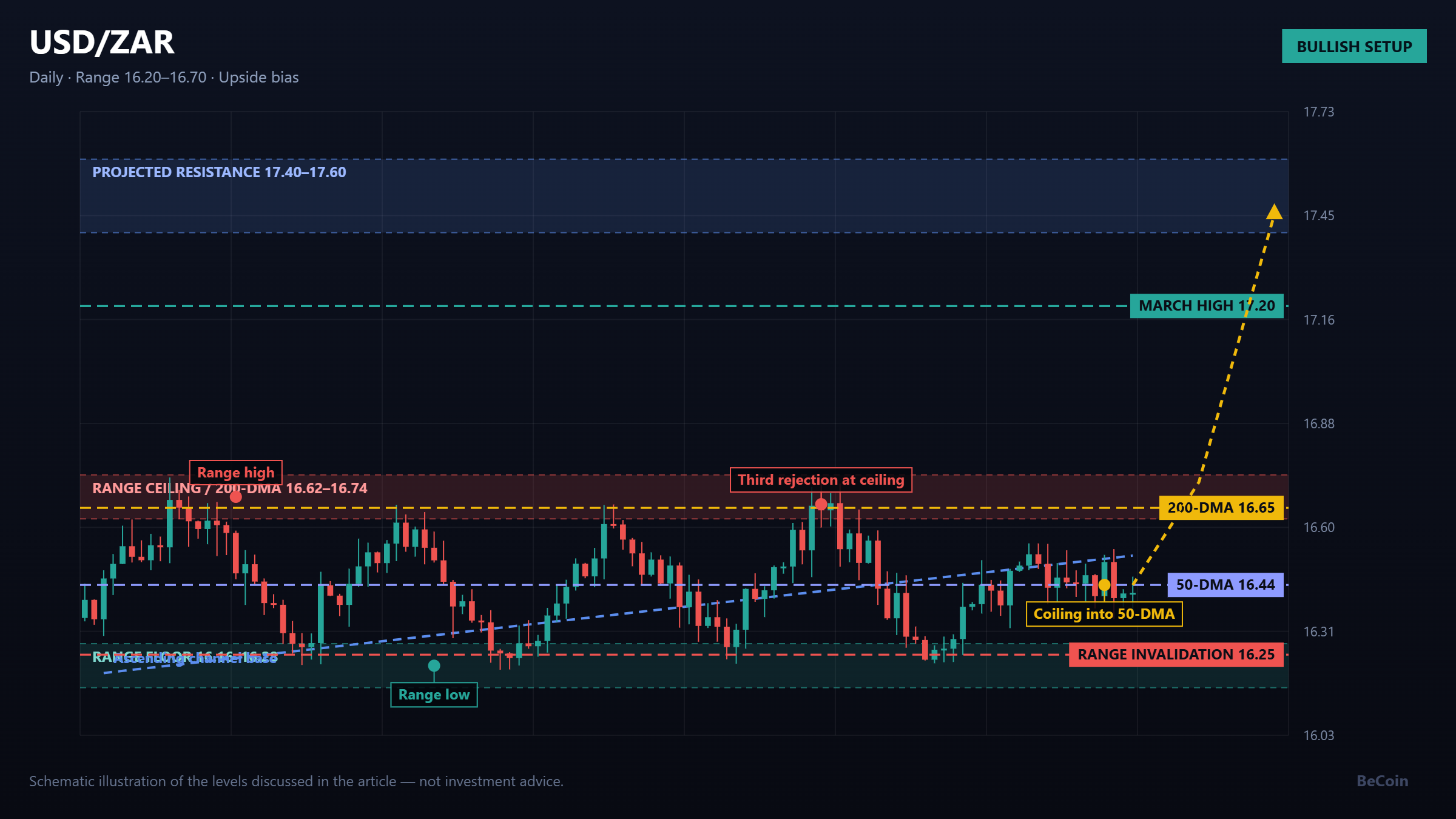
USD/ZAR has done almost nothing for months. Price has bounced between roughly 16.20 and 16.70, punishing breakout traders on both sides and rewarding nobody except the people who stopped watching. Ranges like this are boring right up until the moment they are not, and this one has been compressing long enough that the eventual resolution is likely to be worth trading.
The USD/ZAR technical picture
Two moving averages sit inside the upper half of the range and give it structure. The 50-day around 16.44 has been acting as a pivot, and the 200-day near 16.65 marks the effective ceiling. A daily close above 16.65 to 16.70 turns the range into a base and opens the path toward the March high near 17.20, with a broader objective in the 17.40 to 17.60 area if the move develops into a full impulse.
The downside case is equally clean. A break of 16.25 with follow-through targets the lower band and would suggest the rand is winning the tug of war outright. Between those two lines, everything is noise.
The rand story that gets ignored
The consensus view of the South African rand is a reflexively negative one, and the current data does not really support it. South Africa has been posting a substantial trade surplus, with the most recent quarterly release showing a sharp improvement, and the current account has swung to a multi-year high. That is a genuinely supportive backdrop for a currency that most of the market treats as a permanent short.
The South African Reserve Bank has also been ahead of the curve on policy, tightening before its developed-market peers rather than after. A central bank with a head start on the Federal Reserve is a rand-positive detail that rarely makes headlines.
What actually decides the breakout
Yield differentials. The spread between South African and US ten-year yields is the cleanest single indicator for this pair. If that spread widens through 4.00 percent and pushes toward 4.50 percent, the dollar side is winning and the upside break becomes credible. If it compresses, the range holds or breaks lower.
US labour market data remains the immediate catalyst. Strong payrolls give the Fed room to stay restrictive, which supports the dollar leg. Weak prints do the opposite and tend to send USD/ZAR straight back to the bottom of the range.
The commodity channel
Precious metals matter here in a way they do not for most pairs. South Africa is a major producer, and metals strength tends to filter through to the rand via export revenue and sentiment. A pullback in metals prices removes one of the rand's structural supports, which is part of why the upside case has any traction at all right now.
How to trade a range you cannot predict
The honest answer is that the edge in a range like this comes from trading its boundaries, not its middle. Fading 16.65 with a stop above 16.75, or buying 16.25 with a stop below 16.15, both offer defined risk. Guessing the breakout direction in advance offers none.
For anyone positioning for the upside continuation, the sequence to wait for is a daily close above 16.70, a successful retest of that level as support, and a widening yield spread confirming it. Two out of three is a trade. One out of three is a hope.
Bottom line
USD/ZAR remains range bound between 16.20 and 16.70 with the 16.44 and 16.65 moving averages framing the upper half. A confirmed break above 16.70 opens 17.20 and eventually the 17.40 to 17.60 area, while a loss of 16.25 favours the rand. The trade surplus and the SARB's early tightening argue that any dollar rally will be harder work than the market assumes.
Becoin.net Premium Forecast - Becoin.net Tariff Plans
This article is educational market commentary and is not investment advice. Trade your own plan and manage risk accordingly.

The Best Broker Without Complicated Features (And Why Simplicity Wins)
Most traders don’t fail because they lack knowledge. They fail because their platform buries them in noise before they even place their first trade. Here’s what actually works. It Started With a Confession From a $10 Trader A reader messaged us a few months back. He had been trying to trade for three weeks, had […]
EUR/USD holds 1.1414 before the ECB decision: three scenarios
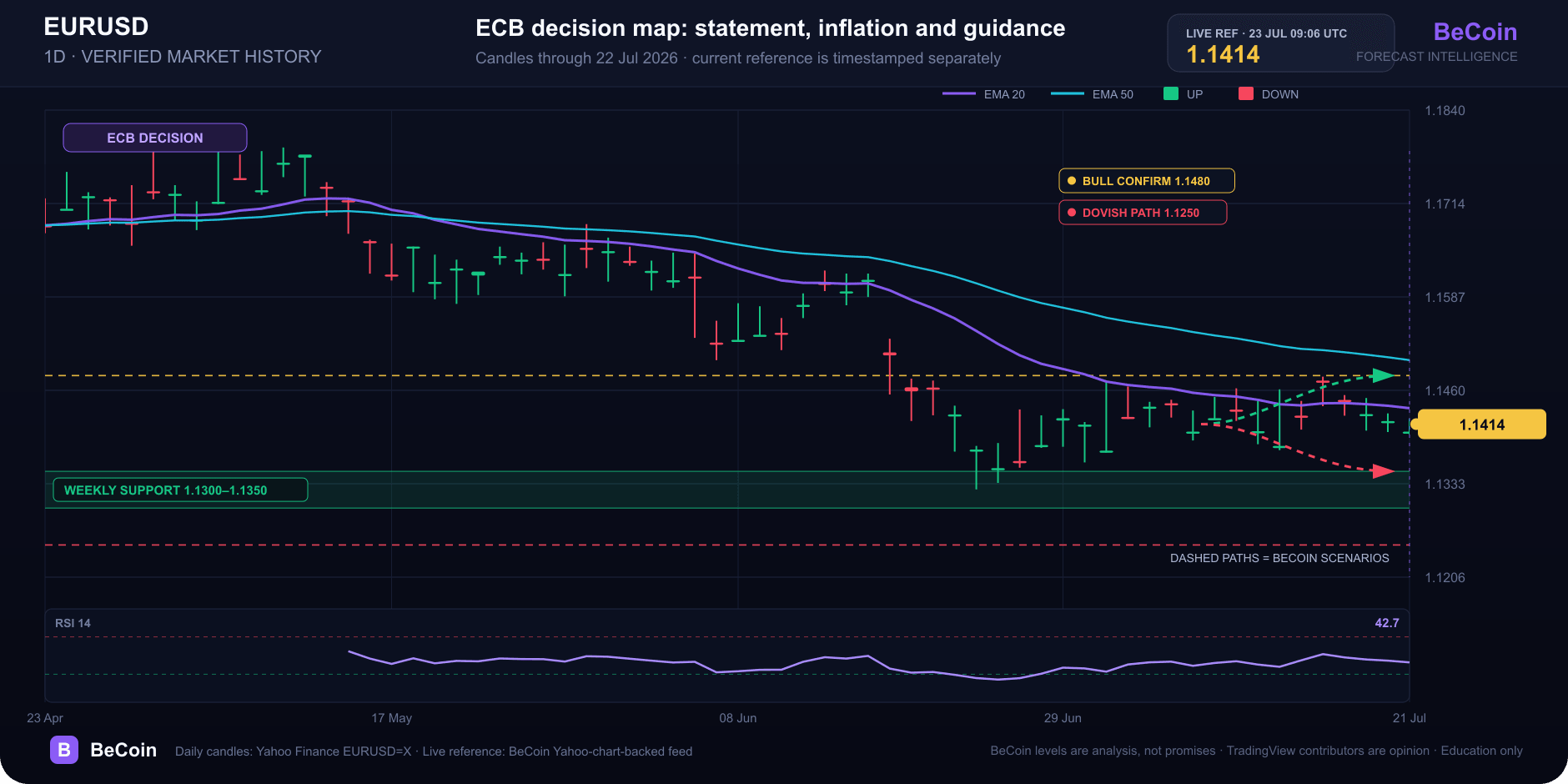
EUR/USD traded near 1.1414 before the ECB’s July decision. Here is what a hold, hawkish hold or surprise hike could mean for 1.1350 and 1.1480.

Trading Currency Strength Instead of Single Pairs
It was a Tuesday afternoon when I realized I was fighting a losing battle against a ghost. My screen was a chaotic web of indicators. I had the EUR/USD chart open, a moving average crossing over here, a relative strength index flashing oversold there, and a price action setup that looked textbook perfect. I clicked […]

Which Broker Has Better Risk Management Tools?
The burning smell of my own account blowing up is a scent I will never forget. It was a rainy Tuesday afternoon a few years back. I sat huddled over my laptop, watching a currency pair oscillate. Confident, arrogant, and entirely unprotected, I clicked buy. Minutes later, a sudden market spike completely wiped out my […]

Finding My Perfect Workspace: The Search for the Best Broker for My Daily Trading Routine
The alarm goes off at 6:00 AM. By 6:30 AM, I am sitting in front of my monitors with a steaming mug of black coffee. The house is completely quiet, the market is preparing its next major move, and my charts are completely bare. This is my daily sanctuary. For a long time, this morning […]

Which Broker Is Better for Weekend Trading?
It was a chilly Saturday morning, and while the rest of the world was sleeping in or catching up on shows, I was staring at a completely frozen screen. My usual EUR/USD chart looked like a heart monitor flatlining. The traditional markets were closed. The banks were shut down. For a long time, that was […]