2-Year Treasury Yield at 4.18%: Fed Hike Bets Pin Short End
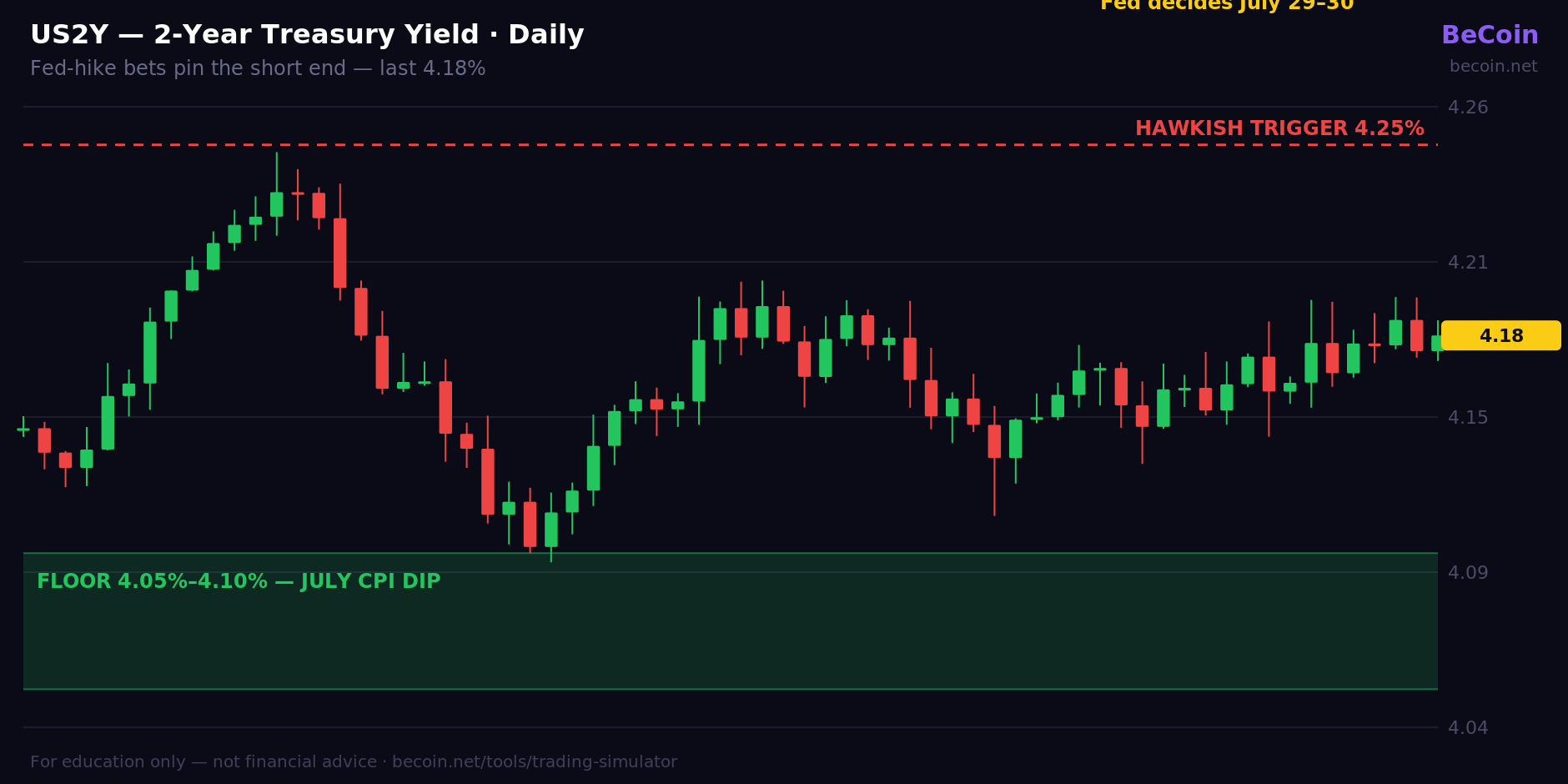
The US 2-year Treasury yield finished the week at 4.18%, up 2 basis points on Friday and holding the tight band it has kept all month. The short end barely moved through a week that saw chip stocks routed, softer CPI and PPI prints, and another round of Middle East headlines — because the 2-year answers to exactly one master: the Federal Reserve.
Why it matters. The 2-year is the market's cleanest read on Fed policy over the next 24 months, and at 4.18% it is pricing a central bank that is done cutting and may not be done hiking. Markets still keep at least one hike this year on the table, and this week's softer inflation data moved the long end far more than the short end — the 10-year eased to 4.55%, steepening the 2s10s curve to about +37 basis points. That combination — an anchored front end and a drifting long end — is what a "higher for longer, plus term premium" regime looks like. Every floating-rate borrower, money-market fund and bank margin in America reprices off this number.
Technical analysis. The yield has spent July inside a 4.10%–4.25% corridor, and 4.18% sits dead center. The upper rail at 4.25% is the hawkish trigger: a weekly close above it would signal the market moving from "one hike maybe" to "one hike, then another," and would drag the whole front-of-curve complex with it. Below, 4.05%–4.10% is the floor built on the July CPI dip — it would take a run of soft data or a genuine growth scare to crack it. Compression this tight into a July 29–30 Fed meeting rarely lasts; the corridor tends to break within days of the statement.
BeCoin's forecast read. The model's 24-hour and weekly paths are close to flat — dead center of a policy-driven range earns no directional edge. Its month view leans slightly higher on yields: the fed-funds path implied by the front end still discounts less hiking than Fed rhetoric suggests, and the model treats that gap as more likely to close from the market side. The asymmetric scenario is a hawkish surprise on July 30 that forces 4.25% quickly; the model gives the dovish break below 4.05% the lower weight. Track the full bond complex on the BeCoin forecast hub.
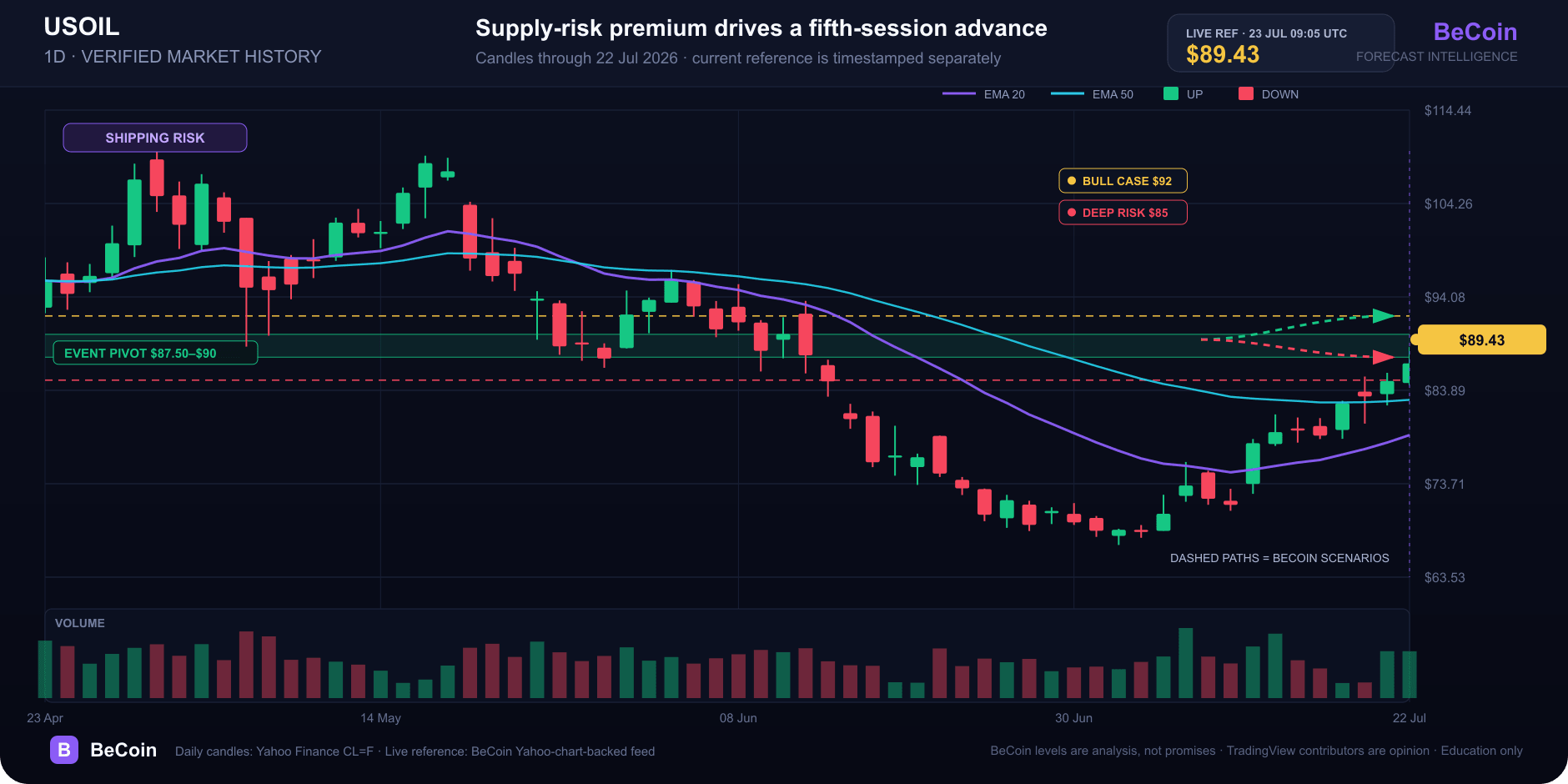
WTI reaches $89.43 as Brent clears $95 on renewed supply risk
WTI traded near $89.43 while Brent moved above $95 as Middle East shipping risk lifted crude for a fifth session. Key levels, catalysts and invalidation.
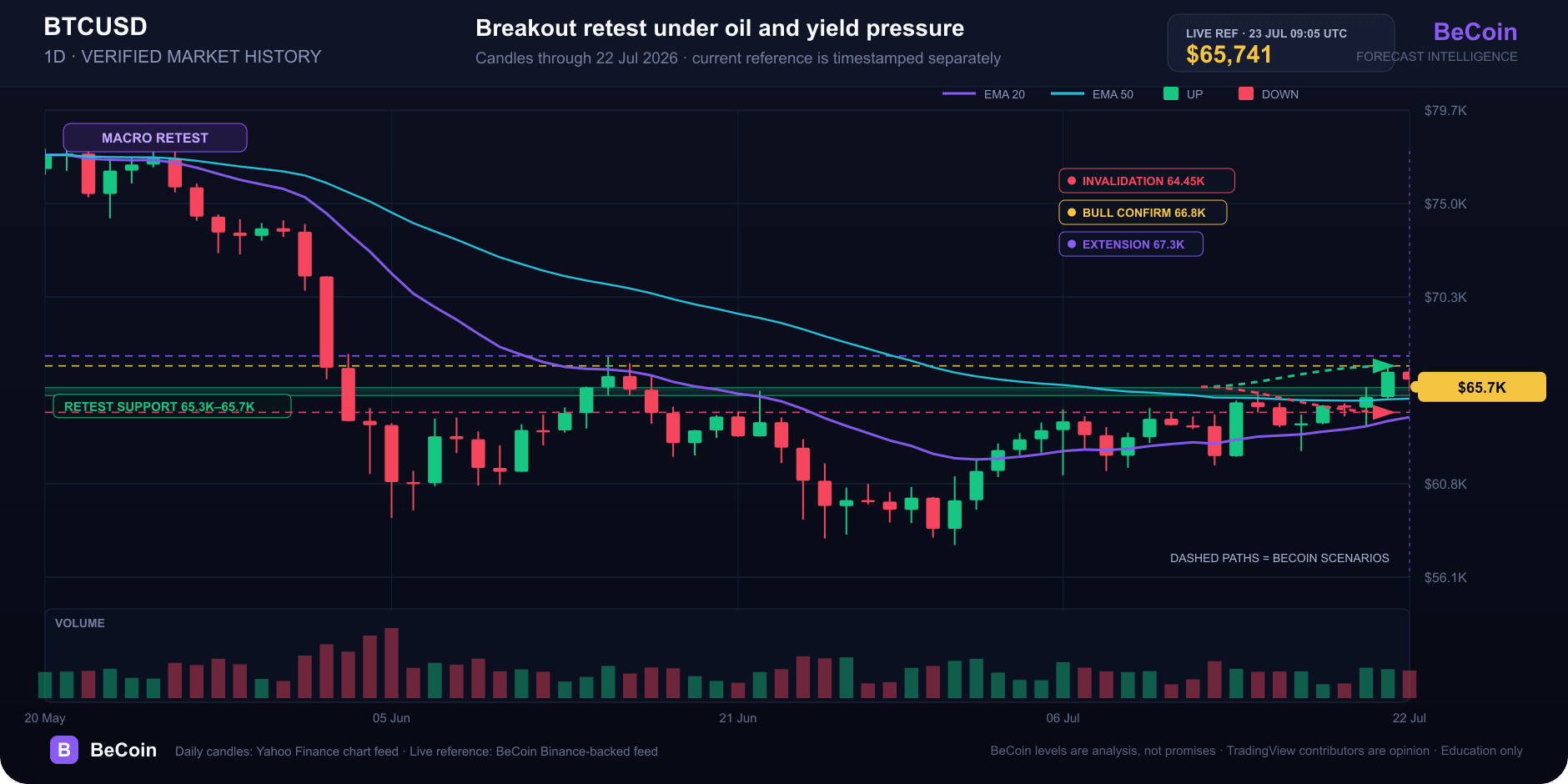
Bitcoin slips to $65,741 as oil and yields test the breakout
Bitcoin is near $65,741 as rising oil and Treasury yields test the $65.7K breakout floor. Here are the levels that confirm or invalidate the move.

How Many People Own Bitcoin? (2026 Data, Charts & Country Breakdown)
About 365 million people owned Bitcoin in 2025 - roughly 4-4.5% of the world and nearly half of all crypto owners. See the year-by-year growth curve, country data, whole-coin rarity, and why estimates disagree.

The Rookie Dashboard: My Raw Hunt for the Best Beginner Broker in 2026
We have all been there. It is late at night, your morning coffee is hours away, and you are staring at a screen pulsing with bright green and red lines. You have twenty dollars burning a hole in your digital wallet and a sudden, burning desire to conquer the financial markets. That was me exactly […]

Which Broker Is Better for Weekend Trading?
It was a chilly Saturday morning, and while the rest of the world was sleeping in or catching up on shows, I was staring at a completely frozen screen. My usual EUR/USD chart looked like a heart monitor flatlining. The traditional markets were closed. The banks were shut down. For a long time, that was […]

Why Traders Move from Binomo to Deriv in 2026: The Real Reasons Behind the Switch
If you spend enough time around trading communities, you’ll notice a pattern. Many traders start with Binomo. Then, after a few months, a surprising number begin looking at Deriv. Some switch completely. Others keep both accounts but gradually move most of their trading activity to Deriv. I noticed this trend while talking to beginner traders […]