Short answer: A Quotex compounding strategy means staking a share of the current balance, so stakes grow after wins and shrink after losses. It changes how fast results arrive, not whether they are positive.
A fixed payout below 100% needs a win rate above 1 ÷ (1 + payout) to break even: 55.6% at an 80% payout. Below that line, compounding makes the balance shrink faster, and bigger shares shrink it faster still.
Even with a real edge, staking too much turns growth negative. At an 80% payout and a 60% win rate, any stake above about 19.8% of the balance loses money over time.
What compounding means on fixed-payout trades
On Quotex and similar platforms, each trade is a fixed-payout contract. If the prediction is right, the trade pays a set percentage of the stake as profit. If it is wrong, the whole stake is lost.
The CFTC describes it this way: at expiry the holder receives "either a pre-determined amount of cash or nothing at all". There is no stop-loss and no partial loss inside one trade.
"Compounding" in this setting means the next stake depends on the current balance. Popular versions fall into three groups:
- Fixed fraction. Stake the same percentage of the current balance on every trade, for example 2% or 5%.
- All-in chain. Reinvest the stake plus the full payout on the next trade, for a set number of steps.
- Daily target tables. Plan a fixed percentage gain per day and compound it, such as "10% a day for 60 days".
Martingale (raising the stake after a loss) is often sold alongside compounding. It is a different rule, covered below.
All numbers in this guide use an 80% payout for illustration. Payouts on fixed-payout platforms vary by asset and time, so the same math should be rerun with the payout actually received.
The break-even win rate comes first
Per $1 staked there are only two outcomes: +payout with probability p, or −1 with probability 1 − p. Setting the average to zero gives the win rate needed just to break even.
Expectancy per $1 = p × payout − (1 − p)
Break-even win rate = 1 ÷ (1 + payout)
80% payout: 1 ÷ 1.80 = 55.6%
| Payout | Break-even win rate | Average result per $100 at 50% wins |
|---|---|---|
| 60% | 62.5% | −$20.00 |
| 70% | 58.8% | −$15.00 |
| 80% | 55.6% | −$10.00 |
| 85% | 54.1% | −$7.50 |
| 90% | 52.6% | −$5.00 |
Compounding does not appear anywhere in this formula. The sign of the average result is set by the win rate and the payout. Stake size only scales it.
The CFTC alert makes the same point with its own example: "assuming a 50/50 chance of winning," the "expected return on investment is actually negative, resulting in a net loss to the customer."
For the full derivation and sample-size math, see expectancy in binary options or the expectancy calculator.
Arithmetic vs geometric growth
With a fixed dollar stake, results add up: each trade adds or removes a set amount. That is arithmetic growth. With a fixed fraction, results multiply: each win multiplies the balance by (1 + f × payout), each loss by (1 − f).
Multiplying has a cost that adding does not. A 10% gain followed by a 10% loss leaves 99% of the start, not 100%. This gap is often called volatility drag.
The growth rate that decides where a compounding balance ends up is the average of the logs, not the average of the returns:
g = p × ln(1 + f × payout) + (1 − p) × ln(1 − f)
f = stake as a share of the balance
Typical balance after n trades = start × e^(n × g)

Three things follow from the chart. At a 50% win rate, growth is negative at every stake size. At exactly break-even, it is still slightly negative, because of the drag.
Even with a hypothetical 60% win rate, growth peaks at a 10% stake and turns negative above about 19.8%. Staking more than that loses money over time, despite the edge.
The peak is the Kelly stake, f* = p − (1 − p) ÷ payout. At 60% and 80% it is 0.60 − 0.40 ÷ 0.80 = 10%. At 50% it is negative, which means do not trade. Try values in the Kelly criterion calculator.
The gap between the average and the typical result grows with stake size. The table assumes the hypothetical 60% win rate, 200 trades and a $100 start.
| Stake (% of balance) | Average (arithmetic) balance | Typical (geometric) balance |
|---|---|---|
| 2% | $137.68 | $133.45 |
| 5% | $222.20 | $182.76 |
| 10% | $492.16 | $224.00 |
| 25% | $5,248.49 | $32.11 |
At a 25% stake the average looks huge, but it is pulled up by a few very lucky paths. The typical account ends with about a third of its start. Compounding plans that quote the average hide this.
Why compounding speeds up losses
When the win rate is below break-even, the growth rate g is negative for every stake size, and it gets more negative as the stake grows. Compounding then multiplies a loss rate instead of a gain rate.

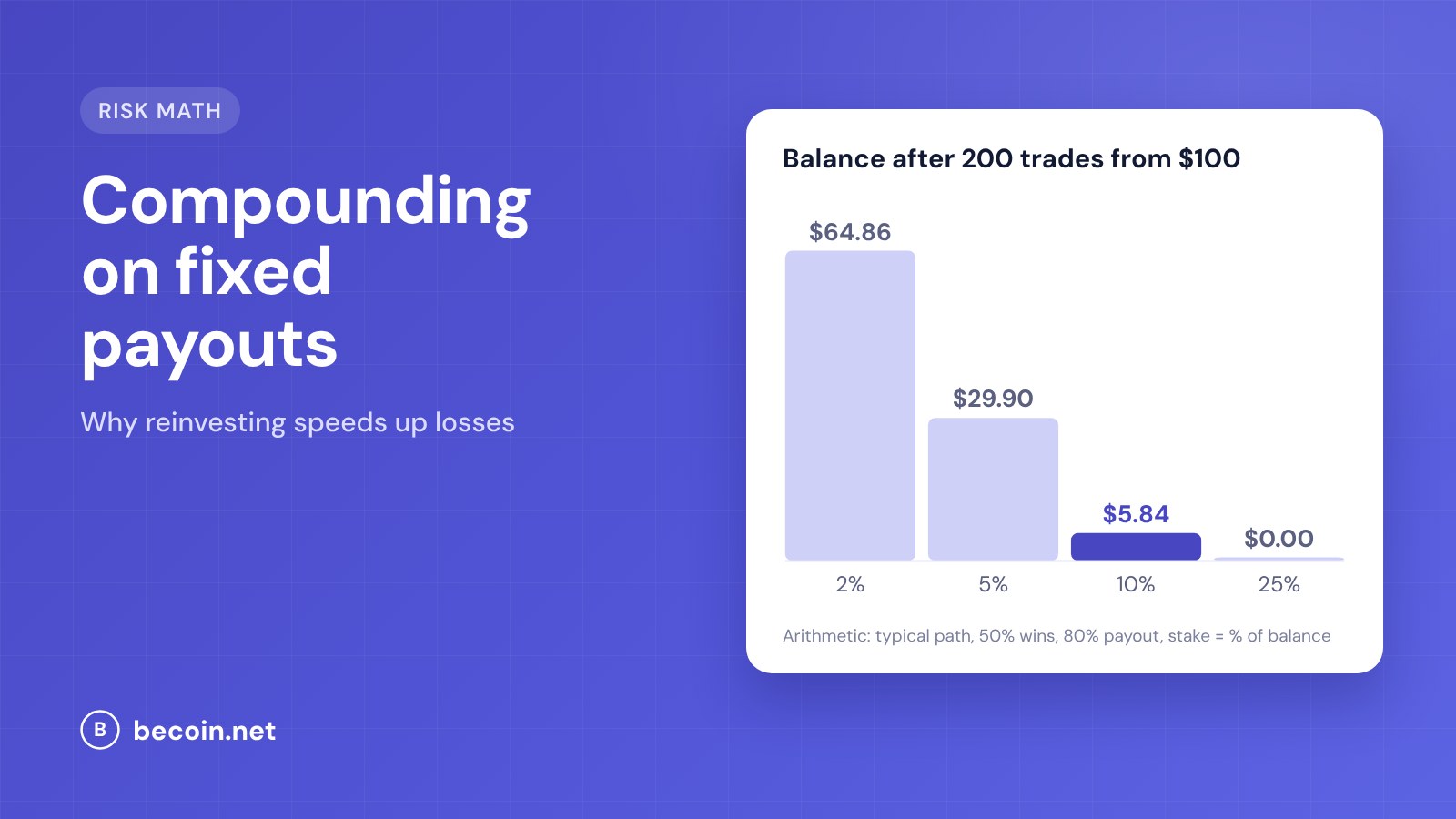
At a coin-flip win rate, a 2% stake leaves a typical $64.86 of $100 after 200 trades. A 10% stake leaves $5.84. A 25% stake leaves less than one cent.
There is one honest point in favour of a small fixed fraction. Because stakes shrink as the balance falls, the losses slow down in dollars. That is damage control, not growth.
A fixed $5 stake from $100 has an average loss of $0.50 per trade at 50% wins, or the whole $100 over 200 trades. A 2% fraction loses less in dollars because its stakes get smaller. Neither makes money.
All-in chains: reinvesting the whole payout
The most common "compounding" demo reinvests the stake plus the full profit on the next trade. At a 90% payout, $10 becomes $19, then $36.10. The arithmetic is right; the risk is that one loss ends the chain.
Balance after k straight wins = stake × (1 + payout)^k
Chance of k straight wins = p^k
| Wins in a row | Balance if all win | Chance at 50% wins | Chance at 60% wins |
|---|---|---|---|
| 1 | $18.00 | 50.0% | 60.0% |
| 3 | $58.32 | 12.5% | 21.6% |
| 5 | $188.96 | 3.1% | 7.8% |
| 8 | $1,102.00 | 0.4% | 1.7% |
The balance grows by 1.8× per step, while the chance of getting there falls by 0.5× per step at a coin flip. Multiply them: 1.8 × 0.5 = 0.9. Each extra step keeps 90% of the value on average, a 10% loss per step.
So a longer chain does not raise the average result. It makes the rare win bigger and the common outcome, losing the whole first stake, more likely.
How often losing streaks happen
Any compounding rule has to survive losing streaks. Long streaks are much more common than intuition suggests once many trades are placed.
| Trades placed | 4+ losses | 5+ losses | 6+ losses | 8+ losses |
|---|---|---|---|---|
| 20 | 47.8% | 25.0% | 12.2% | 2.7% |
| 50 | 82.7% | 55.2% | 31.5% | 8.4% |
| 100 | 97.3% | 81.0% | 54.6% | 17.0% |
| 200 | 99.9% | 96.6% | 80.1% | 32.0% |
Even a hypothetical 55% win rate (45% losses) has a 64.7% chance of a 5-loss streak and a 36.3% chance of a 6-loss streak within 100 trades.
The number of straight losses needed to halve a balance depends only on the stake share: about 35 at 2%, 14 at 5%, 7 at 10% and 3 at 25%.
Losses to halve = ln(0.5) ÷ ln(1 − f)
f = 10%: ln(0.5) ÷ ln(0.9) = 6.6 → 7 losses
Fixed fraction vs martingale
A fixed fraction cuts the stake after a loss. Martingale does the opposite: it raises the stake so that the next win recovers all earlier losses plus the first target.
With a payout below 100%, doubling is not enough. Each stake must be (1 + 1 ÷ payout) times the last one: 2.25× at an 80% payout.
| Trade after losses | Stake | Total staked so far | Chance of reaching this step (50% wins) |
|---|---|---|---|
| 1st | $5.00 | $5.00 | 100% |
| 3rd | $25.31 | $41.56 | 25.0% |
| 5th | $128.14 | $226.66 | 6.25% |
| 6th | $288.33 | $514.99 | 3.13% |
| 8th | $1,459.65 | $2,623.36 | 0.78% |
Every win in the sequence only nets the first target, $4. A run of six losses in a row costs $514.99, and the table above shows such a run has a 54.6% chance within 100 coin-flip trades.
Martingale also leaves the expectancy unchanged. Each $1 staked still loses $0.10 on average at a 50% win rate and 80% payout. Raising stakes raises the total staked, so it raises the average loss in dollars.
| Rule | Stake after a loss | Effect on expectancy | Main risk |
|---|---|---|---|
| Fixed dollar stake | Same | None | Steady loss if win rate is below break-even |
| Fixed fraction | Smaller | None | Volatility drag; large shares shrink the balance |
| All-in chain | Chain ends | None | One loss wipes out the chain |
| Martingale (2.25× at 80%) | Much larger | None | A short streak exhausts the balance |
For more on stake rules, see binary options money management rules.
Risk of ruin by stake size
A pure fixed fraction never reaches exactly zero, because each stake is a share of what is left. In practice, minimum trade sizes and a falling balance end the account long before that.
A more useful test is the chance of losing half the balance. The chart shows the exact probability of falling to 50% of the start at any point within 200 trades.

| Stake (% of balance) | 50% win rate | 60% win rate (hypothetical) |
|---|---|---|
| 2% | 19.5% | 0.0% |
| 3% | 57.1% | 0.6% |
| 5% | 87.0% | 6.9% |
| 10% | 98.3% | 36.3% |
| 20% | 99.9% | 76.1% |
At a coin-flip win rate, the question is when the balance halves, not whether. A 1% stake avoids it within 200 trades (about 0.01%), but over 500 trades the chance rises to about 23%.
Model other thresholds with the risk of ruin calculator.
A worked example (hypothetical)
The numbers below are made up to show the method. They are not real results and not a target.
Two hypothetical accounts start with $100 at an 80% payout and place the same 20 trades. Account A stakes a fixed $5. Account B stakes 5% of its current balance, so it starts at $5 too.
Account A: $100 + wins × $4 − losses × $5
Account B: $100 × 1.04^wins × 0.95^losses
| Wins / losses | Win rate | A: fixed $5 | B: 5% of balance |
|---|---|---|---|
| 10 / 10 | 50% | $90.00 | $88.63 |
| 11 / 9 | 55% | $99.00 | $97.02 |
| 12 / 8 | 60% | $108.00 | $106.22 |
| 14 / 6 | 70% | $126.00 | $127.29 |
For account B, the order of wins and losses does not change the final balance; only the counts matter. The account still ends below account A unless the win rate is far above break-even.
Over 20 trades, compounding at 5% only beats the fixed stake at the 70% row. Over 200 trades at a hypothetical 60%, the two end close together: about $180 for the fixed stake and a typical $182.76 for 5%.
The lesson: compounding is not a source of profit. It amplifies whatever edge exists, and with no edge it amplifies the loss.
Why "10% a day" tables mislead
Compounding tables online often promise a daily percentage gain. The arithmetic is simple and looks convincing: $10 compounded at 10% a day for 60 days is $10 × 1.1^60 = $3,044.82.
The table only assumes the result. It contains no win rate, no payout and no losing days. Given the break-even math above, a 10% daily gain on fixed-payout trades would need a large, stable edge that no table shows.
A useful test for any compounding plan: does it state the win rate, payout and stake share, and show what happens after a 5-loss streak? If not, it is a projection, not a strategy.
To see how ordinary compounding works with a stated rate, use the compound interest calculator.
What regulators say about Quotex
Quotex's own websites (qxbroker.com, quotex.com) could not be checked for this update on 20 Nov 2026. So this article does not quote its payouts, legal entity or list of restricted countries.
Published regulator warnings that name Quotex include:
- CNMV (Spain), 28 June 2021. Warning that quotex.io/es, QUOTEX LTD and AWESOMO LTD are not authorised to provide investment services in Spain.
- CMVM (Portugal). Warning on "Quotex/Maxbit LLC and Quotex/Awesomo Ltd" and sites including quotex.com, qxbroker.com and quotex.io: "not authorised to carry out any type of financial intermediation activity in Portugal". Shared on Norway's Finanstilsynet investor alerts list on 9 Jan 2023.
- SECP (Pakistan), 9 April 2025. Press release stating that "Quotex is NOT authorized to operate in Pakistan" and naming qxbroker.com and its Play Store app.
The wider rules apply too. In 2018 ESMA cited binary options' "structural expected negative return and embedded conflict of interest between providers and their clients" when it agreed to prohibit retail sales in the EU.
The FCA made its UK ban permanent from 2 April 2019. Its executive director Christopher Woolard called binary options "gambling products dressed up as financial instruments".
Check your own regulator's register and warning list before dealing with any firm. BeCoin's methodology explains how we source these checks.
Checklist
- Is the product legal where you live, and is the firm on your regulator's register?
- What is the break-even win rate, 1 ÷ (1 + payout), at the payout actually received?
- Is there a measured win rate above that line, from a large sample of one method?
- Is the stake share below the Kelly stake, and well below the point where growth turns negative?
- How many straight losses would halve the balance at this stake share?
- Does the plan raise stakes after losses? If so, it is martingale, not compounding.
- Does any compounding table show a win rate, payout and losing streaks, or only a daily target?
- Is this money you can afford to lose in full?
FAQ
What is the compounding strategy in Quotex?
It means staking a share of the current balance, or reinvesting each payout, so stakes grow after wins. It changes the size of results, not their sign. Below a 55.6% win rate at an 80% payout, it loses money.
Does compounding work on binary options?
Only if the true win rate is above 1 ÷ (1 + payout) after costs, and the stake share is small. With a negative expectancy, compounding shrinks the balance faster as the stake share grows.
What percentage of the balance should be staked per trade?
No stake share makes a negative expectancy positive. With a hypothetical 60% win rate at 80%, growth peaks at a 10% stake and turns negative above about 19.8%. At 50% wins, the Kelly answer is zero.
Is compounding the same as martingale?
No. Compounding raises stakes after wins; martingale raises them after losses. At an 80% payout, martingale needs 2.25× the last stake, so six losses from a $5 start cost $514.99.
How fast can $10 grow with compounding on Quotex?
Arithmetic alone says $10 at 10% a day for 60 days is $3,044.82. That figure assumes the outcome. At a 50% win rate and 80% payout, every compounding stake size shrinks the balance over time.
Is Quotex regulated?
We could not load Quotex's own site to check its stated licences. Spain's CNMV, Portugal's CMVM and Pakistan's SECP have published warnings that Quotex entities are not authorised in their countries.
Bottom line
Compounding on fixed-payout trades multiplies results; it does not create them. The break-even win rate is 1 ÷ (1 + payout), 55.6% at an 80% payout.
Below that line, every stake share shrinks the balance, and bigger shares shrink it faster. Even above it, staking too much turns growth negative.
All-in chains and martingale only rearrange the same negative average. Regulators in the UK and EU ban binary options for retail clients, and several have warned about Quotex by name.