
EUR/USD Holds Below 1.1600 as Middle East Tensions Meet a Resilient Dollar
- EUR/USD trades near 1.1565, capped below the 1.1600 barrier as Middle East risk and a firm US dollar offset supportive Eurozone data.
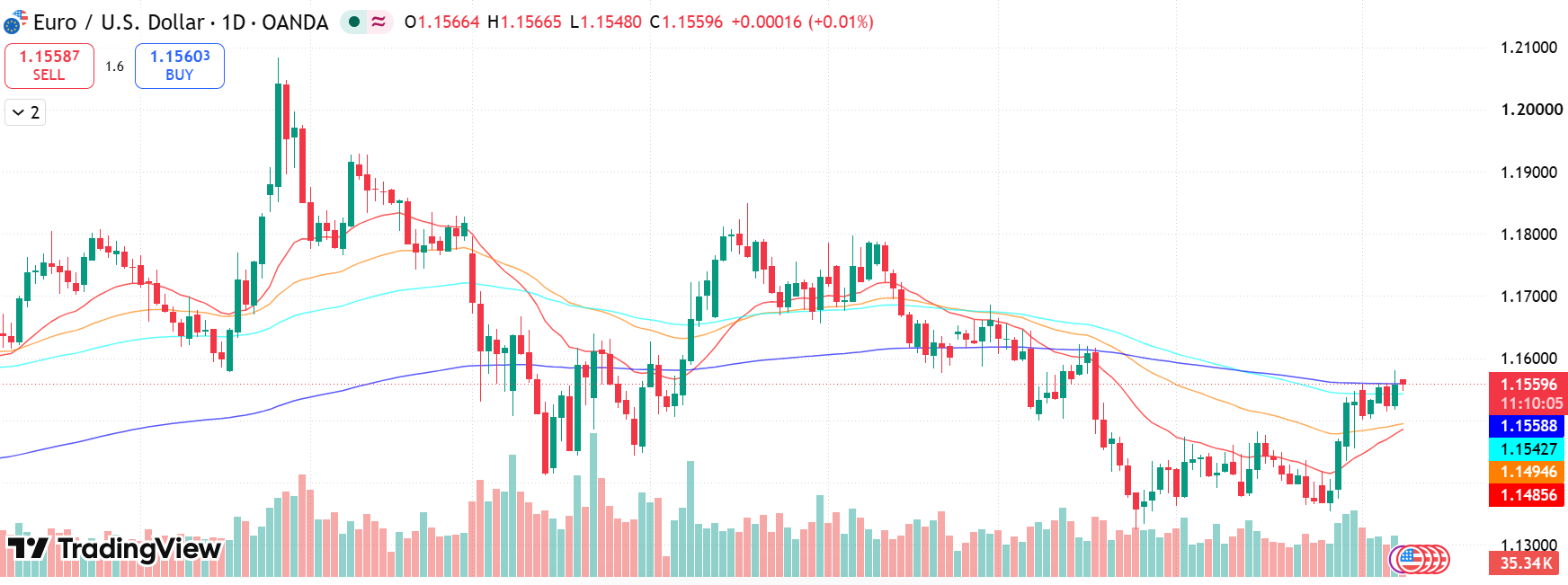
- Chart shows price back above its 10-, 20- and 30-period moving averages, even though it still sits below the 100- and 200-day averages on the daily chart.
- A confirmed daily close above 1.1600 opens the path toward 1.1715, while a slip under 1.1480 would hand the near-term initiative back to dollar bulls.
Fundamental Analysis
EUR/USD enters the new week under pressure from two competing forces. Renewed Middle East tensions have kept a bid under the US dollar as a traditional safe haven, while a steady stream of firm US data has trimmed expectations for near-term Federal Reserve rate cuts. That combination has capped the euro's advance just below the psychologically important 1.1600 level, even as the pair has clawed back its early-week losses.
Safe-Haven Flows and Dollar Strength
Geopolitical risk premia tend to favor the dollar over the euro, and the current backdrop is no exception. As long as headlines out of the Middle East keep sentiment fragile, dollar demand should stay structurally supported, which is one reason EUR/USD has struggled to build real momentum above 1.1600 despite several attempts this month. Traders should treat any escalation headline as a potential catalyst for a fast, sentiment-driven drop toward the 1.1480 support band.
Eurozone Data and the Fed-ECB Policy Gap
On the other side of the ledger, Eurozone data has been resilient enough to keep the European Central Bank from signaling additional easing, which limits how far the pair can fall on rate-differential grounds alone. The policy gap between the Fed and the ECB is narrower than earlier in the cycle, and that narrowing is a key reason EUR/USD has held a higher range this year than in prior years. Unless US data surprises meaningfully to the upside, the fundamental backdrop looks more like a tug-of-war than a one-way dollar trend.
Technical Analysis: What the Chart Show
Pulling up the EUR/USD chart confirms the fundamental tug-of-war. The pair trades around 1.1565, comfortably above its 10-, 20- and 30-day moving averages, which points to a constructive short-term trend. The 100- and 200-day simple moving averages sit higher, meaning the broader trend picture stays mixed until price clears those longer-term benchmarks convincingly.
Key Levels to Watch
The 1.1600 handle is the level to beat. It roughly aligns with the classic daily pivot resistance zone and has rejected several intraday attempts. A confirmed close above it would put the 1.1670-1.1715 supply zone in view. On the downside, the 1.1480-1.1500 area lines up with a rising short-term moving average and the first pivot support, making it the first meaningful floor; a break below it would expose the 1.1280 region.
Momentum and Moving Averages
The 14-day RSI is reading in the low 60s on the daily chart, comfortably inside neutral-to-bullish territory without flashing overbought conditions, which leaves room for further upside before momentum becomes a headwind. The MACD line sits marginally positive, and the faster-reacting Hull moving average has already turned higher, often an early signal that short-term momentum is building before slower moving averages confirm it.
Trading Takeaways
For traders, the setup argues for a level-based approach rather than a directional bet. A break and hold above 1.1600 on rising volume would justify scaling into a long position targeting 1.1715, with a protective stop placed below the breakout point. Conversely, a rejection at 1.1600 followed by a slide under 1.1480 would favor short setups back toward 1.1280. Because the geopolitical catalyst can reverse on a single headline, position sizing should stay smaller than usual, and traders should avoid holding large directional exposure into major news windows. For a deeper look at how this pair is behaving inside its broader range.
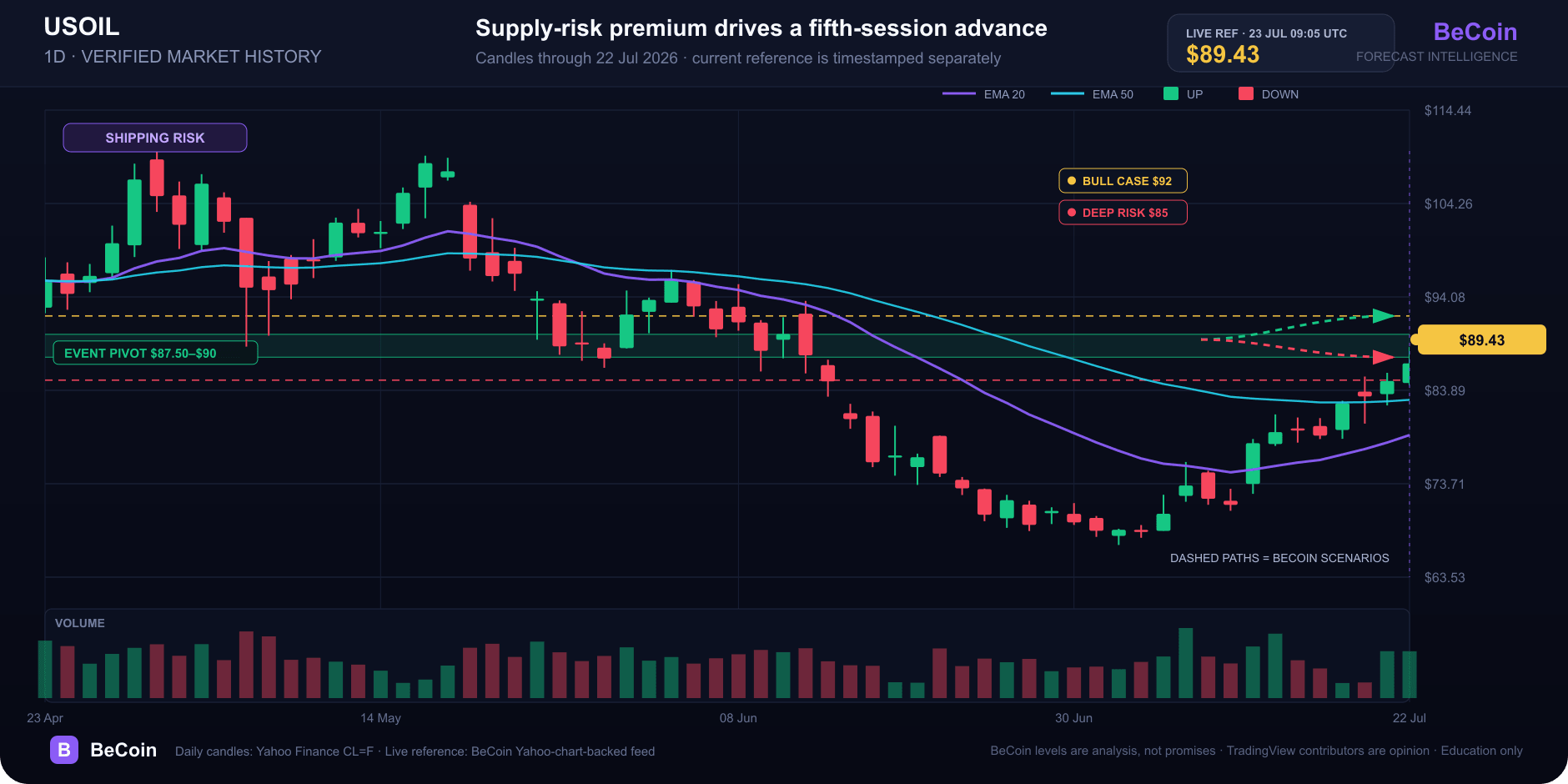
WTI reaches $89.43 as Brent clears $95 on renewed supply risk
WTI traded near $89.43 while Brent moved above $95 as Middle East shipping risk lifted crude for a fifth session. Key levels, catalysts and invalidation.
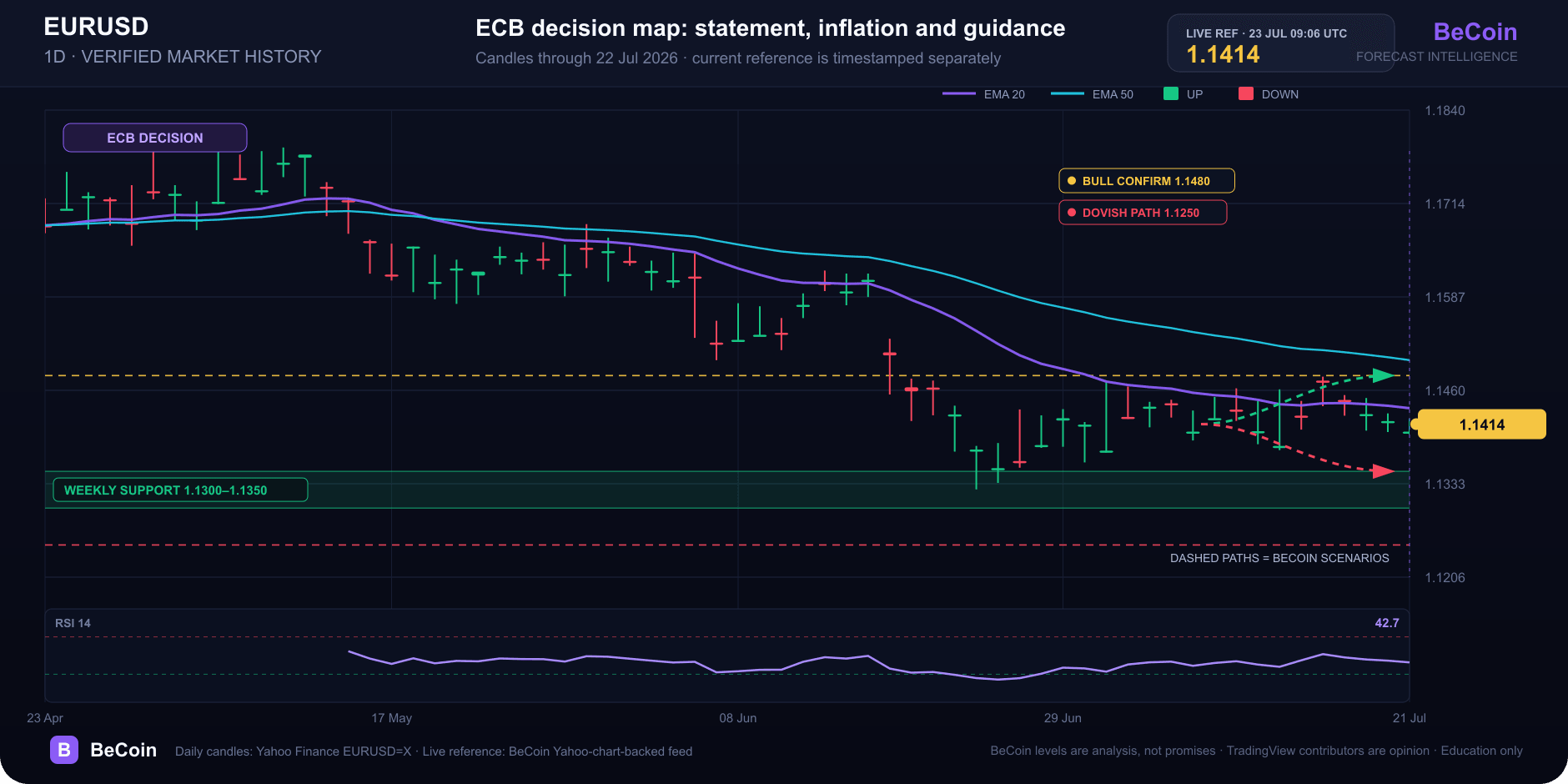
EUR/USD holds 1.1414 before the ECB decision: three scenarios
EUR/USD traded near 1.1414 before the ECB’s July decision. Here is what a hold, hawkish hold or surprise hike could mean for 1.1350 and 1.1480.

Trading Currency Strength Instead of Single Pairs
It was a Tuesday afternoon when I realized I was fighting a losing battle against a ghost. My screen was a chaotic web of indicators. I had the EUR/USD chart open, a moving average crossing over here, a relative strength index flashing oversold there, and a price action setup that looked textbook perfect. I clicked […]

Which Broker Is Better for Weekend Trading?
It was a chilly Saturday morning, and while the rest of the world was sleeping in or catching up on shows, I was staring at a completely frozen screen. My usual EUR/USD chart looked like a heart monitor flatlining. The traditional markets were closed. The banks were shut down. For a long time, that was […]

IQ Option vs Deriv Chart Comparison
The Night I Realized My Charts Were Lying to Me It was three in the morning, the exact hour when the market looks either like a goldmine or a psychological hazard. I was sitting in front of two monitors, a lukewarm mug of coffee in hand, watching a critical support level on EUR/USD. On my […]

Best Trading Platform for Slow Internet in 2026
A slow internet connection can ruin trades faster than a bad strategy. Charts freeze, apps reload, and delayed execution creates unnecessary losses. This is especially common for traders using mobile data, shared WiFi, or older smartphones. Most broker reviews ignore this issue completely. After testing multiple platforms on weaker connections and low-end Android devices, some […]