Crude Rises While Refining Margins Fall — What the Split Could Mean
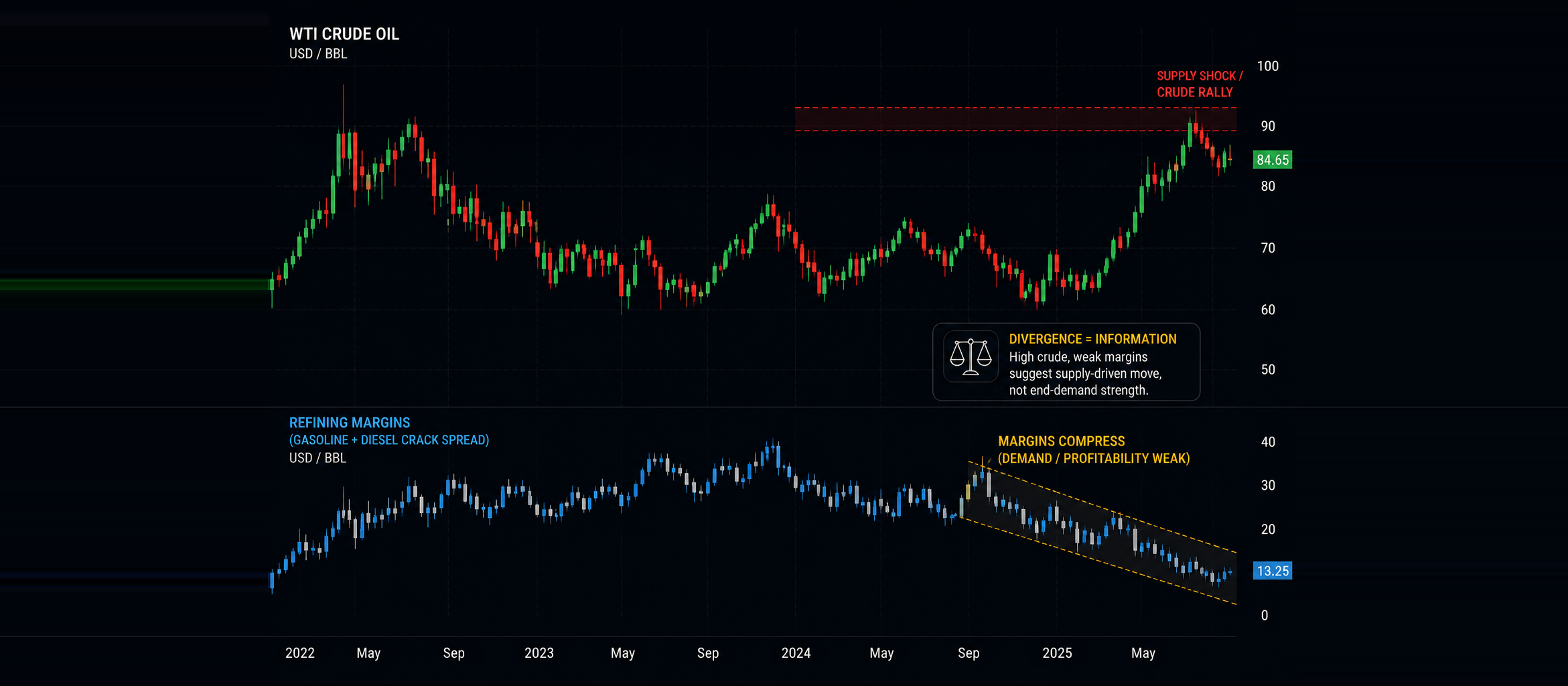
Crude oil gets the headlines, but crude is an input rather than a product. Nobody consumes it directly. What the world actually buys is diesel, gasoline, jet fuel and the petrochemical feedstocks derived from them. So when the price of the input rises while the profitability of turning it into products falls, the two halves of the market are telling different stories, and the disagreement is more informative than either price alone.
What refining margins measure
The margin, usually expressed through crack spreads, is the difference between the value of refined products and the cost of the crude used to make them. A widely quoted version compares one barrel of crude against a weighted basket of gasoline and distillate. Because refiners can slow runs when processing becomes unprofitable, the spread is a reasonably direct read on demand for finished fuels. It also reflects refining capacity available at a given moment, which is why maintenance schedules and unplanned outages move it independently of crude.
Why the two can move apart
The most common explanation is that the crude rally is supply-driven rather than demand-driven. If a production cut, sanctions decision or geopolitical disruption removes barrels, crude can rise while end demand for fuel is unchanged or weakening. Refiners then face a higher input cost they cannot pass on, and the spread compresses. A second explanation is a shift in product mix, where strength in one fuel masks weakness in another. A third is capacity: newly commissioned refining capacity can compress margins globally even when crude and product demand are both healthy.
What the divergence tends to imply
Historically, a supply-driven crude rally accompanied by falling margins has been the less durable configuration, because the price increase is not validated by consumption. Sustained rallies have more often been accompanied by firm or widening spreads, which indicates that end users are absorbing higher costs. That said, the relationship is not mechanical, and margin weakness caused purely by new capacity coming online carries a very different meaning from margin weakness caused by falling diesel demand. Distinguishing between those two is the analytical work.
The data that resolves it
Several inputs separate the explanations. Refinery utilisation rates show whether runs are being cut in response to the squeeze. Product inventories relative to seasonal norms show whether the weakness is demand or supply of products. Diesel specifically is the most economically sensitive of the major fuels, so its spread relative to gasoline often reveals whether industrial activity is slowing. Freight rates and crude quality differentials show whether the issue is logistical rather than fundamental. And the futures curve for both crude and products indicates whether the market expects the condition to persist. The Market Forecast Hub is a practical place to compare these series against price.
What would invalidate the reading
The divergence loses meaning in a few situations. If margin weakness is concentrated in a single region undergoing a capacity build, it describes local economics rather than global demand. If a temporary outage has removed refining capacity, the spread can move sharply for reasons unrelated to consumption. And if the crude benchmark being compared is not the grade those refiners actually process, the calculated spread is measuring a relationship that does not exist operationally. Checking regional detail before drawing macro conclusions is essential.
Becoin.net Tariff Plans ---> Here
Using the split as context
The purpose of watching this relationship is to understand what kind of oil market is in front of you: one where price is being pushed by scarcity, or one where it is being pulled by consumption. That distinction changes how durable a move is likely to be. It is not a trade recommendation, and this article contains no entries, targets or advice about positioning in energy markets.
EUR/USD holds 1.1414 before the ECB decision: three scenarios
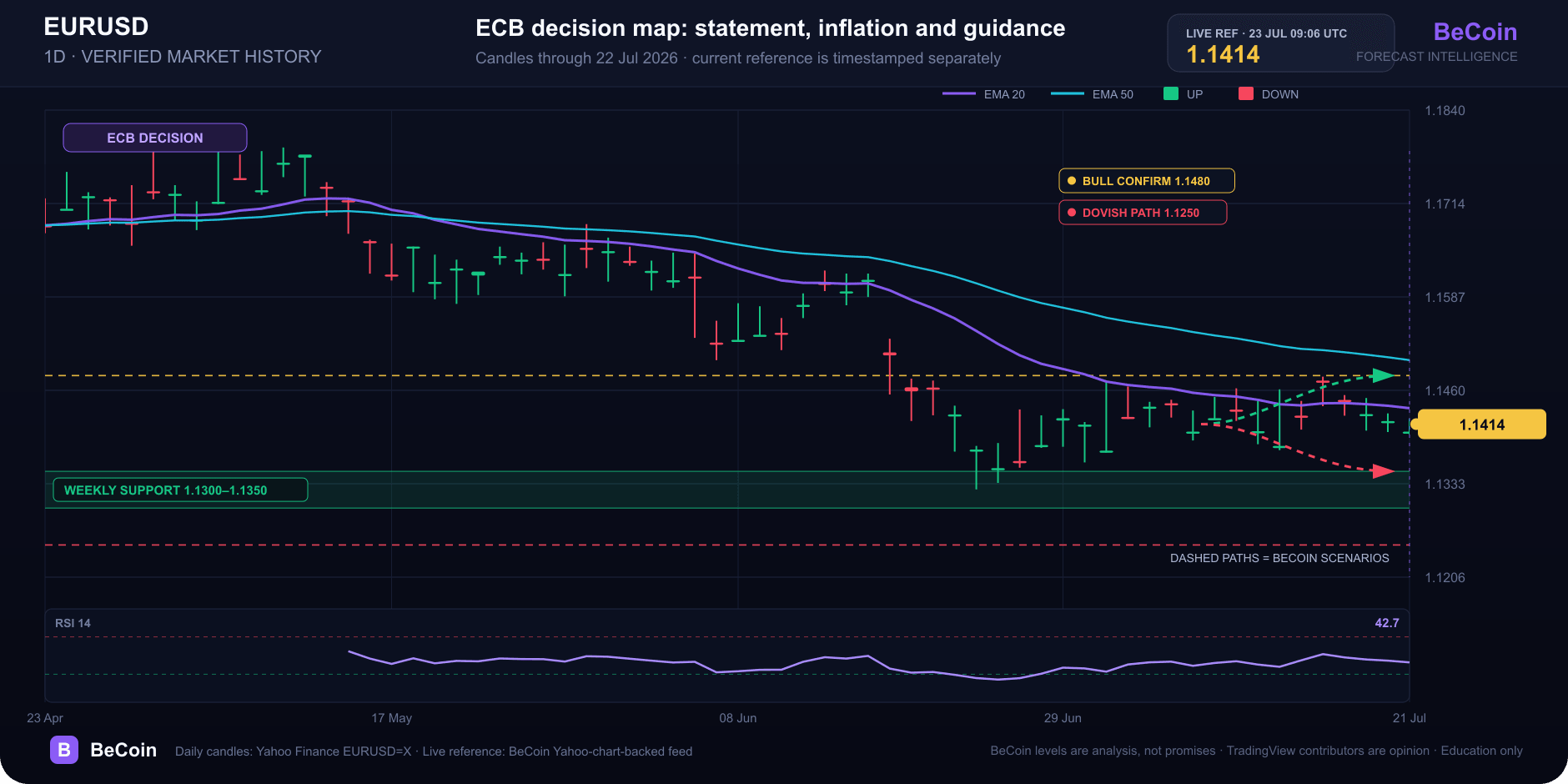
EUR/USD traded near 1.1414 before the ECB’s July decision. Here is what a hold, hawkish hold or surprise hike could mean for 1.1350 and 1.1480.
Bitcoin slips to $65,741 as oil and yields test the breakout
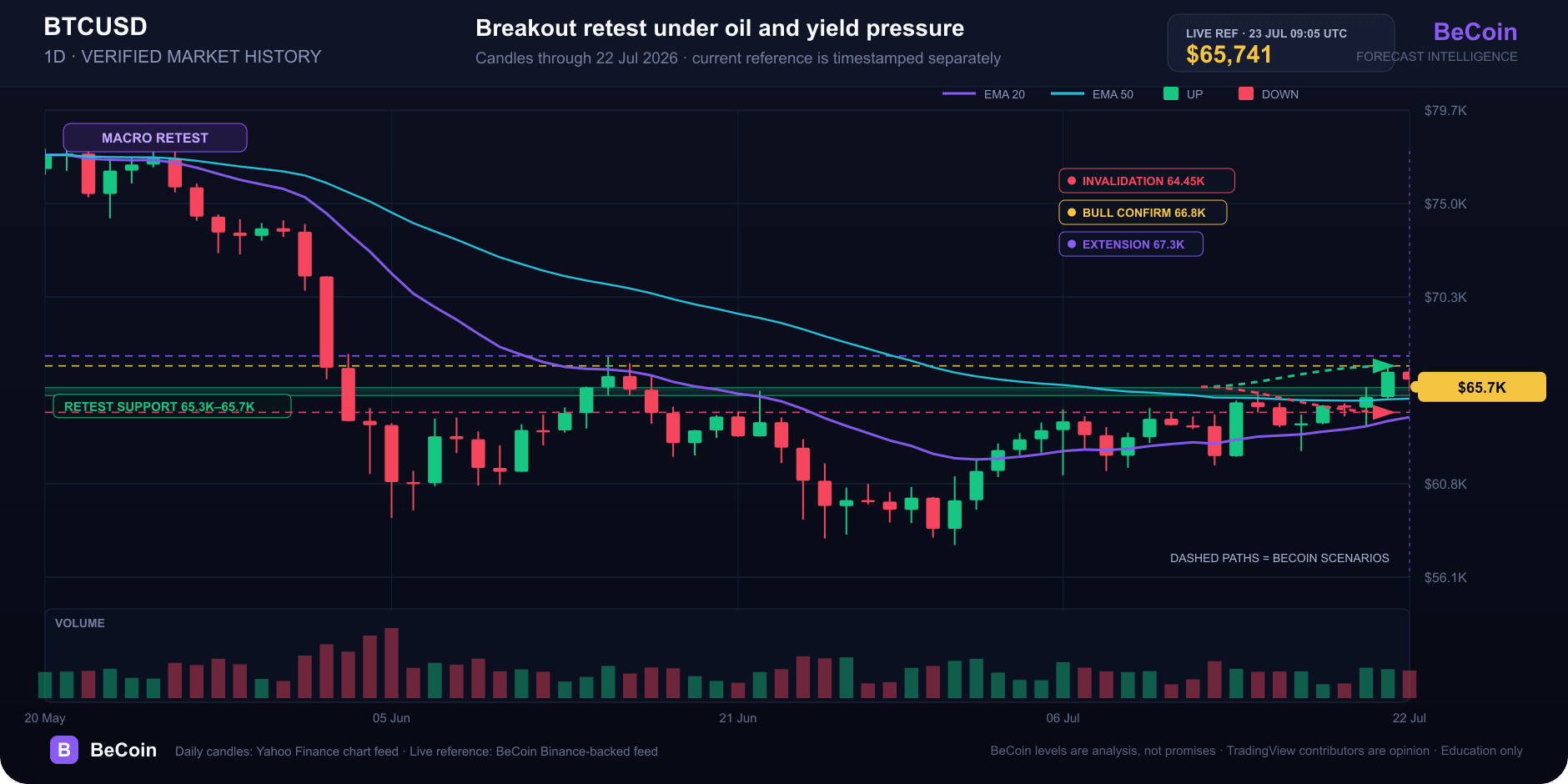
Bitcoin is near $65,741 as rising oil and Treasury yields test the $65.7K breakout floor. Here are the levels that confirm or invalidate the move.

Capital Core Verification Process Explained: KYC, Restrictions, and Withdrawal Delays
I learned something the hard way with offshore-style brokers: the smoothest part is usually opening the account, funding it, and placing the first few trades. The real test starts when you try to move money back out. That’s exactly why I wanted to document the Capital Core verification process from a trader’s perspective, not from […]
WTI reaches $89.43 as Brent clears $95 on renewed supply risk
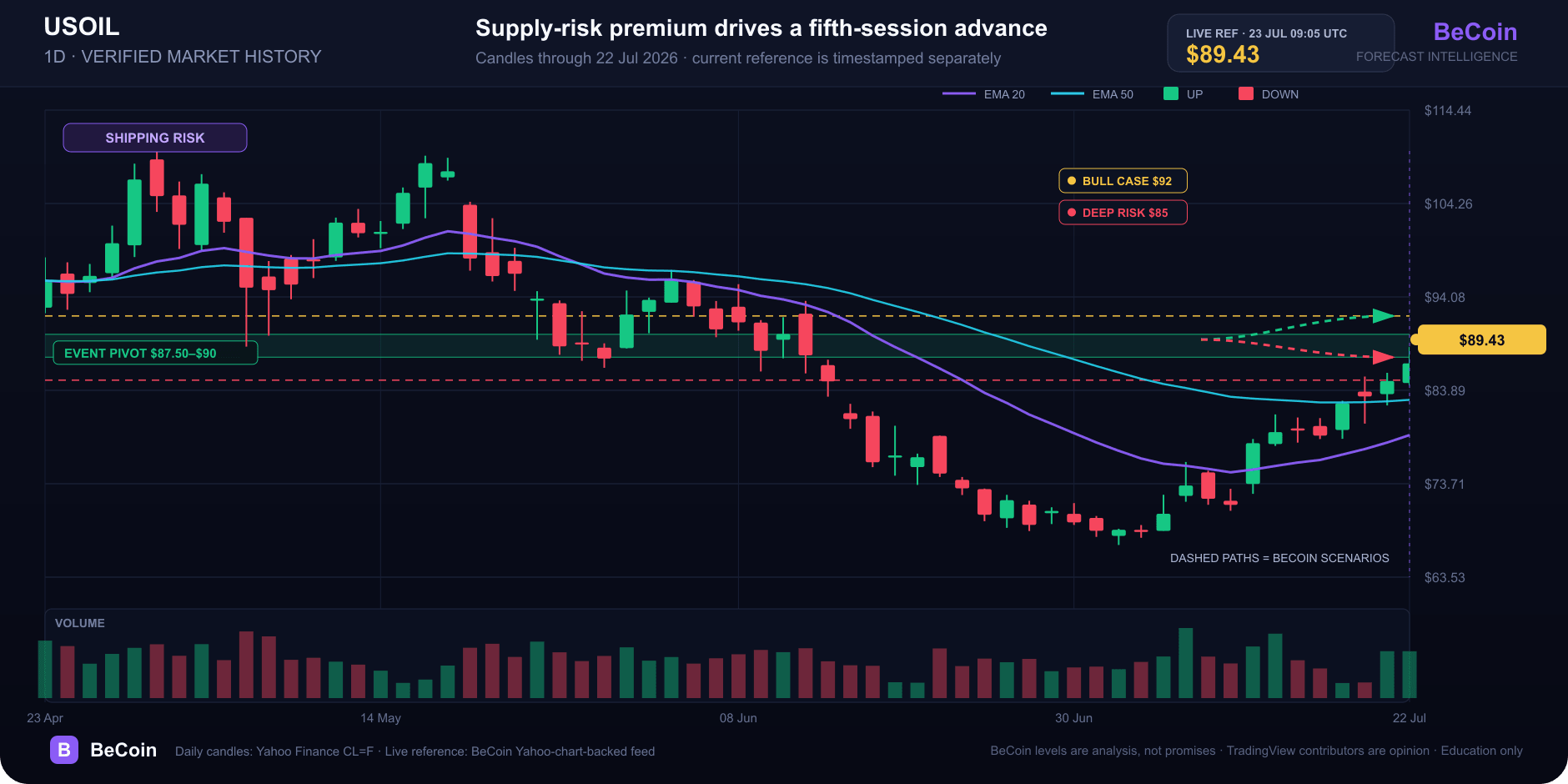
WTI traded near $89.43 while Brent moved above $95 as Middle East shipping risk lifted crude for a fifth session. Key levels, catalysts and invalidation.

Trading Currency Strength Instead of Single Pairs
It was a Tuesday afternoon when I realized I was fighting a losing battle against a ghost. My screen was a chaotic web of indicators. I had the EUR/USD chart open, a moving average crossing over here, a relative strength index flashing oversold there, and a price action setup that looked textbook perfect. I clicked […]

The Clock and the Cash: My Journey into the Hidden Rhythm of Session-Based Trading
There was a time when I thought the global financial market was a single, monstrous wave that never stopped moving. I believed that if I sat in front of my monitors long enough, clicking buttons whenever a pretty pattern appeared on my charts, the market would eventually reward my sheer endurance. I was dead wrong. […]