
Capital Core for US Traders: Can Americans Use It Safely?
I’ll be honest: when I first started digging into Capital Core for US traders, I wasn’t looking for hype. I was looking for a boring answer.
Can I sign up from the US?
Can I actually trade?
And the real question nobody asks loudly enough: if I win, can I withdraw without drama?
That last one matters more than everything else.
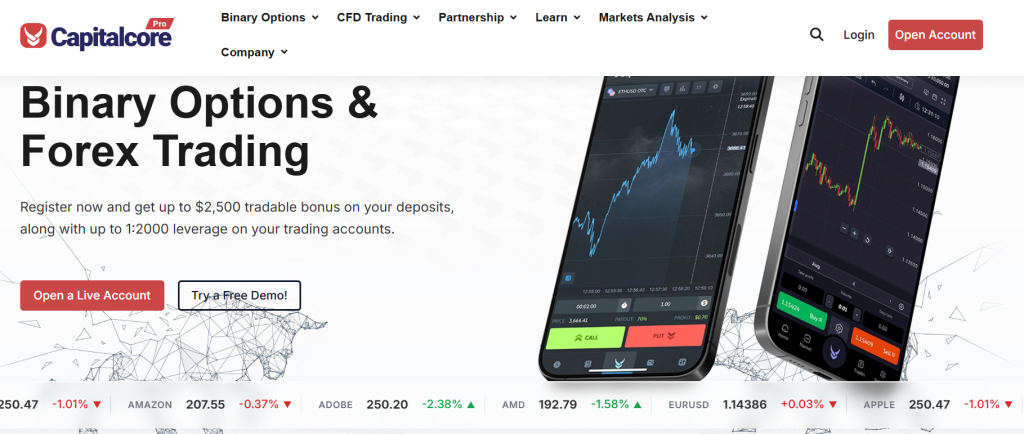
Most of the top search results about Capital Core either stop at surface-level broker specs or fall into the same lazy pattern: minimum deposit, leverage, bonus, asset list, “is it legit,” done. The problem is that US traders need a different lens. The question is not just whether Capital Core exists or whether it offers day trading and CFDs. The question is whether an American can use it without misunderstanding the legal, regulatory, and practical risks.
That’s the gap I want to close here.
This is the article I wish I had when I first looked at Capital Core for US traders. Not a sales page. Not a scare piece. Just a realistic breakdown of what I’d do, what I’d avoid, and how I’d test the platform before trusting it with real money.
If you want to test the platform the same way I do, start small and treat it like a live audit, not a “big opportunity.” You can open a small account here: Open a Capital Core account
My first reaction when I checked Capital Core from a US-trader perspective
The first thing that caught my attention was that Capital Core openly markets day trading, CFDs, high leverage, and low minimum deposits, which immediately tells me this is not operating like a US-regulated exchange-style platform. On its own website, Capital Core currently advertises account minimums starting at $10, leverage up to 1:2000 for CFD-style accounts, and a separate options platform with minimum position sizes as low as $1.
That’s not automatically good or bad. It just tells me exactly what bucket this belongs in:
- Offshore broker model
- Retail-friendly onboarding
- High-risk products
- Different rules than what US traders get domestically
That distinction matters because many US traders still assume “if a broker accepts me, it must be fine.” That’s not how this works.
The first lesson I learned: “accessible” is not the same as “protected”
A lot of American traders confuse access with safety.
Yes, several third-party reviews and broker roundups currently list Capital Core among platforms that accept US clients, and even rank it as one of the day trading brokers used by Americans.
But that does not mean:
- It is regulated in the United States
- It offers the same legal protections as a US exchange
- You have the same dispute resolution options you’d expect from a US-regulated financial firm
That was the first mental reset I had to make.
So if you’re searching Capital Core for US traders, here’s the clean version:
Yes, Americans appear able to open and use the platform.
No, that does not mean Americans are using a US-regulated product.
That single distinction is where most articles fail.
Can Americans actually use Capital Core?
From what I found, yes, US traders appear to be able to use Capital Core in practice.
Here’s why I say “appear” instead of making a lazy absolute statement:
- Capital Core’s own site presents a standard global signup flow and publicly uses a US phone contact while marketing broadly to retail traders.
- Multiple recent third-party broker comparison sites specifically list Capital Core as a broker accepting US clients.
- Community discussion on Reddit also reflects that traders in the day trading space view Capital Core as one of the offshore platforms accessible to Americans.
That said, I never treat third-party “accepts US clients” claims as final truth. Broker policies can change quietly. That’s why if I were testing this today, I’d do it in this order:
- Open the account
- Complete KYC immediately
- Confirm funding methods available to a US resident
- Make a tiny deposit
- Make a few small real trades
- Request a small withdrawal before scaling anything
That last step is where trust starts.
The real issue: Capital Core is not the same as a US-regulated day trading platform
This is where the article needs to be blunt.
When I looked at Capital Core for US traders, I had to separate two very different worlds:
1) The US-regulated model
Historically, US traders looking for binary-style exposure used exchange-structured products, where pricing, clearing, and oversight worked differently from the typical offshore OTC model. A current US binary trading guide makes this exact distinction: US-authorized binary contracts are exchange products, not the same as offshore OTC binaries.
2) The offshore broker model
Capital Core clearly fits the second category: an offshore-style retail broker offering short-expiry trading, CFDs, bonuses, and very high leverage. Its current public site structure, product menu, and account marketing all point in that direction.
That doesn’t mean “never use it.”
It means use the right expectations.
If you go in thinking this is equivalent to a US exchange, you’re already making a dangerous mistake.

My honest answer: Is Capital Core safe for US traders?
If someone asked me privately, “Is Capital Core safe for US traders?” my answer would be:
It can be usable, but I would never call it “safe” in the same way I’d describe a fully US-regulated venue.
That’s the most honest wording I can give.
Here’s how I personally frame it:
What makes it usable
- Low minimum deposit
- Platform appears accessible to US users
- Multiple asset classes
- Binary-style and CFD-style flexibility
- Small-size testing is possible because of low entry thresholds
What keeps it in the caution category
- It’s not operating as a mainstream US-regulated broker model
- High leverage increases blow-up risk fast
- Bonus offers can distort trader behavior
- Withdrawal confidence has to be proven by your own test, not marketing claims
- Offshore dispute resolution is weaker if something goes wrong
That last point is the one most people avoid because it kills the excitement.
But it matters.
What I’d do before trusting Capital Core with real money as a US trader
When I test any offshore broker, I do not start by asking “how much can I make?”
I start by asking “how easily can I leave?”
That mindset alone has saved me from dumb decisions.
My 5-step trust test for Capital Core
| Step | What I do | Why it matters |
| 1 | Open account with the smallest possible deposit | Proves US onboarding is actually functional |
| 2 | Complete KYC before serious trading | Avoids withdrawal surprises later |
| 3 | Place 5–10 tiny trades only | Tests execution and pricing feel |
| 4 | Request a small withdrawal early | This is the real broker test |
| 5 | Re-deposit only if withdrawal is smooth | Trust should be earned, not assumed |
This is the exact framework I’d use for Capital Core for US traders.
And if the withdrawal feels slow, confusing, inconsistent, or support starts giving vague answers, I stop there. No debate.

My biggest concern with Capital Core for US traders: people size up too fast
This is the pattern I see over and over:
- Trader finds a broker that accepts US clients
- Sees $10 minimum deposit
- Sees high payouts or leverage
- Deposits too much too early
- Wins a few trades
- Feels “validated”
- Then scales before a withdrawal test
- Then discovers the broker relationship was never truly tested
That’s not a Capital Core problem only. That’s a trader problem.
But Capital Core for US traders especially attracts this behavior because it feels easy to start.
And easy starts can create expensive overconfidence.
What top Google results usually miss about Capital Core for Americans
This is the content gap I noticed immediately.
Most reviews talk about:
- Deposit minimum
- Platform features
- Bonuses
- Asset list
- Leverage
- General legitimacy
What they rarely address properly is:
1) The difference between “available” and “regulated”
This is the most important point for Americans and it’s often buried or softened.
2) The withdrawal-first framework
Most reviews mention withdrawals as a feature, not as a trust test.
3) The legal-risk mindset
Even if a broker accepts US clients, that doesn’t mean the relationship carries the same legal comfort or dispute pathway as a domestic regulated venue.
4) Product structure matters
A US trader comparing offshore day trading to exchange-style binary contracts is not comparing like with like. A current US binary guide explicitly says the US-regulated binary structure differs from the OTC fixed-payout model common offshore.
5) Risk behavior is the real edge
The broker itself is only half the story. The other half is whether the trader sizes responsibly.
That’s why I think the better question is not “Can Americans use Capital Core?”
It’s “Can Americans use Capital Core without lying to themselves about the risk?”
My experience-driven rule: I ignore the bonus until the first withdrawal clears
Capital Core currently promotes deposit bonuses on its website, including up to $2,500 in tradable bonus language.
I’m not against bonuses in theory.
I just think most traders handle them badly.
Here’s my personal rule:
On a new offshore broker, I treat the bonus as irrelevant until I’ve completed:
- KYC
- Real trades
- One clean withdrawal
- Support response test
Until then, the bonus is just decoration.
This is especially important when reviewing Capital Core for US traders, because the wrong trader psychology goes like this:
“Broker gave me more capital, so I can size up.”
No.
The bonus does not reduce your broker risk.
It can actually increase it if it changes your behavior.
If you want to test Capital Core the disciplined way, open the smallest live account you can, skip the oversized first deposit, and run a withdrawal-first audit here: Start with a small Capital Core account
How I would actually trade Capital Core if I were in the US
If I were trading Capital Core from the US today, my operating rules would be strict.
Rule 1: I would only fund what I’m comfortable losing completely
That sounds harsh, but it’s the correct frame for any offshore short-expiry or leveraged platform.
Rule 2: I would not start with the “best” account type
Capital Core’s public account lineup currently ranges from lower-entry accounts to larger tiers like Silver, Gold, and VIP, with higher deposit thresholds and different spreads/bonus caps.
That sounds attractive. It is also how traders get trapped into overcommitting before they’ve proven the broker relationship.
I would start with the lowest-friction account possible.
Rule 3: I would not trade emotionally just because the broker allows it
Low minimums and easy access can create casino behavior if you’re not careful.
Rule 4: I would separate “broker test capital” from “strategy capital”
This is something I wish more traders did.
- Broker test capital = money used to test execution, funding, withdrawal, support
- Strategy capital = money used after the broker has already passed the trust test
Most people combine both and wonder why they get sloppy.
A realistic scenario: how I’d test Capital Core with $100 as a US trader
Let me make this practical.
If I wanted to evaluate Capital Core for US traders without doing anything reckless, I’d likely use a structure like this:
Phase 1: The broker test
- Deposit: $50 to $100
- Goal: Not profit
- Focus: Account flow, KYC, funding speed, platform behavior, payout consistency, withdrawal process
Phase 2: The micro-trade test
- Risk per trade: 1% to 2% of test capital
- Number of trades: 10 to 20
- No martingale
- No revenge entries
- No “I just need one more”
Phase 3: The exit test
- Withdraw a meaningful portion early
- Judge the experience by:
- Clarity
- Speed
- Support quality
- Any extra verification friction
Phase 4: The decision
If the withdrawal is smooth, only then I consider whether the platform deserves a larger allocation.
That’s it.
No drama. No guru behavior. No screenshots of fake growth curves.
What about Capital Core reviews saying it’s one of the best for US traders?
You’ll see that claim in some review sites. For example, one recent broker roundup lists Capital Core among the top day trading brokers accepting US clients, especially after changes in the US binary landscape.
I don’t dismiss that.
But I also don’t outsource my risk model to affiliate-driven rankings.
A broker can be:
- Popular
- Functional
- Widely used
- Even well-reviewed
…and still not be “safe” in the way a new US trader assumes.
That’s why I think the right phrasing is:
Capital Core may be a practical option for Americans who specifically want offshore-style short-expiry trading, but it should be treated as a controlled-risk tool, not a trust-first broker relationship.
That’s the adult version of the answer.
My honest take on regulation and why I never sugarcoat it
This is where I think a lot of reviews become dishonest.
If you’re talking about Capital Core for US traders, you cannot bury the regulation conversation under a paragraph about fast withdrawals and bonuses.
You have to say it clearly:
- Capital Core’s public positioning is not that of a mainstream US-regulated broker
- Its product structure is not the same as the US exchange-style binary model
- That changes the protection framework for Americans
Even community discussions reflect that experienced traders view offshore day trading brokers differently from CFTC-style US venues. Reddit conversations around Capital Core show exactly that tension: users acknowledge US accessibility, but they also explicitly flag the lack of US-style regulatory comfort as a reason to be cautious.
I don’t use Reddit as proof of truth.
I use it as proof of what real traders are worried about.
And the worry is valid.
So, should US traders use Capital Core?
Here’s my personal answer.
I think Capital Core can make sense for a specific type of US trader:
- You already understand offshore broker risk
- You’re not confusing access with protection
- You trade small and methodically
- You care more about withdrawal behavior than marketing
- You’re disciplined enough to stop if anything feels off
I do not think it makes sense if:
- You are brand new to short-expiry trading
- You need strong legal/regulatory comfort
- You tend to chase losses
- You use bonuses as a reason to size up
- You assume “it worked for others” means it will work for you
That’s the real dividing line.
My final verdict on Capital Core for US traders
If I had to summarize my full view in one paragraph, it would be this:
Yes, Capital Core for US traders appears to be a real and currently accessible option for Americans who want offshore-style day trading and CFD trading. But “can use” is not the same as “can use safely.” If you’re in the US, the only sensible way to approach Capital Core is with small initial funding, immediate KYC, a fast withdrawal test, zero emotional scaling, and a clear understanding that this is not the same protection model as a US-regulated venue.
That’s the truth I’d put in my own trading journal.
Not because it sounds exciting.
Because it keeps me honest.
And if I’m being completely transparent, that’s the only way I think Capital Core for US traders should ever be approached.
If you decide to test it, do it the disciplined way I’ve described: small deposit, real trades, early withdrawal, then scale only on evidence. If you want to start with that exact approach, here’s the account link: Open Capital Core with a small test deposit

Quick FAQs: Capital Core for US traders
Can Americans use Capital Core?
Based on current broker listings, community discussion, and Capital Core’s public-facing availability, yes, Americans appear able to use it.
Is Capital Core legal for US traders?
The practical answer is that US users appear to be accepted, but that does not make it equivalent to a US-regulated brokerage relationship. The bigger issue is regulatory protection, not just account access.
Is Capital Core safe for US traders?
I would call it usable with caution, not “safe” in the same sense as a US-regulated venue.
What is the safest way to test Capital Core from the US?
- Small deposit
- Finish KYC first
- Take a few real trades
- Request a withdrawal early
- Only scale after a smooth payout

Capital Core Account Types Explained: Which One Fits Your Trading Budget?
When I first started looking at Capital Core account types, I made the same mistake most traders make. I looked at the bonus first. Then I looked at the leverage. And only after that did I start asking the question that actually matters: Which account can I realistically manage without forcing trades just because I […]
Which Broker Has Faster Withdrawals? Real 2026 Comparison for Traders
When most beginners choose a broker, they focus on bonuses, signals, or flashy interfaces. But after trading for a while, you realize one thing matters more than almost anything else: How fast can you actually withdraw your money? A broker can look perfect until your first withdrawal request gets stuck in “processing” for three days. […]
Fastest Withdrawal Brokers (Real Test Results)
The first time I made a profitable trade, I wasn’t thinking about strategy anymore. I was thinking about one thing. Can I actually withdraw this? I requested my payout and waited. And waited. That “processing” label stayed there longer than my trade itself. That moment changed how I evaluate brokers. Since then, I’ve made it […]

$10 to $50 Trading Challenge – Strategy + Real Results (Case Study)
Turning $10 into $50 sounds easy until you actually try it. Small accounts expose every weakness in your trading. One bad decision can erase hours of progress, and emotional trading becomes much harder to control when every dollar matters. This case study breaks down how a $10 account was realistically grown to $50 using a […]

I Started with $10 on Quotex – Day 1 Results (Real Case Study)
Most beginner traders ask the same question:Can you actually grow a small account like $10? Instead of theory, I decided to test it in real conditions. This is a Day 1 case study of trading with $10 on Quotex, documenting everything from setup to execution, mistakes, emotions, and actual results. No hype, no fake screenshots, […]