Bitcoin Energy Consumption 2026: How Much Power It Uses
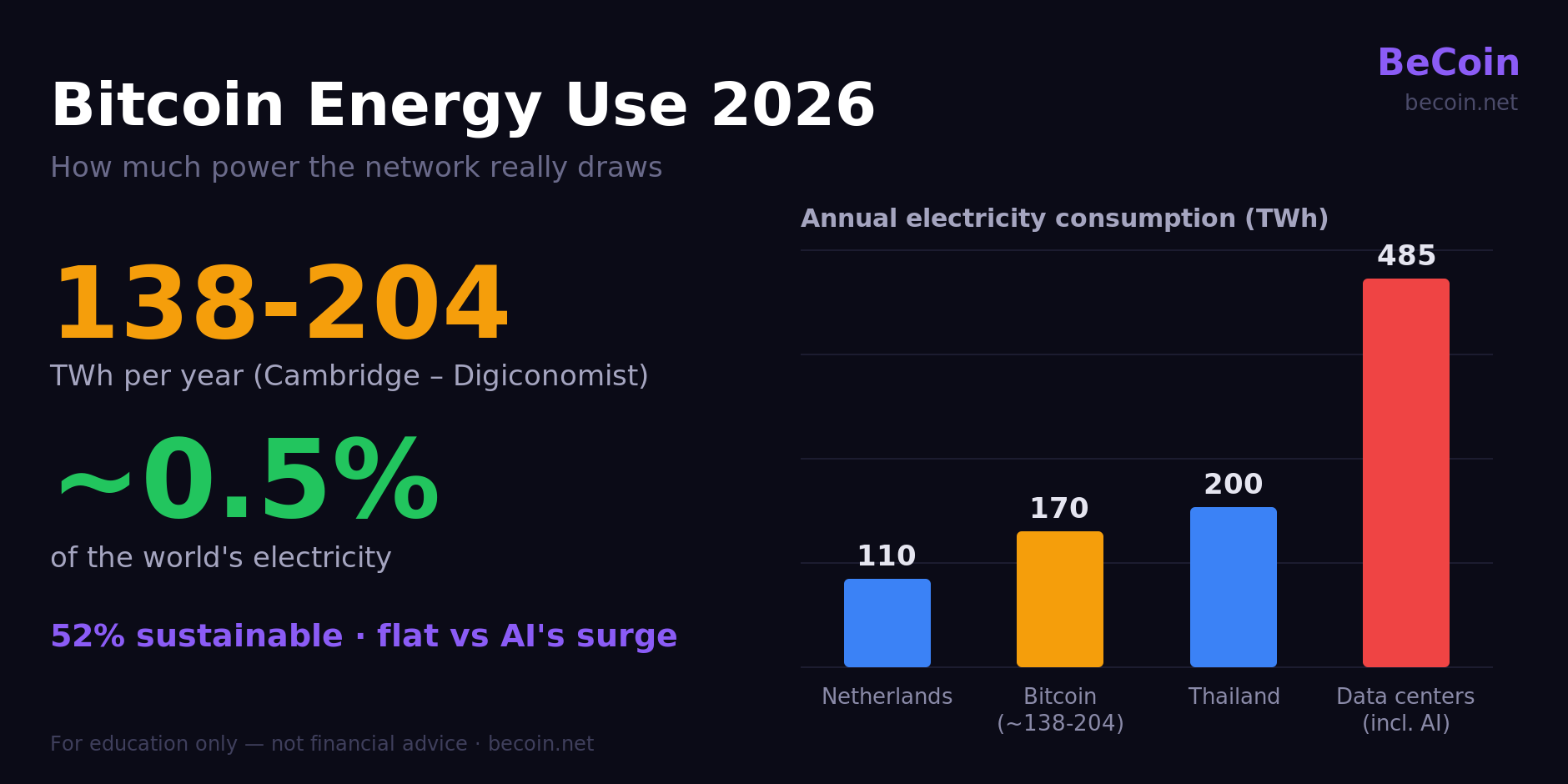
The Bitcoin network consumes an estimated 138 to 204 terawatt-hours (TWh) of electricity per year — roughly 0.4% to 0.7% of the world's total power generation, or about as much as a mid-sized country such as Thailand or the Netherlands. The lower figure comes from the University of Cambridge; the higher one from the Digiconomist index. Both are credible, and the gap between them is the most important thing most articles never explain. Here is the full 2026 picture — how much power Bitcoin really uses, why the leading estimates disagree, where the energy comes from, and how it now compares with the far faster-growing appetite of AI.
How much electricity does Bitcoin use?
There is no meter on the Bitcoin network, so its power draw has to be estimated. The two most-cited trackers arrive at very different numbers because they use different methods. The University of Cambridge's research team puts the annual figure near 138 TWh, while the independent Digiconomist index reads about 204 TWh. Both agree on the order of magnitude: Bitcoin uses roughly as much electricity in a year as an entire medium-sized nation.
| Estimate source | Annual electricity | Method | As of |
|---|---|---|---|
| Cambridge (CCAF) Digital Mining Report | ~138 TWh | Firm-level survey + hardware model | 2025 |
| Digiconomist Energy Consumption Index | ~204 TWh | Economic model (miner revenue) | Mid-2026 |
For scale, the entire world generates roughly 30,000 TWh of electricity a year, so even the higher estimate is well under 1% of the global total. Put another way, the Bitcoin network draws more power than the Netherlands (~110 TWh) and lands in the same range as Thailand (~200 TWh) or Pakistan (~158 TWh). If Bitcoin were a country, it would rank around the 25th-largest electricity consumer on Earth. For the wider context of how many people are actually behind this network, see our breakdown of how many people own Bitcoin.
Why do the two main estimates disagree?
A near-50% gap between two respected indices sounds like an error, but it is mostly method. Three choices explain almost all of it. First, the model: Digiconomist works backward from miner revenue, assuming miners spend a large share of income on power, which tends to produce a higher number; Cambridge builds up from a survey of actual mining firms and their hardware, which tends to produce a lower, more conservative one. Second, the survey base: the 2025 Cambridge estimate draws on direct data from 49 mining companies operating across 23 countries — ground-truth that older efficiency-only models lacked. Third, what is counted: Digiconomist also publishes carbon, e-waste, and water figures on top of raw electricity, while Cambridge focuses tightly on power and a separate emissions estimate. Neither is "wrong"; serious coverage cites the measure that fits the question and notes the range rather than a single scary or single rosy figure.
What share of global electricity and emissions is that?
Bitcoin's electricity use works out to roughly 0.4% to 0.7% of global generation, depending on which index you use. On the carbon side, the estimates again diverge: Cambridge's 2025 survey puts network emissions near 39.8 million tonnes of CO2-equivalent, while Digiconomist's live index — which assumes a more fossil-heavy power mix — reads about 114 million tonnes. That upper figure is comparable to the annual carbon footprint of the Czech Republic, and represents somewhere between about 0.1% and 0.3% of global energy-related CO2 emissions. The spread exists because carbon depends entirely on where the mining happens and what fuels the local grid, which no one can pin down precisely.
Where does Bitcoin mining's energy come from?
The energy mix has shifted meaningfully as mining industrialized and moved to North America. Cambridge's 2025 study found that about 52.4% of the electricity used by Bitcoin miners now comes from sustainable sources — renewables plus nuclear — up sharply from earlier years. The single largest mining hub is the United States, which the survey pegged at 75.4% of reported activity, followed by Canada at 7.1%. Critics counter that miners run around the clock and therefore lean on fossil "baseload" power when renewables are intermittent, which is why Digiconomist's carbon figures stay high. Both points can be true at once: the average is greener than it was, but a constant 24/7 load is still hard to power cleanly. To see how the asset itself has performed against that backdrop, our what-if-I-invested tool traces Bitcoin's long-run returns.
Bitcoin vs AI data centers: the real 2026 energy story
For years Bitcoin was the headline villain of digital energy use. In 2026 that framing is out of date. Global data centers consumed roughly 485 TWh in 2025 and are on track for 500 TWh or more this year — already several times Bitcoin's entire footprint — with the International Energy Agency projecting the sector to nearly double toward 945 TWh by 2030. The key difference is direction of travel: Bitcoin's power draw has largely plateaued as mining hardware got more efficient, while AI-driven data-center demand is climbing about 15% a year, more than four times faster than overall electricity demand. In other words, the network many people still picture as the energy problem is now the smaller and flatter of the two.
| Sector | Approx. annual electricity | Trend |
|---|---|---|
| Bitcoin network | ~138–204 TWh | Roughly flat |
| Global data centers (incl. AI) | ~485–550 TWh | Rising ~15%/yr |
How much energy does one Bitcoin transaction use?
Because the network's total power is spread across a small number of on-chain transactions, the per-transaction figure looks enormous. Digiconomist estimates a single Bitcoin transaction carries about 882 kWh of electricity — roughly what an average US household uses in a month — and around 492 kg of CO2. The same index attributes about 20 kilotonnes of electronic waste a year to discarded mining rigs, and thousands of gigalitres of water to cooling and power generation. One important caveat: this "per-transaction" math is misleading as a guide to real-world impact, because the energy secures the whole network and its stored value, not each individual payment, and layer-two systems settle many payments per on-chain transaction. It is a vivid statistic, but not a like-for-like comparison with a card swipe.
Is Bitcoin becoming more energy efficient?
Yes, per unit of computing. Mining chips have grown dramatically more efficient each hardware generation, and every four-year "halving" cuts the block subsidy, squeezing out the least efficient miners. But total consumption has not fallen, because efficiency gains are offset by more machines coming online whenever the price rises — energy use tracks miner revenue, not transaction count. The only change that would slash Bitcoin's footprint outright is a switch in consensus mechanism: moving from proof-of-work to proof-of-stake, as Ethereum did in 2022, is estimated to cut energy use by more than 99.8%. Bitcoin's community has shown no appetite for that change, viewing proof-of-work's physical cost as core to its security. For where the asset itself may be headed, see our Bitcoin forecast.
FAQ
How much electricity does Bitcoin use in 2026?
Between about 138 TWh (University of Cambridge) and 204 TWh (Digiconomist) per year — roughly 0.4% to 0.7% of global electricity generation, comparable to a mid-sized country such as Thailand or the Netherlands.
What percentage of the world's electricity does Bitcoin use?
Roughly 0.4% to 0.7%, depending on the index. Against global electricity generation of about 30,000 TWh a year, even the higher 204 TWh estimate is under 1%.
How much CO2 does Bitcoin produce?
Estimates range from about 39.8 million tonnes of CO2 (Cambridge, 2025) to about 114 million tonnes (Digiconomist, which assumes a more fossil-heavy grid). That is somewhere between roughly 0.1% and 0.3% of global energy-related emissions.
Is Bitcoin mining powered by renewable energy?
Partly. Cambridge's 2025 survey found about 52.4% of mining electricity comes from sustainable sources (renewables plus nuclear). The share has risen, but miners' constant 24/7 demand still pulls in fossil power when renewables are unavailable.
Does Bitcoin use more energy than AI?
No longer. Global data centers — increasingly driven by AI — consumed roughly 485 TWh in 2025, several times Bitcoin's total, and are growing about 15% a year while Bitcoin's footprint stays roughly flat.
Why do Bitcoin energy estimates vary so much?
Different methods. Digiconomist models energy from miner revenue (higher); Cambridge builds up from a survey of real mining firms and hardware (lower). The two also make different assumptions about the power mix, which widens the carbon gap further.
Methodology and sources
Figures are drawn from primary, dated sources: the University of Cambridge Centre for Alternative Finance — Cambridge Bitcoin Electricity Consumption Index (CBECI) and the Cambridge Digital Mining Industry Report (published April 2025; ~138 TWh, 52.4% sustainable energy, 39.8 MtCO2e, US 75.4% of surveyed mining) — and the Digiconomist Bitcoin Energy Consumption Index (live dashboard, retrieved July 2026; ~204 TWh, 114 Mt CO2, ~882 kWh and ~492 kg CO2 per transaction, ~20 kt e-waste). Data-center comparison figures come from the International Energy Agency and 2025–2026 sector reporting (~485 TWh in 2025, ~15%/yr growth, ~945 TWh projected by 2030). Global electricity generation (~30,000 TWh) is used for share calculations; country comparisons are approximate. Energy estimates shift with Bitcoin's price, hardware efficiency, and where mining takes place — treat all numbers as dated ranges, not exact readings.
This article is for educational purposes only and is not financial or environmental advice. Energy and emissions estimates are approximations by the cited publishers and can differ significantly by methodology.
Curious where Bitcoin and 100+ other assets might move next? Get full access to all 100+ assets →

How Many People Own Bitcoin? (2026 Data, Charts & Country Breakdown)
About 365 million people owned Bitcoin in 2025 - roughly 4-4.5% of the world and nearly half of all crypto owners. See the year-by-year growth curve, country data, whole-coin rarity, and why estimates disagree.

How Much Money Do You Really Need to Start Trading? A Realistic Beginner’s Guide for 2026
One of the most common questions beginners ask is: How much money do I need to start trading? It sounds like a simple question, but the answer depends on what you actually mean by start trading. Are you trying to learn? Are you hoping to grow savings over time? Are you trying to create a […]

Why 90% of Traders Lose Money (Real Reasons Beginners Don’t Realize)
Most Traders Don’t Lose Because of Strategy — They Lose Because of Behavior If you ask most beginners why traders fail, you’ll hear answers like: But after observing thousands of beginner trading behaviors, the truth is much simpler and more uncomfortable: “Most traders lose money because of how they behave, not what they use.” Even […]

Safest Trading Platforms (Risk Breakdown) – Real Comparison for 2026
Choosing a trading platform isn’t about features — it’s about avoiding hidden risk. Most traders compare brokers like Quotex vs Pocket Option vs Deriv vs Olymp Trade expecting a clear winner. Instead, they find conflicting reviews, promotional claims, and no real explanation of how these platforms behave when money is on the line. The real […]
Deriv Binary Options vs Offshore Brokers: Execution Model Comparison
I did not start my trading journey thinking about execution models. Like most beginners, I started with charts, indicators, and the belief that if I could just find the right entry signal, profits would follow. My early trading notebook was full of screenshots of RSI signals, candlestick patterns, and support levels. What it did not […]

Why Market Open Hours Create the Best Trading Opportunities
I used to think trading was a 24-hour conveyor belt of endless cash. In my earliest days, armed with a laptop, a hot cup of coffee, and far too much unearned confidence, I would stare at charts at 11:00 PM on a Tuesday. The candles barely moved. They crawled across my screen like snails on […]