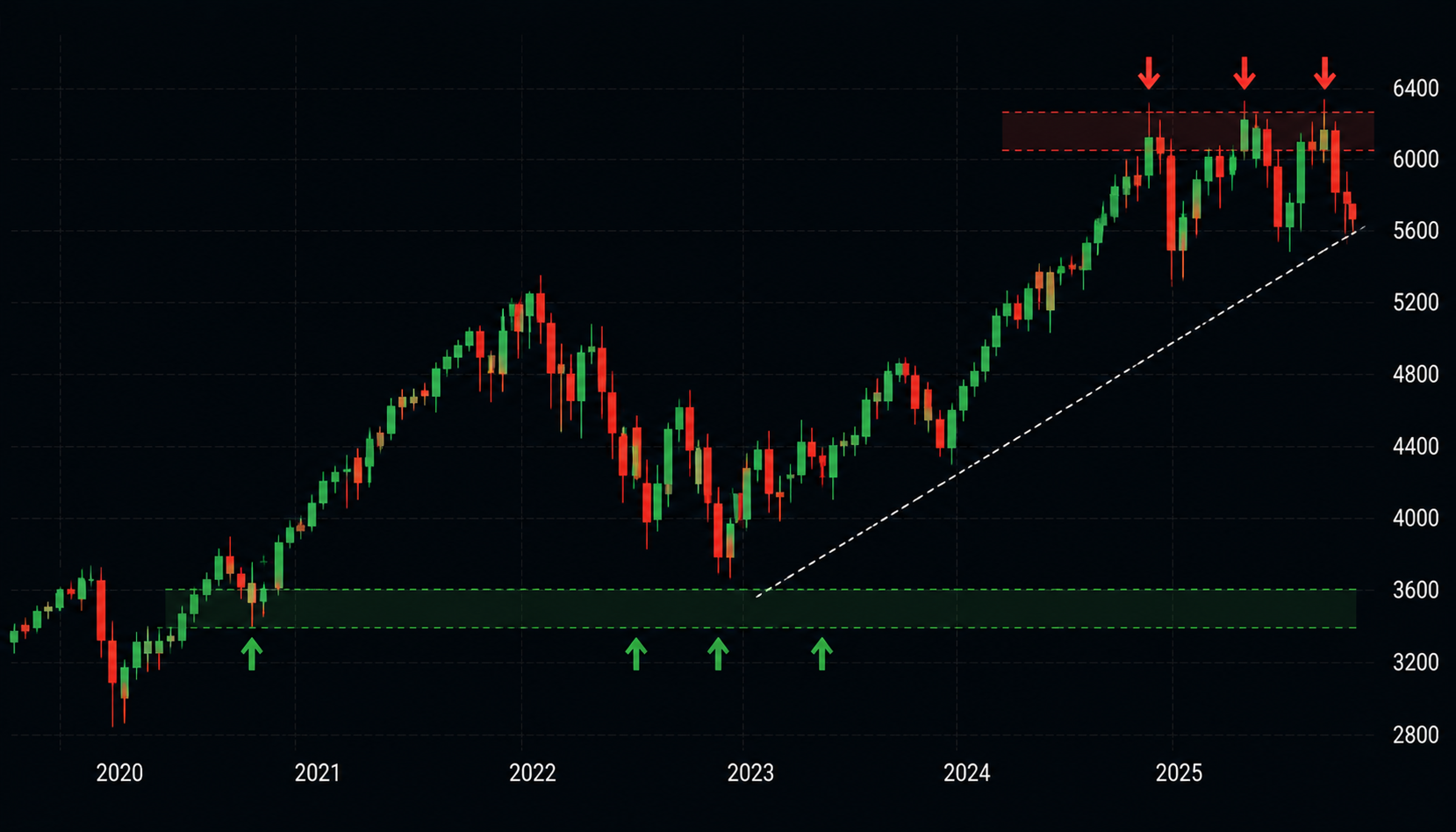
What Would Break the Earnings-Growth Story Supporting Current Valuations?
Every valuation argument is an earnings argument wearing different clothes. When a market trades at a high multiple of current profits, the implicit claim is that profits will grow into the price. That claim is testable. Rather than debating whether equities are expensive, it is more useful to write down what the market is assuming and then identify the evidence that would show those assumptions failing. Stating the disconfirming conditions in advance is the discipline that separates analysis from opinion.
The assumptions inside the earnings-growth story
Four assumptions usually do the heavy lifting. First, that margins stay near their elevated levels rather than reverting toward long-run averages. Second, that revenue growth continues at a pace above nominal economic growth, which requires either market share gains or pricing power. Third, that the largest index constituents keep converting capital spending into earnings at historically unusual rates of return. Fourth, that financing costs do not rise faster than earnings, so that debt refinancing does not consume the growth. Each is measurable, and each has a history of behaving differently than consensus expected.
Where margins are the weakest link
Margin assumptions deserve the most scrutiny because they are the most mean-reverting variable in corporate finance. Elevated margins invite competition, attract regulatory attention and depend on input costs staying favourable. The specific things to watch are unit labour costs relative to output prices, the gap between producer and consumer price inflation, and whether companies are guiding to margin expansion or defending current levels. A sustained divergence between revenue growth and earnings growth is the clearest early evidence that pricing power is fading.
The concentration problem
When a small number of companies contribute a large share of index earnings growth, the aggregate story becomes a story about those firms. That changes the nature of the risk. Broad economic resilience matters less than the capital spending cycle and competitive position of a handful of businesses. The relevant data includes the earnings contribution of the largest constituents, their capital expenditure relative to operating cash flow, and whether depreciation from recent investment is beginning to compress reported profits. Comparing equal-weight and cap-weight earnings trends is a quick way to see whether the story is broad or narrow, and the Market Forecast Hub is a useful place to track those series.
What the disconfirming evidence looks like
A few observations would constitute genuine evidence against the thesis rather than noise. Forward earnings estimates falling for two consecutive quarters while the index holds its multiple would show price and fundamentals separating. Margin guidance being revised down across several sectors rather than one would suggest a systemic rather than idiosyncratic problem. Rising interest expense as a share of operating profit would show financing costs eating growth. And a widening gap between reported and cash earnings would indicate that accounting rather than business performance is supporting the numbers.
What would confirm the story instead
Fairness requires stating the other side. Broadening earnings growth beyond the largest constituents, margins holding while unit labour costs fall, and capital spending translating into revenue within a normal payback period would all support the current valuation framework. If those appear together, the high multiple looks less like optimism and more like an accurate forward assessment.
Becoin.net Tariff Plans ---> Here
How to use a thesis test
The point of this exercise is not to predict a downturn or to recommend defensive positioning. It is to specify in advance what evidence would change the conclusion, so that a genuine deterioration is recognised from data rather than from price action after the fact. Nothing in this article constitutes investment advice or a recommendation regarding any security.
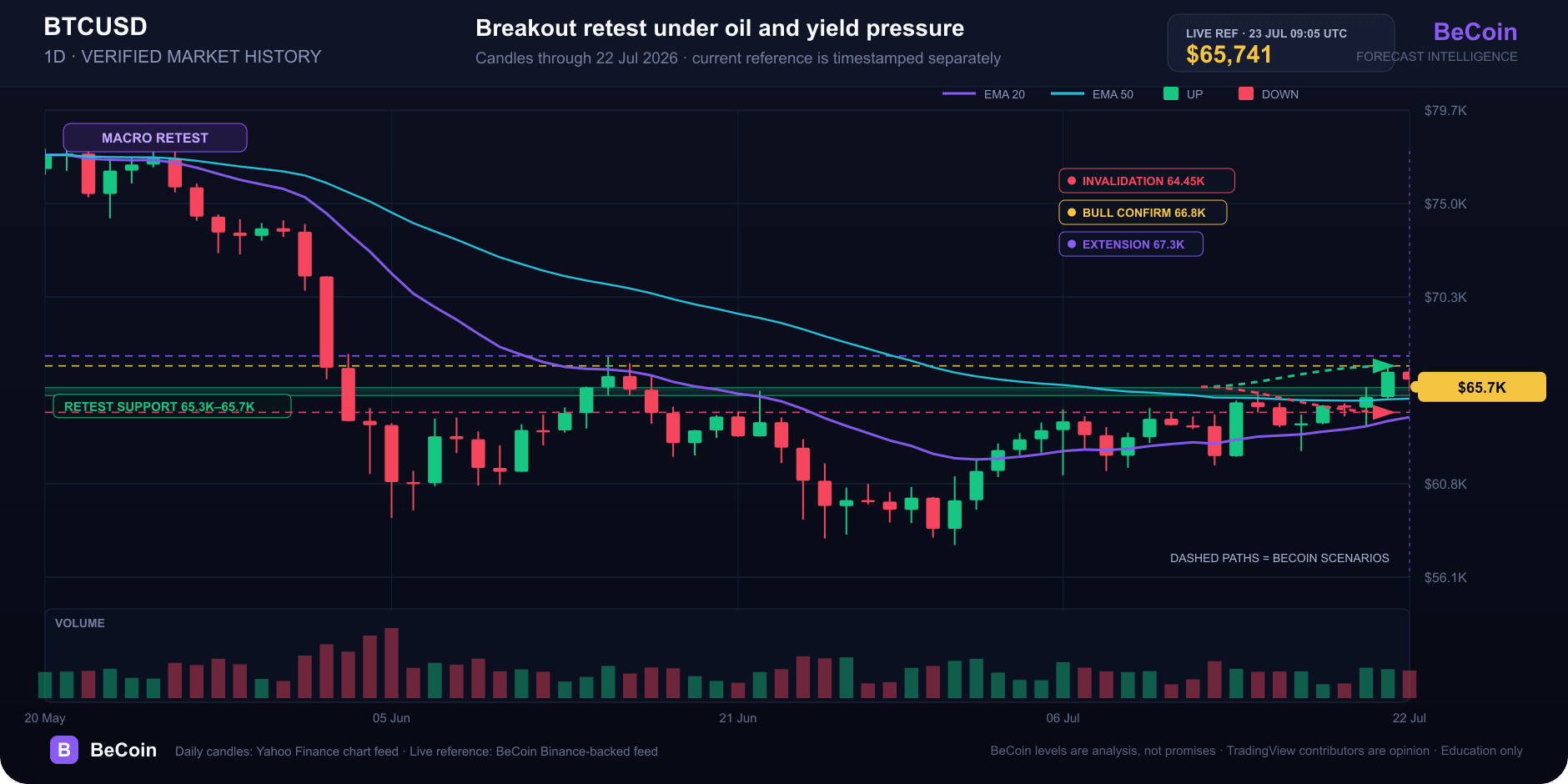
Bitcoin slips to $65,741 as oil and yields test the breakout
Bitcoin is near $65,741 as rising oil and Treasury yields test the $65.7K breakout floor. Here are the levels that confirm or invalidate the move.

Why Market Open Hours Create the Best Trading Opportunities
I used to think trading was a 24-hour conveyor belt of endless cash. In my earliest days, armed with a laptop, a hot cup of coffee, and far too much unearned confidence, I would stare at charts at 11:00 PM on a Tuesday. The candles barely moved. They crawled across my screen like snails on […]

The Clock and the Cash: My Journey into the Hidden Rhythm of Session-Based Trading
There was a time when I thought the global financial market was a single, monstrous wave that never stopped moving. I believed that if I sat in front of my monitors long enough, clicking buttons whenever a pretty pattern appeared on my charts, the market would eventually reward my sheer endurance. I was dead wrong. […]

How Many People Own Bitcoin? (2026 Data, Charts & Country Breakdown)
About 365 million people owned Bitcoin in 2025 - roughly 4-4.5% of the world and nearly half of all crypto owners. See the year-by-year growth curve, country data, whole-coin rarity, and why estimates disagree.

Which Broker Is Better for Weekend Trading?
It was a chilly Saturday morning, and while the rest of the world was sleeping in or catching up on shows, I was staring at a completely frozen screen. My usual EUR/USD chart looked like a heart monitor flatlining. The traditional markets were closed. The banks were shut down. For a long time, that was […]

Best Trading Platform for Slow Internet in 2026
A slow internet connection can ruin trades faster than a bad strategy. Charts freeze, apps reload, and delayed execution creates unnecessary losses. This is especially common for traders using mobile data, shared WiFi, or older smartphones. Most broker reviews ignore this issue completely. After testing multiple platforms on weaker connections and low-end Android devices, some […]