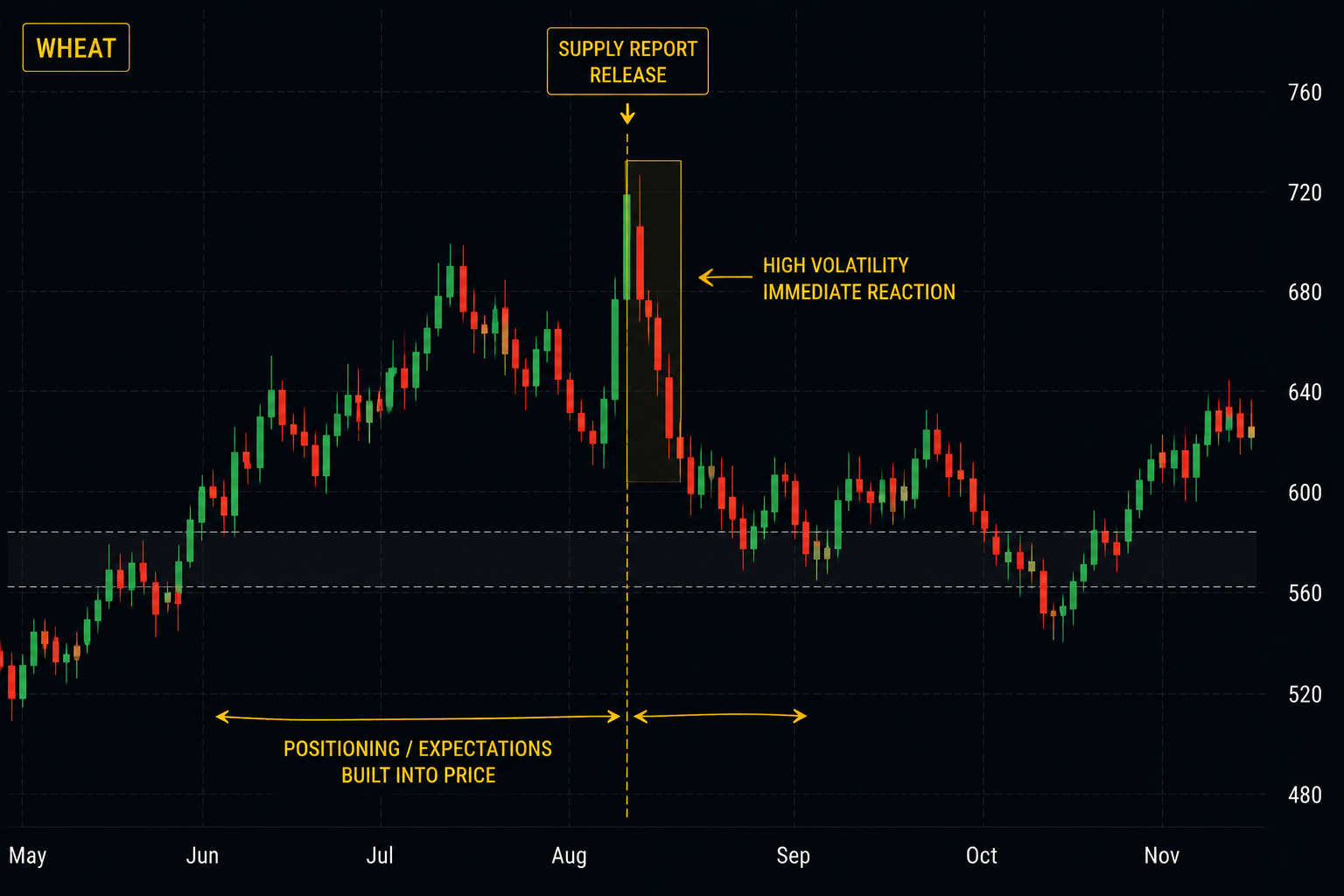
What to Watch Before the Next Major Grain Supply Report
Agricultural markets have a rhythm that most other asset classes lack. On a published schedule, an official agency releases updated estimates of production, consumption and ending stocks, and prices reprice within seconds of the release. Because the timing is known, the analytical work happens beforehand. Preparation for one of these releases is not about guessing the number, it is about understanding which parts of the report the market actually cares about and what is already reflected in price.
What a grain supply report contains
The core of any major crop report is a balance sheet: opening stocks, production, imports, domestic use, exports and ending stocks. From those figures comes the stocks-to-use ratio, which is the single most watched output because it expresses tightness in a comparable way across seasons. The report also updates yield and acreage assumptions, and revises prior estimates. Revisions to previous figures often move price as much as the new headline, since they change the trajectory rather than just the level.
Which inputs matter most beforehand
Several data streams shape expectations ahead of a release. Weather models covering the major growing regions matter most during pollination and grain-fill windows, when yield outcomes are decided in a matter of days. Crop condition ratings provide a running estimate that markets extrapolate. Export sales data show whether demand is validating or contradicting the supply picture. Currency moves in exporting countries affect competitiveness and therefore trade flows. Freight and basis levels reveal what is happening physically, which sometimes disagrees with the futures market. Comparing these against the futures curve is the most useful pre-report exercise, and the Market Forecast Hub is a practical place to review them together.
Understanding what is already priced
The most common analytical error before a scheduled release is treating a bullish or bearish estimate as automatically bullish or bearish for price. What matters is the gap between the report and expectations. Surveyed analyst estimates give a rough consensus. Options implied volatility for the expiry closest to the release shows how large a move the market is prepared for. Futures positioning shows which side is already crowded, which determines the asymmetry of the reaction. A tight stocks number that everyone expected can produce a lower price if positioning is heavily long into the release.
The structural questions behind the numbers
Beyond the immediate release, a few slower-moving factors shape the season. Planted acreage responds to relative prices between competing crops, so the ratio between them matters as much as either price. Input costs, particularly fertiliser and diesel, influence yield decisions and therefore future supply. Policy decisions on biofuel blending or export restrictions can reallocate demand overnight. And multi-year inventory levels determine how much buffer exists if a growing region disappoints.
What would invalidate a pre-report framework
Preparation of this kind fails in identifiable ways. If the release includes a methodology change, historical comparisons break down and the market may not know how to price it. If a major exporter imposes restrictions between the data collection date and the release, the balance sheet is stale on arrival. And if positioning data is unavailable or delayed, the asymmetry assessment is guesswork. In each case the honest response is to acknowledge that the framework cannot be applied rather than to apply it anyway.
Becoin.net Tariff Plans ---> Here
How to use event preparation
The goal is to know in advance which numbers matter, what the market expects and which conditions would make the reaction surprising. That is a monitoring exercise, not a positioning one. This article does not suggest trades around any scheduled release, and taking directional risk into a binary event carries risks that no amount of preparation removes.

Which Broker Is Better for Students in 2026?
For students, trading usually starts with one simple goal: learning how markets work without risking too much money. Most students are not starting with huge budgets. They are trading from a phone, using mobile internet, balancing studies, and trying to avoid losing money quickly. That changes what actually matters in a broker. The “best broker” […]
Deriv vs IQ Option for Synthetic Indices: Which Platform Is Better in 2026?
Synthetic indices have become one of the most talked about trading categories among beginners and experienced traders alike. Unlike forex or crypto markets that depend on real world events, synthetic indices operate 24/7 using algorithm driven price movements. That means traders can access opportunities at any time without waiting for market openings or major news […]
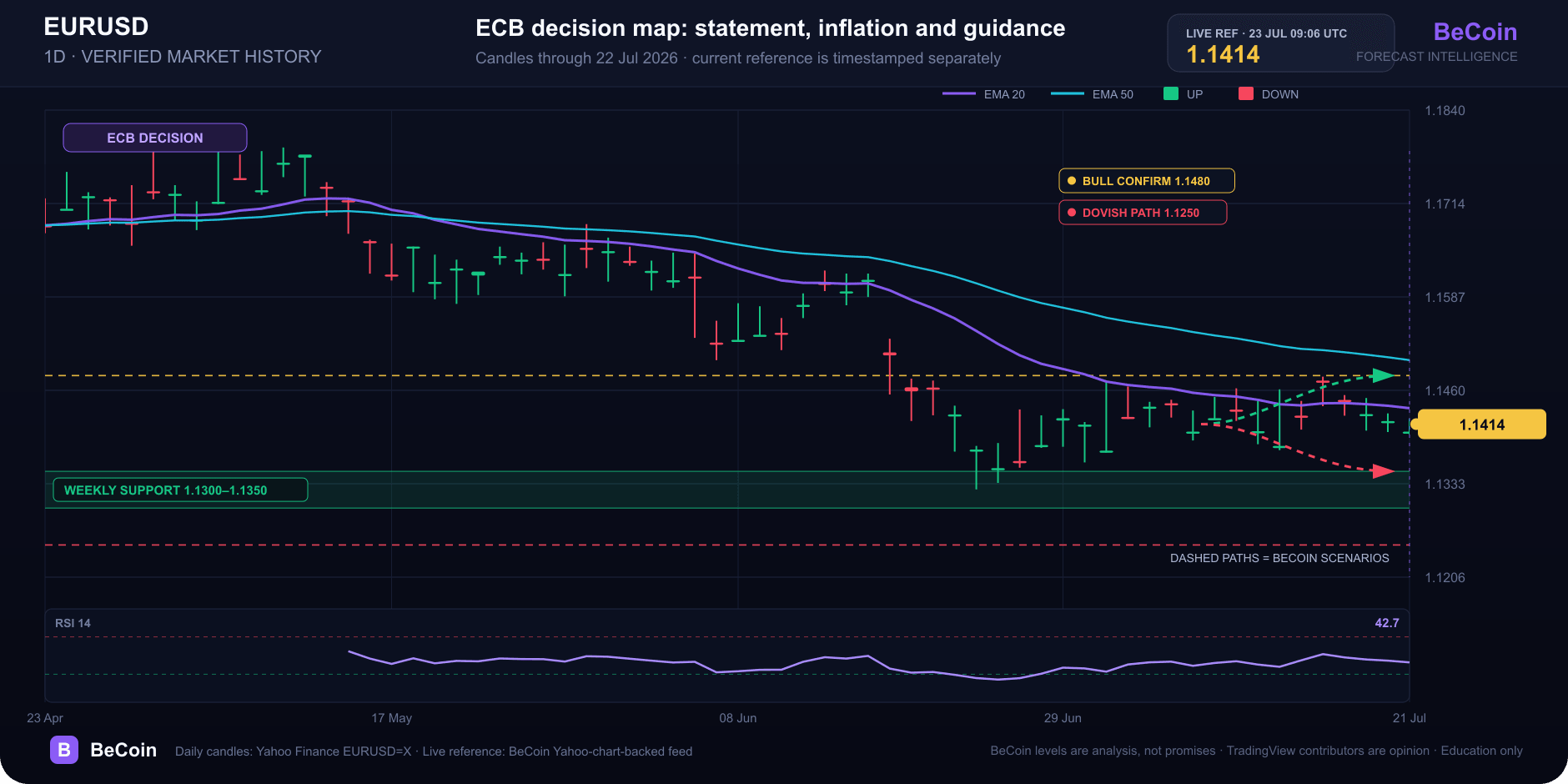
EUR/USD holds 1.1414 before the ECB decision: three scenarios
EUR/USD traded near 1.1414 before the ECB’s July decision. Here is what a hold, hawkish hold or surprise hike could mean for 1.1350 and 1.1480.
Finding My Perfect Workspace: The Search for the Best Broker for My Daily Trading Routine
The alarm goes off at 6:00 AM. By 6:30 AM, I am sitting in front of my monitors with a steaming mug of black coffee. The house is completely quiet, the market is preparing its next major move, and my charts are completely bare. This is my daily sanctuary. For a long time, this morning […]

Which Broker Is Better for Weekend Trading?
It was a chilly Saturday morning, and while the rest of the world was sleeping in or catching up on shows, I was staring at a completely frozen screen. My usual EUR/USD chart looked like a heart monitor flatlining. The traditional markets were closed. The banks were shut down. For a long time, that was […]

The Best Broker Without Complicated Features (And Why Simplicity Wins)
Most traders don’t fail because they lack knowledge. They fail because their platform buries them in noise before they even place their first trade. Here’s what actually works. It Started With a Confession From a $10 Trader A reader messaged us a few months back. He had been trying to trade for three weeks, had […]