Strongest Currency in the World 2026: Top 10 Ranked
Strongest Currencies in the World
The ten highest-valued currencies against the US dollar, the exchange-rate regimes behind them, and why the ranking says less about economic strength than it appears to. Rates as of 3 August 2026.
The short answer
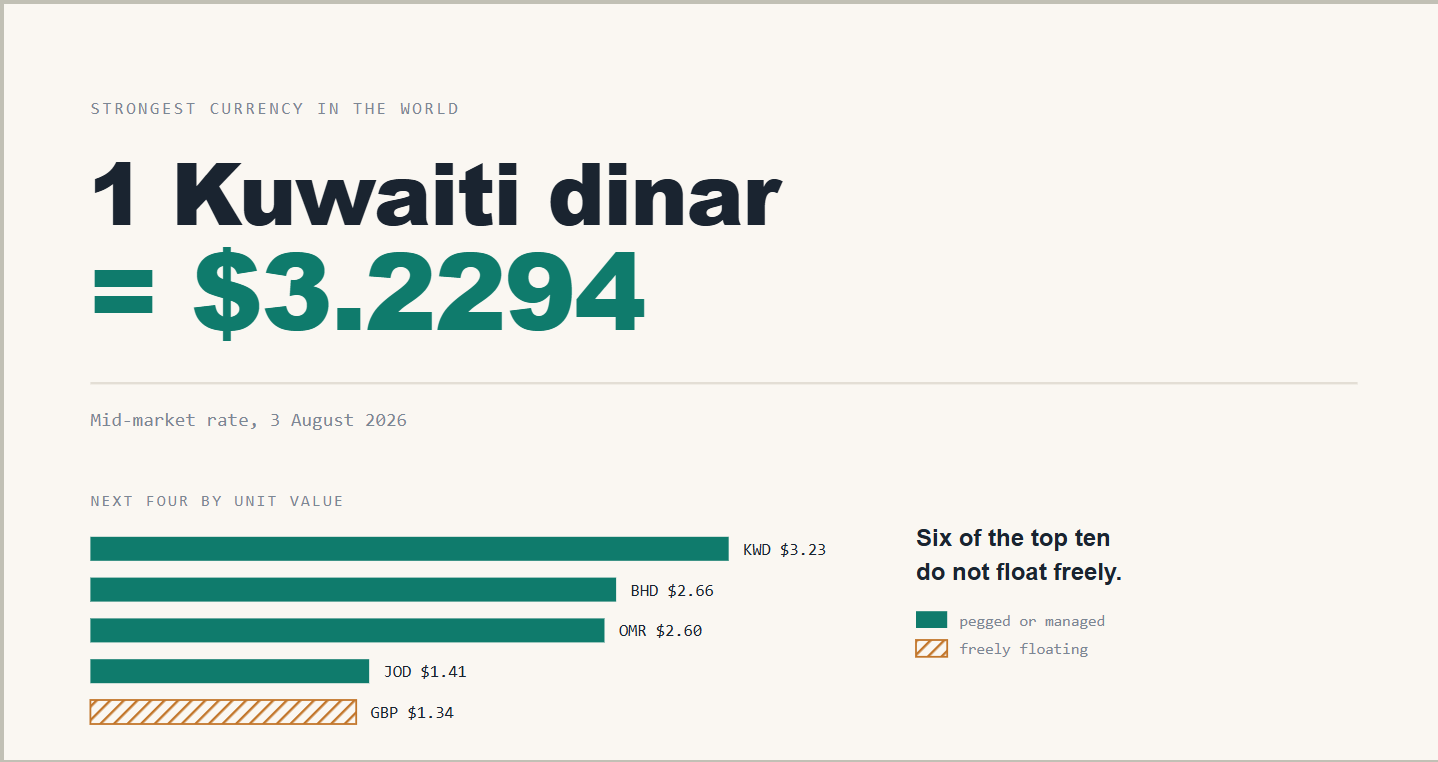
The Kuwaiti dinar (KWD) is the strongest currency in the world by unit value, at $3.2294. It has held the position for decades and is not close to losing it — the second-placed Bahraini dinar is 21% behind.
One caveat before the table. Most currently published rankings quote the dinar at $3.25 or $3.26. That was true in the first half of 2026; it isn't now. The dinar has drifted down roughly 1.1% over the past twelve months and has traded between $3.2207 and $3.2343 over the last week. If you need the number for anything that matters, take it from a live feed rather than from a listicle.
The ten strongest currencies by unit value
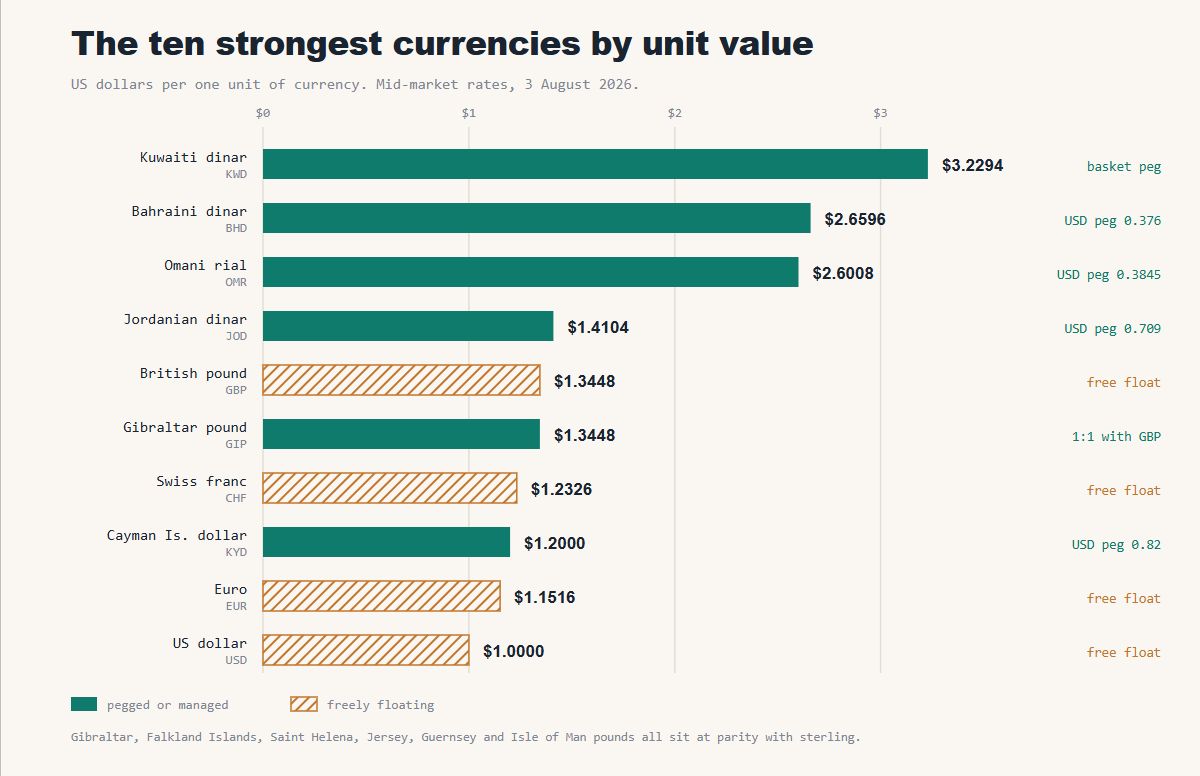
| # | Currency | Code | USD per unit | Exchange-rate regime |
|---|---|---|---|---|
| 1 | Kuwaiti dinar | KWD | $3.2294 | Pegged to an undisclosed currency basket |
| 2 | Bahraini dinar | BHD | $2.6596 | Fixed at 0.376 BHD per USD since 1980 |
| 3 | Omani rial | OMR | $2.6008 | Fixed at 0.3845 OMR per USD since 1986 |
| 4 | Jordanian dinar | JOD | $1.4104 | Fixed at 0.709 JOD per USD |
| 5 | British pound | GBP | $1.3448 | Free float |
| 6 | Gibraltar pound | GIP | $1.3448 | Fixed 1:1 with sterling |
| 7 | Swiss franc | CHF | $1.2326 | Free float |
| 8 | Cayman Islands dollar | KYD | $1.2000 | Fixed at 0.82 KYD per USD |
| 9 | Euro | EUR | $1.1516 | Free float |
| 10 | US dollar | USD | $1.0000 | Free float (reference) |
A note on the pound family: the Falkland Islands, Saint Helena, Jersey, Guernsey and Isle of Man pounds are all fixed one-for-one with sterling, so they share position five. Rankings that list them separately are padding the table rather than adding information.
Immediately below the dollar sit several currencies fixed at exact parity with it — the Bermudian dollar, the Bahamian dollar and the Panamanian balboa among them. Below that, the field drops away steeply.
Why the Gulf occupies the top four
Three factors, in rough order of importance:
The peg was set high and never reset. This is the whole story, and it is mostly a historical accident. The Kuwaiti dinar was introduced in 1961 at parity with the pound sterling — worth about $2.80 at the time — and Kuwait has maintained a high fixed value ever since. The Omani rial has been effectively unchanged since 1986. These are not currencies that climbed to the top of a league table; they were issued near it and held.
Hydrocarbon revenue funds the defence of the peg. Maintaining a fixed rate requires reserves to sell when the currency comes under pressure. Oil and gas exports supply them, and sovereign wealth funds hold the surplus. Bahrain is the partial exception — non-oil sectors account for the large majority of its economy — which is why its peg has held through periods of fiscal strain.
Tight monetary control. Small, centrally managed economies can run the kind of exchange-rate policy that a large open economy cannot.
Why "strongest" is a misleading word
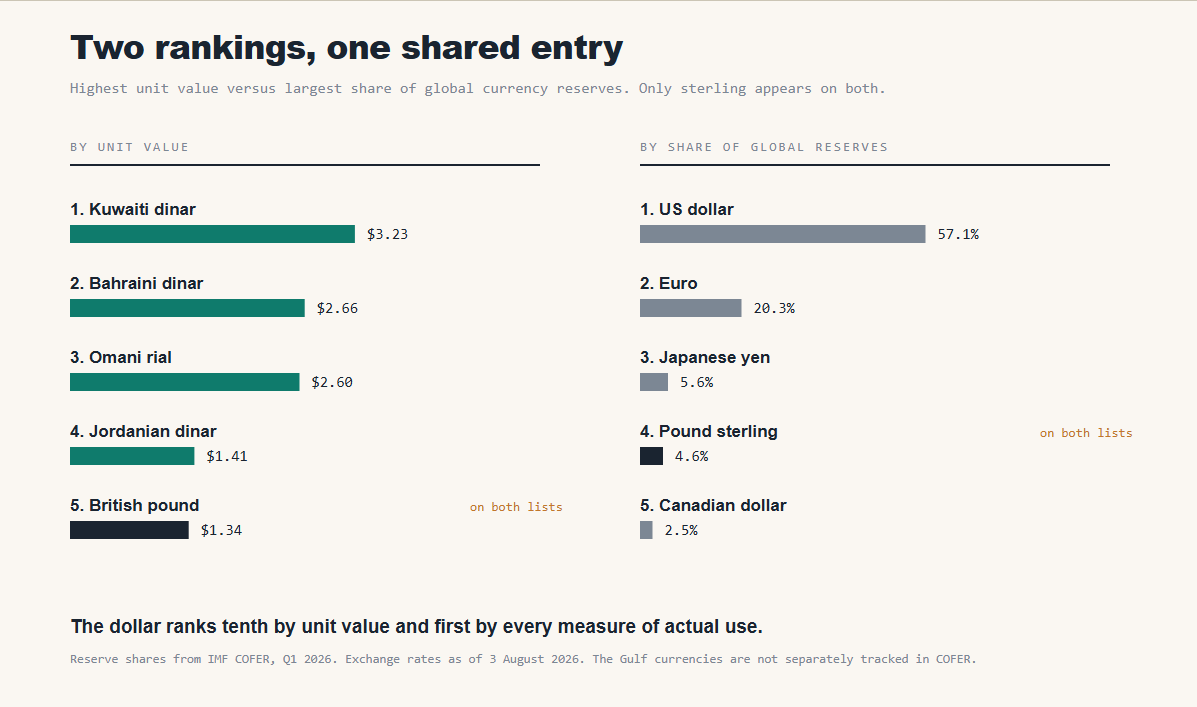
Unit value measures one thing: how many dollars one unit of a currency buys. That is a function of how the currency was denominated, not of the economy behind it.
The clearest demonstration is redenomination. In 2005 Turkey removed six zeros from the lira; one new lira replaced one million old ones. Nothing about the Turkish economy changed that day, but the currency's rank on a list like this jumped by an enormous margin. Any country could do the same tomorrow. Japan's economy is the world's fourth-largest and the yen trades around 164 to the dollar; that number reflects a denomination decision, nothing more.
Measured by anything other than unit value, the ranking inverts:
| Measure | Leader | Where the Gulf currencies place |
|---|---|---|
| Share of global FX reserves (IMF COFER, Q1 2026) | US dollar, ~57% | Not separately tracked |
| Share of global FX turnover (BIS, April 2025) | US dollar, on one side of 89% of trades | Negligible |
| Share of global export invoicing | US dollar, ~54% | Negligible |
Sterling is the only currency that appears in the top five of both the unit-value ranking and the reserve ranking, where it holds about 4.6%.
What actually floats
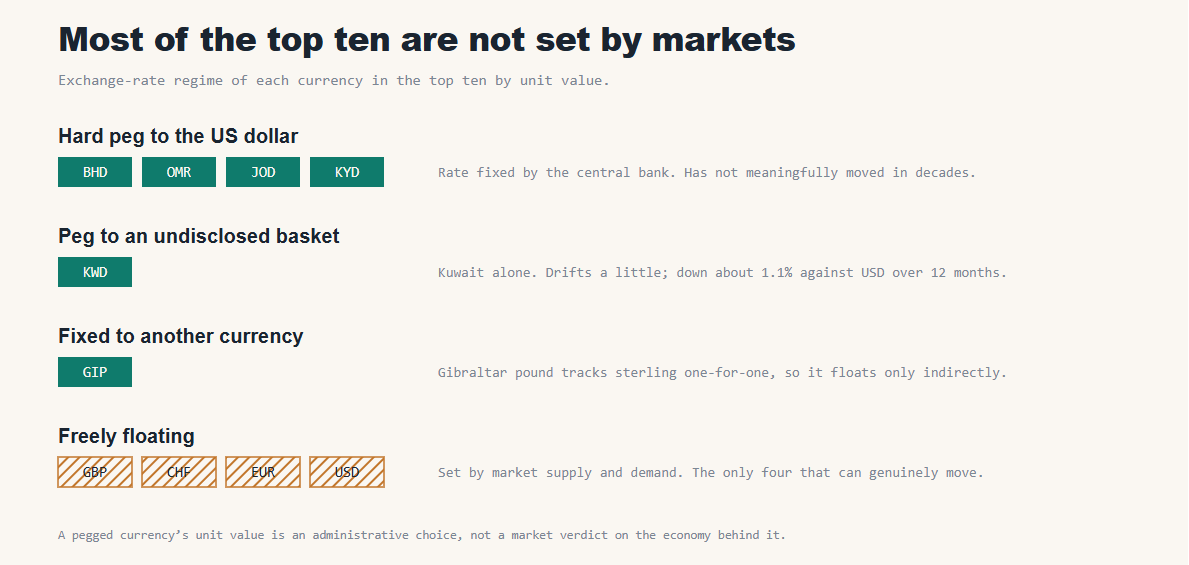
Six of the top ten do not float freely against the dollar. This is the most useful thing on the page for anyone thinking about currencies as an investment rather than a trivia answer.
A pegged currency is not a diversification from the dollar — it is a dollar position wearing different colours. Holding Bahraini dinars instead of dollars gives you almost identical exposure, minus the liquidity. The genuine risk in a pegged currency is not daily volatility but a peg break, which is rare and abrupt: when pegs fail, they tend to move 20–30% in days rather than drifting.
The four currencies that can actually move on their own — sterling, the franc, the euro and the dollar — are the ones with deep markets and meaningful volume.
Recent movement
Over the twelve months to early August 2026, the picture is one of a firm dollar rather than strengthening rivals. The Kuwaiti dinar is down about 1.1% against the dollar over that period, having traded as high as $3.2793 in September 2025. The Swiss franc, a currency usually described as a safe haven, sits close to its weakest level in more than a year against the dollar, with the Swiss National Bank expected to hold its policy rate at 0%. Sterling has traded roughly between $1.30 and $1.36 through 2026 and was around $1.345 at the start of August.
The pegged currencies did not move, because they are not permitted to.
The other end of the table
For the counterpart query: the currencies with the lowest unit value against the dollar as of 2026 include the Iranian rial, the Lebanese pound, the Vietnamese dong, the Laotian kip and the Indonesian rupiah. The same caveat applies in reverse. A low unit value reflects past inflation and denomination history; Vietnam and Indonesia are growing economies whose currencies simply carry a lot of zeros.
FAQ
What is the strongest currency in the world?
The Kuwaiti dinar, at $3.2294 as of 3 August 2026. It has held the top position by unit value for decades.
Why is the Kuwaiti dinar so strong?
It was introduced in 1961 at a high fixed value and has been maintained there ever since, backed by oil revenue, large foreign reserves and a peg to an undisclosed basket of currencies. Its value reflects a policy choice, not a market judgement.
Is the US dollar the strongest currency?
Not by unit value — it ranks tenth on this list. By every measure of actual use, including reserves, trading volume and trade invoicing, it is the most dominant currency in the world by a wide margin.
Is the British pound stronger than the euro?
By unit value, yes: £1 buys about $1.345 against the euro's $1.152. Both float freely, so the gap reflects market pricing rather than a peg.
Does a strong currency mean a strong economy?
No. Unit value depends largely on how a currency was denominated and whether it is pegged. Kuwait's economy is roughly a fiftieth the size of Japan's, whose yen trades at around 164 to the dollar.
Which currency is the most stable?
Stability and unit value are different things. The hard-pegged Gulf currencies barely move by construction; among floating currencies, the dollar, euro, franc and yen have the deepest markets and the most reliable pricing.
Methodology and sources
Exchange rates are mid-market and were taken on 3 August 2026. Sterling, euro and franc rates are cross-checked against ECB reference rates for the same date. Peg parameters come from the issuing central banks. Reserve shares are from the IMF's COFER dataset for Q1 2026; turnover figures are from the BIS Triennial Central Bank Survey conducted in April 2025. Mid-market rates differ from what a bank or bureau will actually quote you, sometimes by several percent.
This page is for information only and is not financial advice.

How Many People Own Bitcoin? (2026 Data, Charts & Country Breakdown)
About 365 million people owned Bitcoin in 2025 - roughly 4-4.5% of the world and nearly half of all crypto owners. See the year-by-year growth curve, country data, whole-coin rarity, and why estimates disagree.

Deriv vs IQ Option for Synthetic Indices: Which Platform Is Better in 2026?
Synthetic indices have become one of the most talked about trading categories among beginners and experienced traders alike. Unlike forex or crypto markets that depend on real world events, synthetic indices operate 24/7 using algorithm driven price movements. That means traders can access opportunities at any time without waiting for market openings or major news […]

Trading Currency Strength Instead of Single Pairs
It was a Tuesday afternoon when I realized I was fighting a losing battle against a ghost. My screen was a chaotic web of indicators. I had the EUR/USD chart open, a moving average crossing over here, a relative strength index flashing oversold there, and a price action setup that looked textbook perfect. I clicked […]

The Rookie Dashboard: My Raw Hunt for the Best Beginner Broker in 2026
We have all been there. It is late at night, your morning coffee is hours away, and you are staring at a screen pulsing with bright green and red lines. You have twenty dollars burning a hole in your digital wallet and a sudden, burning desire to conquer the financial markets. That was me exactly […]
Which Broker Has Better Risk Management Tools?
The burning smell of my own account blowing up is a scent I will never forget. It was a rainy Tuesday afternoon a few years back. I sat huddled over my laptop, watching a currency pair oscillate. Confident, arrogant, and entirely unprotected, I clicked buy. Minutes later, a sudden market spike completely wiped out my […]
Chasing Safety in a High-Stakes World: My Quest for the Best Low-Risk Trading Platforms
I still remember the sinking feeling in my stomach when I lost my first tiny trading account. It wasn’t a massive fortune, but it was mine. That night, I realized a brutal truth about this industry: most beginners fail not because they lack passion, but because they dive into high-risk environments without a life jacket. […]