Strongest Currencies in the World: Top Currencies & Forex Data
Strongest Currencies in the World: The Strongest Currency, Forex & Macro Data
The foreign exchange (Forex) market is the world’s largest financial market, where currencies are continuously bought and sold against one another. Currency values can change because of interest rates, inflation, economic growth, trade balances, political conditions, and investor sentiment.
When people search for the strongest currency in the world, they usually mean the currency with the highest value for one unit when compared with the US dollar. By this measure, the Kuwaiti dinar (KWD) consistently ranks at the top. In June 2026, Forbes Advisor also ranked the Kuwaiti dinar as the strongest currency, at around US$3.22 per dinar.
What Makes a Currency Strong?
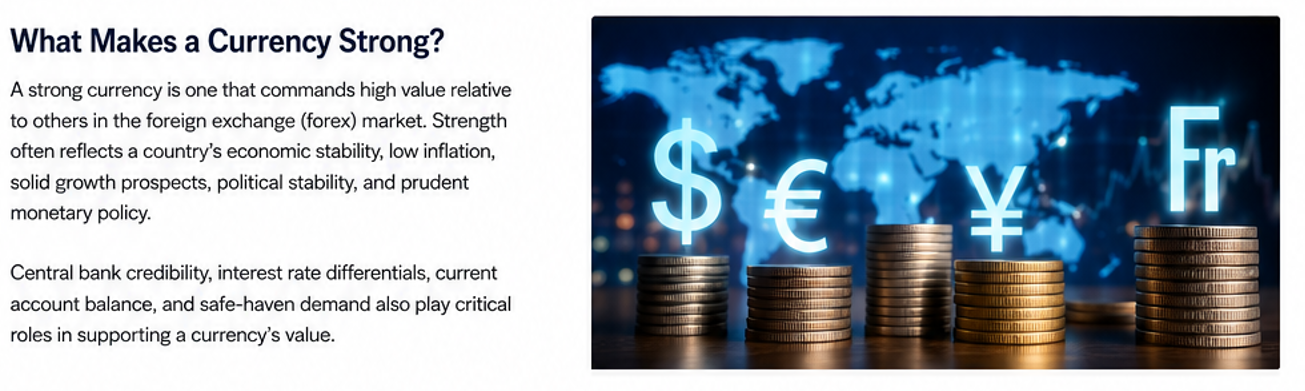
A currency's strength is influenced by several economic and financial factors:
- Interest rates: Higher relative interest rates can attract foreign investment and increase demand for a currency.
- Inflation: Low and stable inflation generally helps preserve purchasing power.
- Economic growth: Strong GDP growth can increase investor confidence.
- Trade balance: Countries that export more than they import can experience stronger demand for their currency.
- Political stability: Stable institutions and predictable policies can encourage international investment.
- Foreign-exchange reserves: Large reserves can help a central bank manage currency-market pressure.
- Government finances: Sustainable debt and fiscal policies can support long-term confidence.
Importantly, a high exchange-rate value does not automatically mean a currency is the world's most influential currency. The US dollar, for example, has a much larger role in international trade and global finance even though one US dollar is worth fewer units of several Gulf currencies.
The Strongest Currency in the World
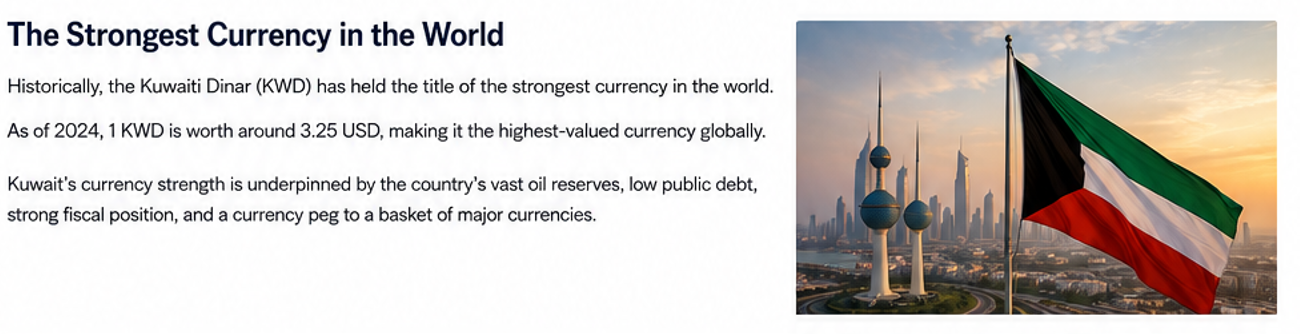
1. Kuwaiti Dinar (KWD)
The Kuwaiti dinar is generally regarded as the world's highest-valued national currency. Current exchange-rate data puts 1 KWD at approximately US$3.24.
Kuwait's currency strength is supported by its oil-export revenues, financial position and monetary framework. The Central Bank of Kuwait publishes official exchange-rate data and maintains the dinar's exchange-rate policy against a basket of currencies.
Other Strong Currencies
2. Bahraini Dinar (BHD)
The Bahraini dinar is another exceptionally high-value currency. It is closely linked to the US dollar and is supported by Bahrain's financial sector and relatively diversified economy. Forbes Advisor places one Bahraini dinar at about US$2.65.
3. Omani Rial (OMR)
The Omani rial is also among the world's highest-valued currencies. Its value is supported by Oman's energy exports and its long-standing exchange-rate relationship with the US dollar. Central Bank of Kuwait data also shows the Omani rial trading at a very high value relative to the Kuwaiti dinar.
4. Jordanian Dinar (JOD)
The Jordanian dinar is another high-value currency and has maintained a close relationship with the US dollar. Its strength reflects monetary policy, exchange-rate management and investor confidence in the currency.
5. British Pound (GBP)
The British pound is one of the world's most important currencies and is widely traded in global Forex markets. Unlike the Gulf currencies above, its value is determined much more directly by market supply and demand.
6.Swiss Franc (CHF)
The Swiss franc is famous for its safe-haven status. During periods of geopolitical or financial uncertainty, investors often seek assets denominated in Swiss francs because of Switzerland's political and financial stability.
Strongest Currencies vs. Most Powerful Currencies
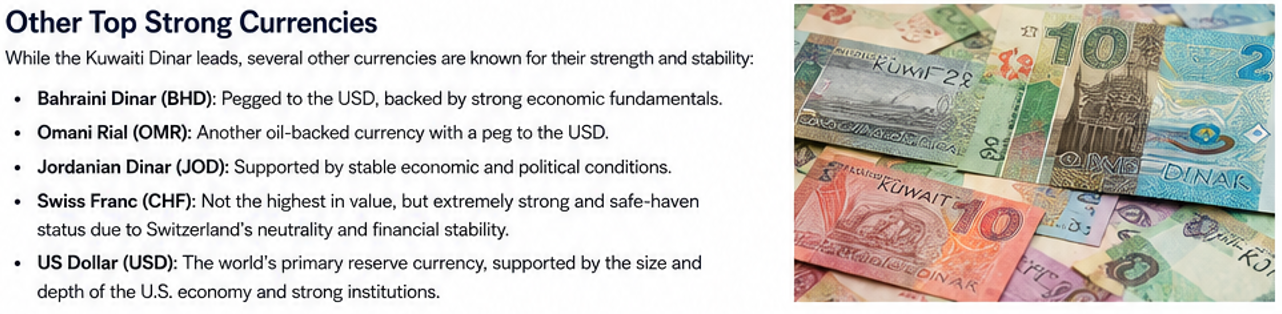
There is an important difference between currency value and global currency importance.
A currency can have a high value against the US dollar without being widely used internationally. The Kuwaiti dinar is an excellent example: one dinar is worth several US dollars, but the currency's international trading volume is much smaller than the dollar's.
The US dollar remains one of the most important currencies for international trade, financial markets, central-bank reserves and global investment.
Therefore, when comparing currencies, analysts should specify whether they mean:
- Highest value per unit
- Strongest performance against another currency
- Most stable currency
- Most widely traded currency
- Most important reserve currency
These are different measurements.
Forex and Macro Data
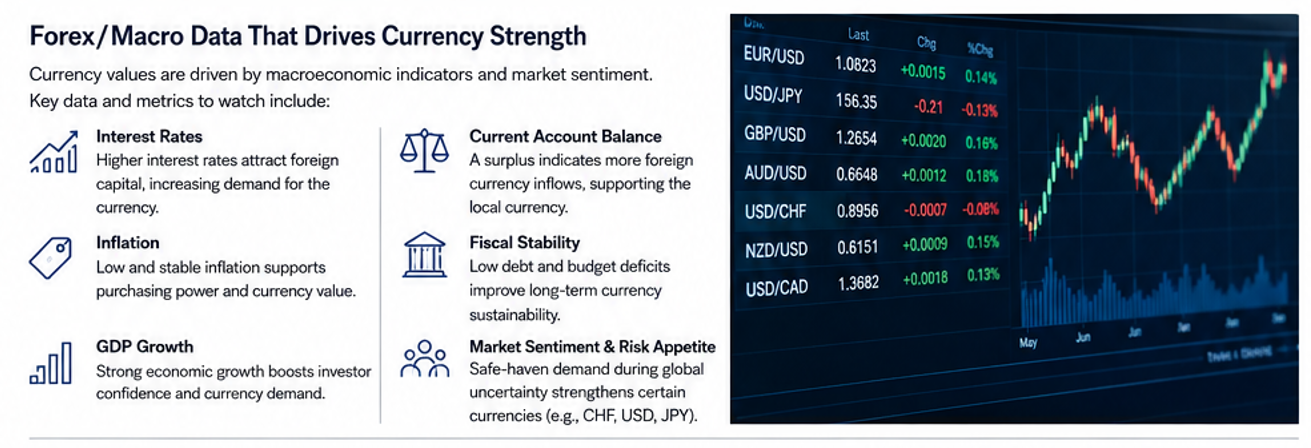
Currency markets react continuously to economic data. Traders and investors monitor several major indicators to understand where currencies could move next.
Interest Rates
Central-bank interest-rate decisions are among the most important Forex events. Higher rates can make assets denominated in a currency more attractive, although the effect depends on inflation, growth expectations and what markets have already priced in.
Inflation
Consumer-price inflation affects purchasing power and monetary policy. If inflation remains high, a central bank may maintain or increase interest rates, potentially influencing the currency.
GDP Growth
Gross domestic product measures economic activity. Stronger-than-expected growth can improve investor confidence, while weak growth can create pressure on a currency.
Employment
Employment and wage data provide clues about economic strength and future consumer spending. Major labor-market reports can create significant short-term movements in Forex markets.
Current Account and Trade Balance
A country that consistently exports more goods and services than it imports may receive strong foreign demand for its currency. However, exchange rates depend on many factors, so a trade surplus alone does not guarantee currency appreciation.
Government Debt and Fiscal Policy
Investors also examine government debt, budget deficits and fiscal sustainability. Confidence in a country's finances can influence long-term currency demand.
A Data-Driven Approach to Currency Strength
For a useful Forex/macro data page, currency analysis should combine exchange rates with economic indicators rather than relying on a single number.
A good data page can include:
| Indicator | Why it matters |
|---|---|
| USD exchange rate | Measures currency value against the dollar |
| Interest rate | Shows monetary-policy conditions |
| Inflation/CPI | Tracks changes in consumer prices |
| GDP growth | Measures economic expansion |
| Unemployment | Indicates labor-market health |
| Trade balance | Shows exports vs. imports |
| Current account | Tracks broader external flows |
| Government debt | Helps assess fiscal sustainability |
| FX reserves | Shows a country's external financial buffer |
Live data is especially important because exchange rates change continuously. For example, the Central Bank of Kuwait publishes regularly updated official currency rates, while current market data can differ depending on the provider and time of measurement.
Why the Kuwaiti Dinar Ranks First
The Kuwaiti dinar's position is not simply about having a large number printed on a banknote. Its high unit value is connected to Kuwait's monetary framework and economic structure.
Kuwait is a major oil exporter, giving the country substantial external revenues. Its central bank also manages the dinar using a currency-basket framework rather than allowing it to float freely like many major currencies.
As a result, the KWD has maintained an unusually high value relative to the US dollar over time.
Final Thoughts
The Kuwaiti dinar is currently the strongest currency in the world when “strength” is measured by the value of one currency unit against the US dollar. The Bahraini dinar, Omani rial and Jordanian dinar are also among the world's highest-valued currencies.
However, currency strength is much more complicated than simply ranking exchange rates. Inflation, interest rates, GDP growth, trade flows, fiscal policy, central-bank decisions and geopolitical risk can all influence Forex markets.
For investors and researchers, the best approach is therefore to combine real-time exchange-rate data with macroeconomic indicators. This provides a more complete picture of why currencies move and whether a currency is genuinely strengthening or simply has a high nominal value.
Becoin.net Premium Forex Forecast- Becoin.net Tariff Plans
Data note: exchange rates fluctuate. The KWD/USD figure above is based on current data retrieved on August 8, 2026; always timestamp exchange-rate tables on a live data page.
Trading Currency Strength Instead of Single Pairs
It was a Tuesday afternoon when I realized I was fighting a losing battle against a ghost. My screen was a chaotic web of indicators. I had the EUR/USD chart open, a moving average crossing over here, a relative strength index flashing oversold there, and a price action setup that looked textbook perfect. I clicked […]

How Many People Own Bitcoin? (2026 Data, Charts & Country Breakdown)
About 365 million people owned Bitcoin in 2025 - roughly 4-4.5% of the world and nearly half of all crypto owners. See the year-by-year growth curve, country data, whole-coin rarity, and why estimates disagree.

Deriv vs IQ Option for Synthetic Indices: Which Platform Is Better in 2026?
Synthetic indices have become one of the most talked about trading categories among beginners and experienced traders alike. Unlike forex or crypto markets that depend on real world events, synthetic indices operate 24/7 using algorithm driven price movements. That means traders can access opportunities at any time without waiting for market openings or major news […]
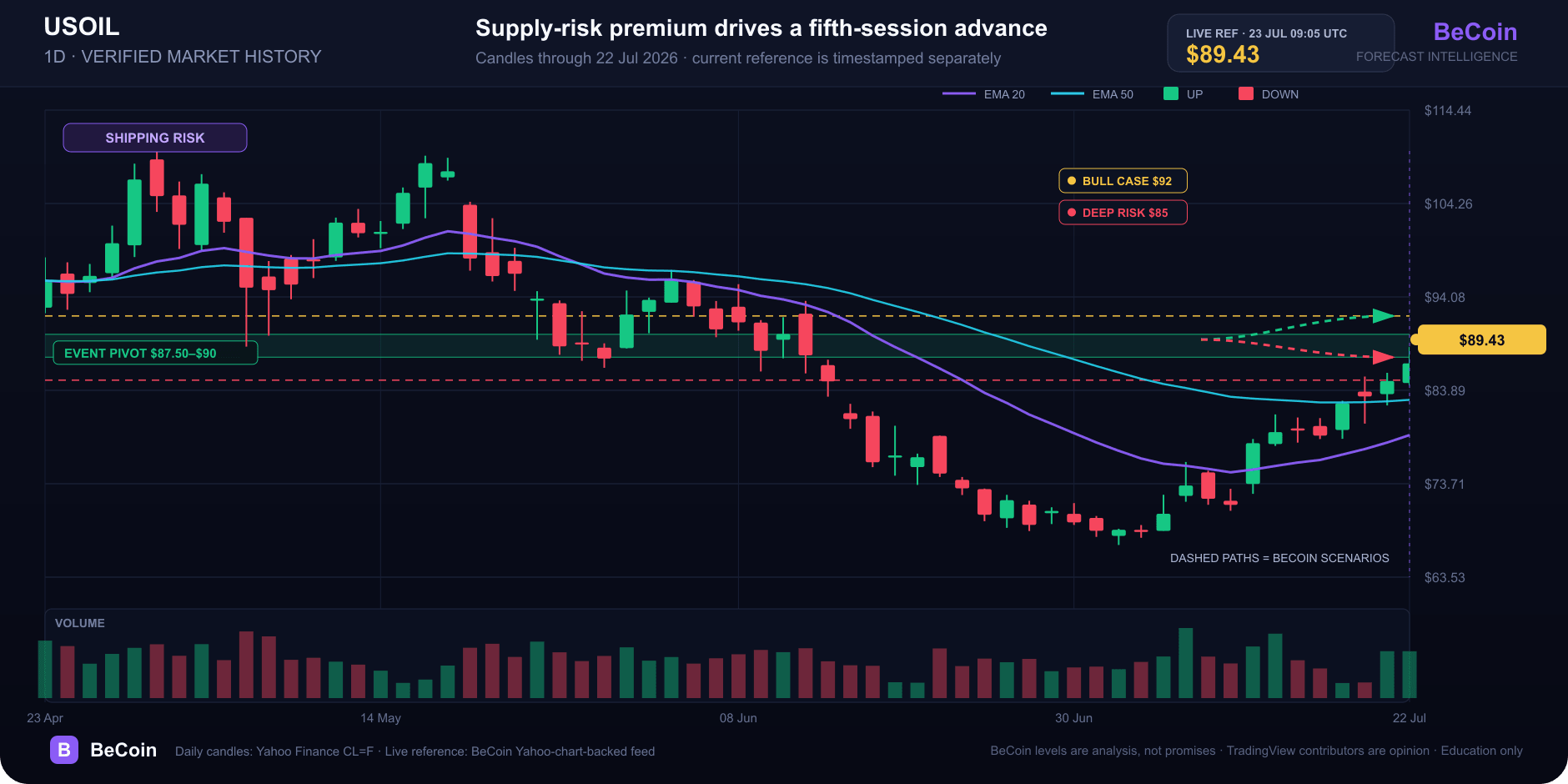
WTI reaches $89.43 as Brent clears $95 on renewed supply risk
WTI traded near $89.43 while Brent moved above $95 as Middle East shipping risk lifted crude for a fifth session. Key levels, catalysts and invalidation.
Which Broker Has Better Risk Management Tools?
The burning smell of my own account blowing up is a scent I will never forget. It was a rainy Tuesday afternoon a few years back. I sat huddled over my laptop, watching a currency pair oscillate. Confident, arrogant, and entirely unprotected, I clicked buy. Minutes later, a sudden market spike completely wiped out my […]
Chasing Safety in a High-Stakes World: My Quest for the Best Low-Risk Trading Platforms
I still remember the sinking feeling in my stomach when I lost my first tiny trading account. It wasn’t a massive fortune, but it was mine. That night, I realized a brutal truth about this industry: most beginners fail not because they lack passion, but because they dive into high-risk environments without a life jacket. […]