EUR/USD Stalls at 1.1560 Resistance — Pullback Toward 1.1510 in Focus
Where the euro stands after the rebound
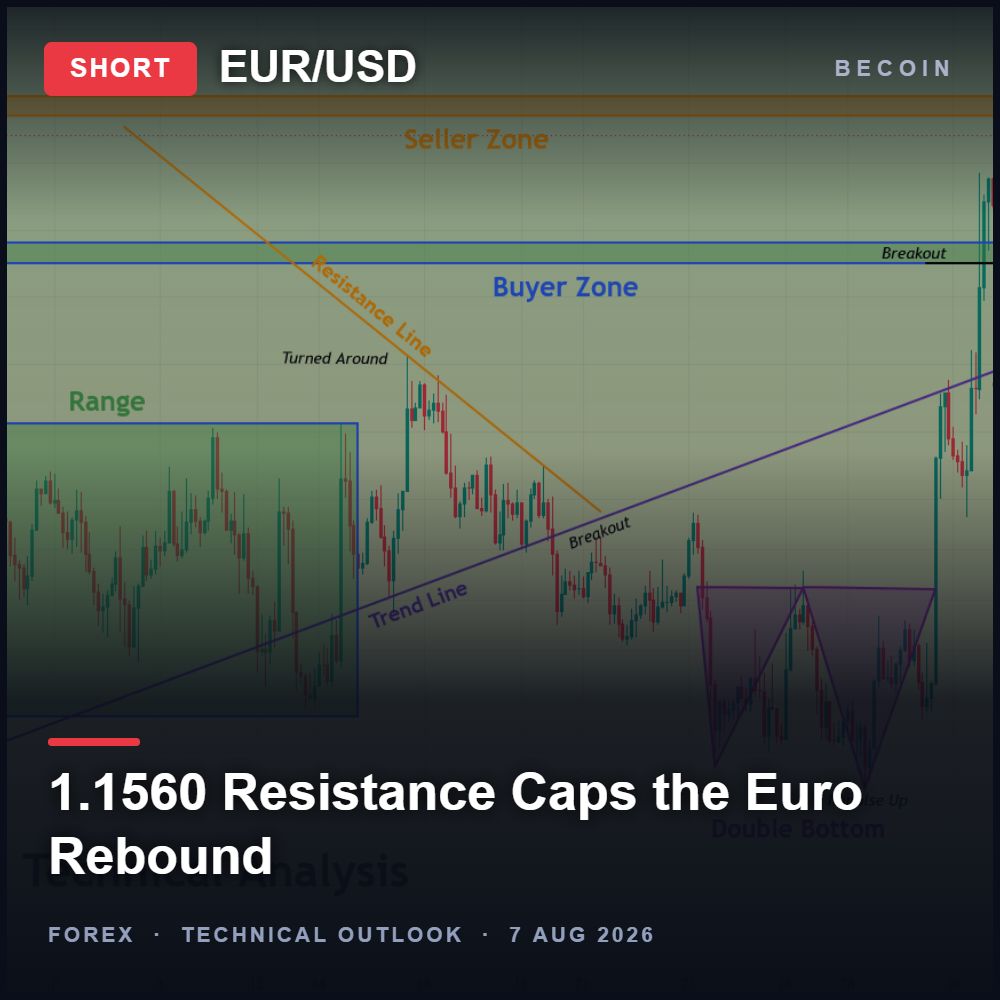
EUR/USD has spent the first week of August recovering from a period of heavy selling, and that recovery has been technically clean. The pair carved out a double bottom on the two-hour chart, pushed through the descending trendline that had been guiding price lower since early July, and then ran into the one area that has consistently ended rallies this summer: the supply band around 1.1560. At the time of writing the pair is changing hands close to 1.1548, which puts it just under the ceiling and comfortably above the ascending trendline that has supported every dip since the middle of July.
Why 1.1560is the level that matters
Resistance only becomes meaningful when it is tested repeatedly, and 1.1560 now qualifies. Price has approached this band several times and has been turned away on each attempt, which tells us sellers are still positioned there and are being refilled rather than exhausted. That is the core of the bearish case laid out in a technical idea as long as the pair trades beneath this zone, the odds tilt toward another rotation lower rather than an immediate breakout.
The downside scenario
If the rejection sticks, the first logical destination is the demand pocket near 1.1510. That area lines up with the previous breakout shelf and with the rising trendline drawn off the late-July lows, so it is a natural place for buyers to defend. A move of roughly fifty pips may not sound dramatic, but on a pair as heavily traded as EUR/USD it represents a clean, well-defined rotation with an obvious invalidation point. Below 1.1510, the next reference is the 1.1460 to 1.1480 pocket where the earlier double bottom formed.
What would break the bearish case
A decisive two-hour or four-hour close above 1.1560 flips the picture. It would mean the supply that has been capping the market has finally been absorbed, and it would open the door toward 1.1600 and the psychological round number above it. Traders leaning short should treat that close as a hard invalidation rather than something to argue with, because failed resistance frequently becomes an accelerant in the opposite direction.
The event risk you cannot ignore
This setup is being framed on the same day the US employment report lands, and payrolls have a habit of overriding intraday structure. Private payrolls came in soft earlier in the week, so a weak headline print would pressure the dollar and could push EUR/USD straight through the 1.1560 ceiling. A firm number does the opposite. Position sizing matters more than usual here, and anyone trading the level should be prepared for the spread and slippage that accompany the release.
Bottom line
The structure is constructive but the pair is stuck under a proven ceiling. Below 1.1560 the bias leans toward a pullback into 1.1510; above it, the recovery has room to extend. Both scenarios are tradable, and neither is worth forcing before the level resolves. This is analysis, not advice, and every trade carries risk.
EUR/USD holds 1.1414 before the ECB decision: three scenarios
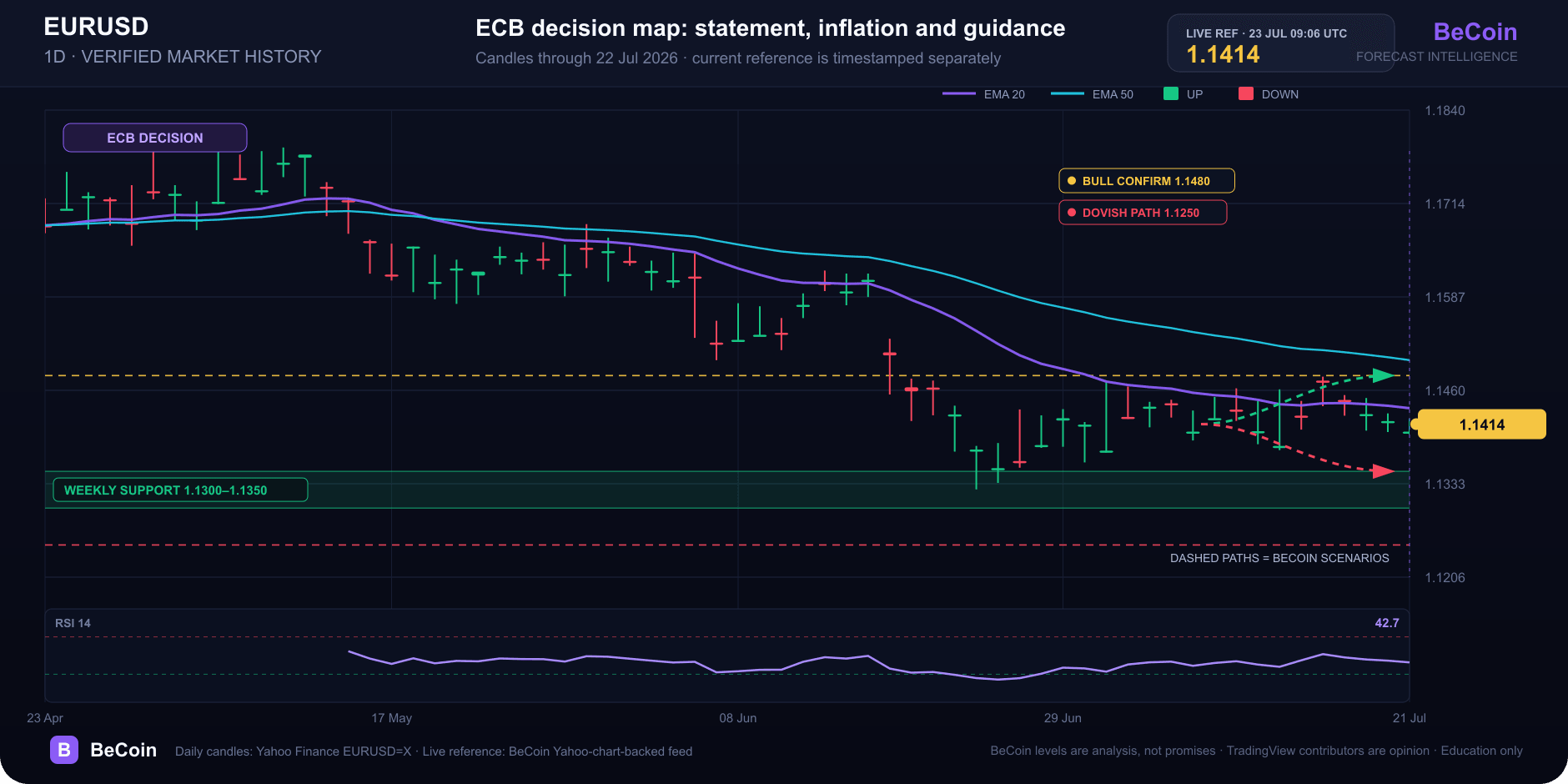
EUR/USD traded near 1.1414 before the ECB’s July decision. Here is what a hold, hawkish hold or surprise hike could mean for 1.1350 and 1.1480.

Trading Currency Strength Instead of Single Pairs
It was a Tuesday afternoon when I realized I was fighting a losing battle against a ghost. My screen was a chaotic web of indicators. I had the EUR/USD chart open, a moving average crossing over here, a relative strength index flashing oversold there, and a price action setup that looked textbook perfect. I clicked […]

The Best Broker Without Complicated Features (And Why Simplicity Wins)
Most traders don’t fail because they lack knowledge. They fail because their platform buries them in noise before they even place their first trade. Here’s what actually works. It Started With a Confession From a $10 Trader A reader messaged us a few months back. He had been trying to trade for three weeks, had […]

Which Broker Has Faster Withdrawals? Real 2026 Comparison for Traders
When most beginners choose a broker, they focus on bonuses, signals, or flashy interfaces. But after trading for a while, you realize one thing matters more than almost anything else: How fast can you actually withdraw your money? A broker can look perfect until your first withdrawal request gets stuck in “processing” for three days. […]
Why Most Deriv Traders Blow Accounts: A Data-Driven Post-Mortem Analysis
The first time I blew a trading account on Deriv, it didn’t happen dramatically. There was no single catastrophic trade. It happened quietly. One loss turned into another. Then I increased the stake to recover the loss. Then the market moved again. Before I realized what had happened, an account balance that took weeks to […]

How Liquidity Affects Day Trading Results
When I first started trading day trading, I believed success was all about finding the perfect indicator. I spent weeks testing moving averages, RSI settings, support and resistance levels, and dozens of YouTube strategies that promised easy wins. Some worked for a few trades, but most failed. What confused me was that the same setup […]