EUR/USD Forecast: 1.1540 Demand Holds While 1.1584 Caps Every Rally
A Channel That Keeps Its Shape
EUR/USD has been climbing inside an ascending channel that almost nobody trusts, largely because the advance has been so slow. Each leg higher has been shallow, each pullback has been shallower, and the pair has spent more time inside a 45-pip band than outside it. That is not a failure of the structure. It is what a low-conviction uptrend looks like.
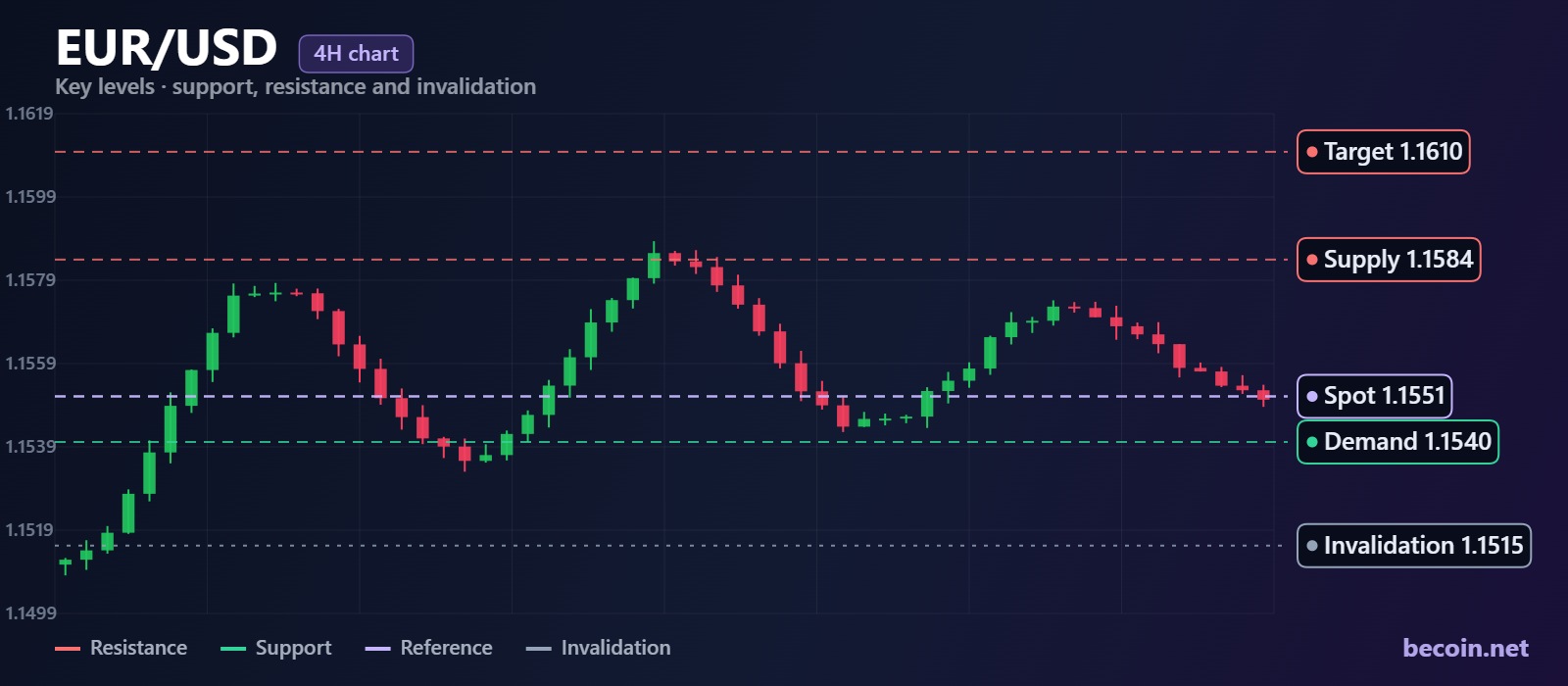
The two lines that matter are the 1.1540 demand zone underneath and the 1.1580 to 1.1584 supply pocket above. Everything in between is the market waiting for a reason.
Why the EUR/USD Forecast Starts at 1.1540
The 1.1540 area is the lower boundary of the channel and the origin of the last two impulsive moves higher. Price has traded into it repeatedly and been lifted away within a handful of candles each time, usually with a long lower wick rather than a decisive body.
Those wicks are the tell. They indicate resting bids being filled rather than momentum buying, which is a slower but more durable form of support. The zone extends a little lower to roughly 1.1515 to 1.1518, and that is where the channel argument genuinely ends. Any read that survives a break of 1.1515 is not really a channel read anymore.
1.1584 Is Where the Sellers Live
Above the market, the pair has now been rejected from 1.1580 to 1.1584 on three separate approaches. Each rejection has been quick, each has produced a red four-hour candle with a visible upper wick, and none has been followed by a retest that held.
That makes the zone a genuine supply shelf rather than a passing pause. Clearing it opens the path toward the 1.1610 supply target at the top of the channel, and a sustained move through 1.1610 would change the character of the whole structure from a grind to a trend. Until then, rallies into the mid-1.1580s are fades until proven otherwise.
The Macro Tension Behind the Range
The reason the pair cannot pick a direction is that both sides of the rate story are stale. European growth data has been soft but not deteriorating, and the dollar side has been dominated by a market that has already priced most of what it expects. Neither central bank has given traders a fresh reason to reprice.
That leaves the pair drifting on flows rather than fundamentals, which is exactly the environment where technical levels do the heavy lifting. It also means the eventual break is more likely to be triggered by a data surprise than by a slow rotation, so the move out of this range should be faster than the range itself.
A Practical Way to Frame the Setup
The structure favours buying reactions at 1.1540 with invalidation below 1.1515, targeting the top of the channel near 1.1610. The mirror trade is selling rejections at 1.1584 with risk above 1.1595 and a first objective back at 1.1540. Both are level-to-level trades, and both depend on waiting for the candle to close rather than anticipating it.
Traders who want the channel boundaries and the supply pockets maintained as they shift can follow the running currency scenarios in Becoin.net Premium Forecast, where the same zones are tracked across the majors with the invalidation points attached. The available coverage levels are listed on Becoin.net Tariff Plans.
What Would Break This Idea
A four-hour close below 1.1515 breaks the channel and turns the demand zone into resistance. That would shift the working bias from buying dips to selling rallies, and it would leave the pair without meaningful structure for a stretch beneath.
On the upside, a four-hour close above 1.1584 that holds through the next candle ends the supply argument. At that point 1.1610 becomes a waypoint rather than a target, and pullbacks into the mid-1.1550s become entries rather than warnings. Everything else is range noise, and the pair has produced plenty of it lately.
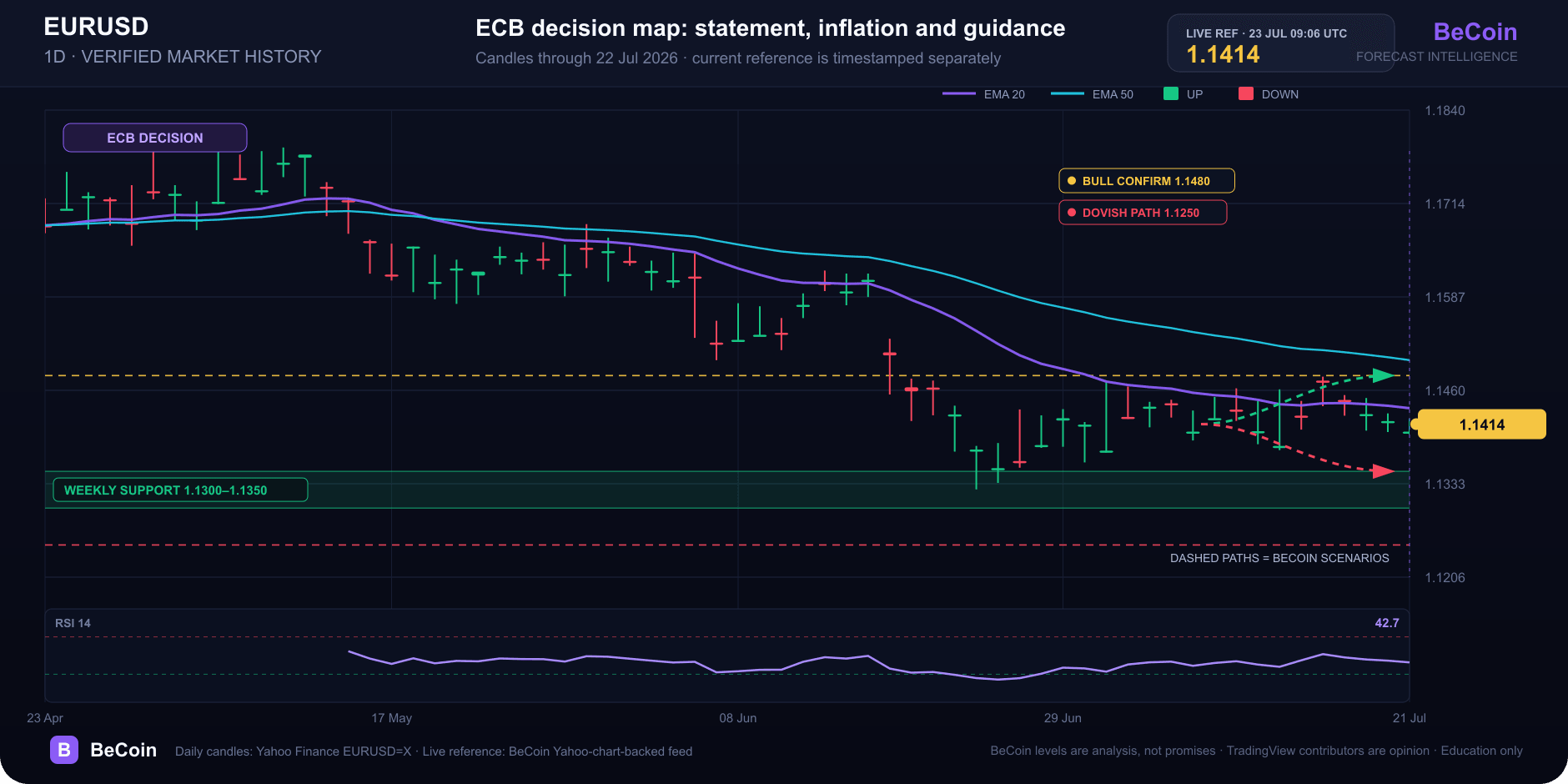
EUR/USD holds 1.1414 before the ECB decision: three scenarios
EUR/USD traded near 1.1414 before the ECB’s July decision. Here is what a hold, hawkish hold or surprise hike could mean for 1.1350 and 1.1480.

How Liquidity Affects Day Trading Results
When I first started trading day trading, I believed success was all about finding the perfect indicator. I spent weeks testing moving averages, RSI settings, support and resistance levels, and dozens of YouTube strategies that promised easy wins. Some worked for a few trades, but most failed. What confused me was that the same setup […]

Which Broker Is Better for Weekend Trading?
It was a chilly Saturday morning, and while the rest of the world was sleeping in or catching up on shows, I was staring at a completely frozen screen. My usual EUR/USD chart looked like a heart monitor flatlining. The traditional markets were closed. The banks were shut down. For a long time, that was […]

Which Broker Has Faster Withdrawals? Real 2026 Comparison for Traders
When most beginners choose a broker, they focus on bonuses, signals, or flashy interfaces. But after trading for a while, you realize one thing matters more than almost anything else: How fast can you actually withdraw your money? A broker can look perfect until your first withdrawal request gets stuck in “processing” for three days. […]

Best Broker for Pakistani Traders in 2026
Finding the best broker in Pakistan is not as simple as choosing the platform with the biggest ads or the highest payout percentage. Pakistani traders face unique challenges including payment method limitations, withdrawal delays, unstable strategies, and brokers that look attractive at first but become difficult to use later. Many beginners deposit money into the […]

Binomo vs IQ Option for Small Accounts: Which Platform Is Better for Beginners in 2026?
Most people entering online trading do not start with thousands of dollars. They start small. Usually with $10, $20, or maybe $50. That small balance changes everything about how a trader behaves. Every loss feels bigger, every win feels emotional, and every mistake has a stronger impact on the account. This is exactly why beginner […]