Walmart Stock Forecast 2026: WMT Stock Price, Targets & Key Levels
Walmart Stock Forecast 2026: WMT Stock Price, Key Support Levels and What Comes Next
Walmart Stock Forecast: Why WMT Stock Price Fell After a Strong Quarter
The Walmart stock forecast changed sharply after the company released its second-quarter fiscal 2027 results on August 20, 2026.
On paper, Walmart delivered a strong quarter. Revenue reached $187.9 billion, up 5.9%, while adjusted earnings per share came in at $0.81. Global eCommerce sales increased 23%, Walmart U.S. comparable sales rose 2.6%, U.S. advertising grew 38%, and global membership fee revenue increased 17%.
Walmart also raised its full-year fiscal 2027 outlook, with constant-currency sales now expected to increase 4% to 5% and adjusted operating income expected to grow 7% to 8.5%.
Yet the Walmart stock price suffered a dramatic post-earnings decline.
The reason is important: investors were not simply reacting to whether Walmart beat estimates. They were looking at the quality and sustainability of the growth, particularly the outlook for the next quarter and the unusually large contribution from tariff refunds.
As of the September 2 close, WMT stock price stood at $106.09, following a modest 0.16% gain on the day. The stock had closed at $103.09 on August 28 before recovering over the following sessions.
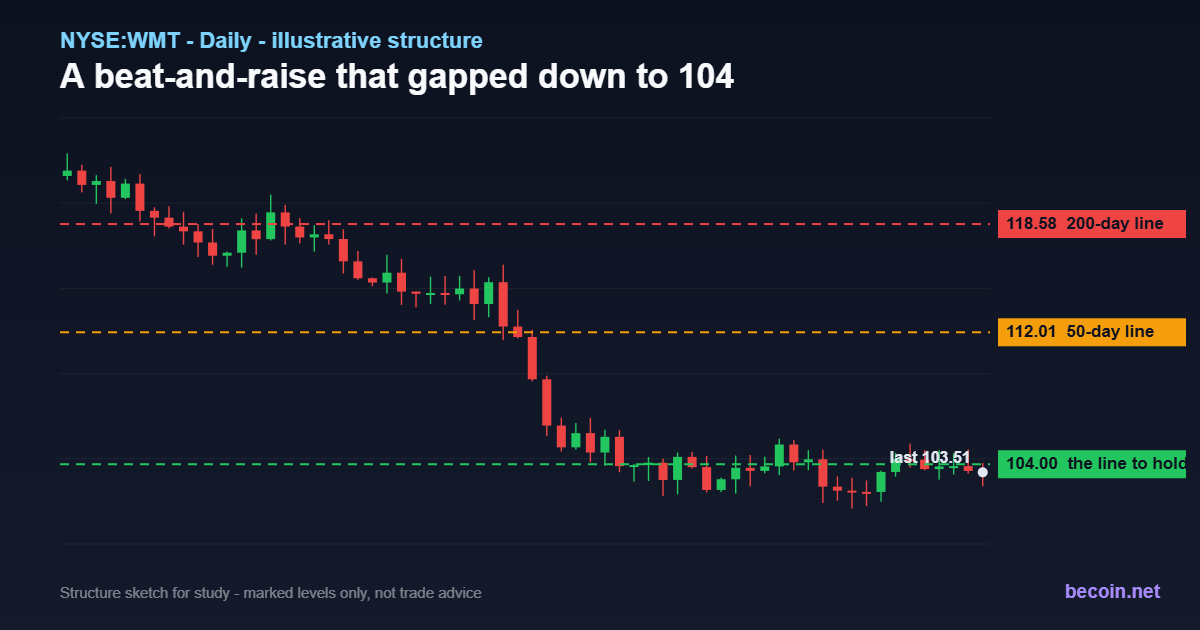
For anyone searching for a Walmart stock forecast 2026, the key question now is whether the stock can turn the $104 area from former resistance into durable support.
Walmart Stock Price Today: Where WMT Stands Now
The latest closing Walmart stock price was $106.09 on September 2, 2026.
That is still well below Walmart's 2026 peak of approximately $135.16, meaning WMT remains in a substantial correction from its high. Historical price data shows the stock closed at $103.09 on August 28, then recovered to $104.87 on August 31, $105.92 on September 1 and $106.09 on September 2.
That recovery matters technically, but it has not yet changed the broader structure.
The stock remains below several important moving averages. Technical data around the start of September showed the 50-day moving average around $111.53 and the 200-day moving average around $118.05, leaving WMT below both major trend references.
So the current setup is simple:
- $104-$106: immediate decision zone
- $102.44-$102.63: important lower support
- $97.94: potential gap-fill/downside magnet
- $95.70: major downside floor
- $111-$112: first major recovery test
- Around $114: earnings-gap resistance
- Around $118: longer-term moving-average resistance
The stock does not need to immediately return to $135 for the technical picture to improve. The first objective is simply to reclaim broken levels and prove that buyers are willing to defend them.
The Level Map for WMT Stock
$104: The Line in the Sand
The $104 area remains one of the most important levels in the current Walmart stock forecast.
It previously acted as resistance during the stock's advance and is now being tested as potential support. WMT closed at $103.09 on August 28, putting price almost directly on that zone before the subsequent recovery.
A sustained defense of $104 would support the bullish case for a stabilization phase.
A decisive breakdown, however, would increase the probability of another move toward the low-$100s.
$102.44-$102.63: Immediate Downside Support
The next important area sits around $102.44-$102.63.
Walmart traded as low as $102.27 on August 27 before recovering. That makes the low-$102 area an important reference for traders watching the Walmart stock price.
A weekly close below this zone would weaken the stabilization thesis.
$97.94 and $95.70: The Next Downside Targets
Below the low-$102 region, attention shifts toward the $97.94 area, followed by the $95.70 region.
A move toward those levels would represent a deeper correction rather than merely a retest of the current support zone.
The key point is that these levels become relevant only if WMT loses the current support structure. They should not be treated as guaranteed targets.
$111-$112: First Real Recovery Test
On the upside, the first meaningful hurdle is around $111-$112.
The 50-day moving average was around $111.53 in early September, placing this region directly above the current Walmart stock price.
A sustained move above this area would be the first evidence that the post-earnings downtrend is beginning to repair.
$114-$118: The Bigger Resistance Zone
Above $112, the next major area is approximately $114, followed by the $118 region.
The $118 area is particularly important because the 200-day moving average was around $118 in early September.
Until WMT can reclaim these levels, rallies should be viewed as recovery attempts rather than a confirmed trend reversal.
Why Walmart Stock Fell Despite Strong Earnings
The most interesting part of thisWalmart stock forecast is that the company's operating results were not weak.
Walmart reported:
- Revenue of $187.9 billion
- Revenue growth of 5.9%
- Adjusted EPS of $0.81
- Global eCommerce growth of 23%
- Walmart U.S. comparable-sales growth of 2.6%
- U.S. advertising growth of 38%
- Global membership fee revenue growth of 17%
The company also raised its full-year outlook.
So why did the stock sell off?
There are two major reasons.
1. The Q3 Outlook Implied Slower Growth
Walmart's fiscal 2027 third-quarter guidance calls for constant-currency net sales growth of 3.0% to 3.75% and adjusted EPS of $0.62 to $0.64.
That sales-growth range is considerably slower than the 5.1% constant-currency revenue growth Walmart delivered in Q2.
Management also highlighted an important calendar effect: the timing of Flipkart's Big Billion Days promotion creates a headwind of more than 100 basis points to Q3 growth because the event shifts between quarters. Management specifically encouraged investors to evaluate Q2 and Q3 together.
That makes the Q3 headline number less alarming than it initially appears, but investors still have to decide whether Walmart's underlying growth is beginning to normalize.
2. Tariff Refunds Made the Margin Beat Look Less Recurring
This is arguably the more important part of the Walmart stock forecast.
Walmart received nearly $2.9 billion in tariff refunds during the quarter.
The company said adjusted operating-income growth of roughly 17% in Q2 included a 750-basis-point net benefit from tariff refunds. Walmart also said that, excluding this benefit, underlying operating-income growth was at the top end of its 7%-10% guidance.
That distinction matters.
A one-time refund can boost reported profitability, but investors generally assign a higher valuation to earnings that can be repeated.
In other words, Walmart's underlying business did not suddenly become weak. The problem is that part of the exceptional margin performance came from a factor that investors cannot simply extrapolate into every future quarter.
Walmart has said it is prioritizing the remaining tariff refunds toward price investments and customer value.
That could support traffic and market share over the longer term, but it also means investors need to separate temporary financial benefits from recurring operating growth.
Walmart Stock Forecast: Bull Case
The bullish case starts with the company's underlying business.
Walmart continues to show strong digital growth, with global eCommerce up 23%. Advertising, membership revenue and marketplace activity are also expanding.
If those higher-margin businesses continue scaling while Walmart maintains traffic and market share, earnings growth could remain stronger than the headline revenue growth suggests.
Technically, the first confirmation would be a sustained move above $111-$112.
A reclaim of approximately $114 would strengthen the recovery setup further, while a move back toward $118 would indicate that the broader downtrend is being challenged.
Analyst targets also show that Wall Street has not abandoned the long-term Walmart growth story. Following the August earnings report, several firms retained Buy ratings even while cutting price targets. Examples included $130 from Raymond James and Guggenheim, $125 from J.P. Morgan and Evercore ISI, $132 from Citi, and $120 from Baird and Wells Fargo.
The bullish argument is therefore not that Walmart's problems have disappeared.
It is that the current Walmart stock price has already discounted a significant amount of disappointment.
Walmart Stock Forecast: Bear Case
The bearish case is centered on valuation and slowing incremental growth.
Walmart remains a premium retailer, and investors have historically been willing to pay a high multiple for its combination of scale, defensive demand and consistent execution.
But the higher the valuation, the less room there is for guidance disappointments.
If Q3 growth lands toward the bottom of management's range and underlying margins soften as tariff-related benefits fade, the market could demand another valuation reset.
Technically, the bear case becomes much stronger if WMT loses $102.44-$102.63 on a sustained basis.
That would expose the stock to the high-$90s and potentially the $95-$96 region.
Oppenheimer has reportedly identified a potential bottoming area in the low-$90s to low-$100s, showing just how divided the market has become after the earnings-driven repricing.
Walmart Stock Forecast for November 2026
The next major catalyst is Walmart's fiscal 2027 third-quarter earnings report on November 19, 2026. Walmart has officially confirmed the release date and plans to release its earnings materials at approximately 6 a.m. Central Time.
That report could settle the biggest debate around the current Walmart stock price:
Was Q2 simply distorted by timing and tariff refunds, or is Walmart's underlying growth actually slowing?
Until then, the market is likely to trade the technical levels.
Scenario 1: $104 Holds
If Walmart continues defending the $104 region and remains above $102.44-$102.63, the stock could establish a trading range.
The first upside objective would be $111-$112, followed by approximately $114.
This would represent stabilization rather than a confirmed bull-market reversal.
Scenario 2: WMT Breaks Below $102.44
A decisive weekly close below approximately $102.44 would weaken the current setup.
That would put the $97.94 area into focus, followed by approximately $95.70.
A move toward those levels would indicate that investors are demanding a larger valuation reset.
Scenario 3: WMT Reclaims $112
A sustained move above $112 would be the first meaningful repair signal.
If WMT then closes above approximately $114, the post-earnings gap would begin to look increasingly vulnerable to a full recovery.
A move toward the $118 region would represent a much more significant trend change.
What Could Move the Walmart Stock Price Next?
Several factors could influence WMT between now and the November earnings report.
Consumer spending
Walmart's value proposition becomes particularly important if consumers become more cautious. Strong traffic and transaction growth would support the bullish case.
Tariffs and refunds
The nearly $2.9 billion tariff refund received in Q2 was significant. The market will watch how Walmart's margins behave as those benefits become less prominent.
eCommerce growth
Global eCommerce growth of 23% remains one of Walmart's strongest growth engines. A continuation of that trend could help justify the company's premium valuation.
Advertising and marketplace
Walmart's advertising and marketplace businesses can potentially generate higher-margin growth than traditional retail. Their continued expansion is therefore important to the long-term Walmart stock forecast.
Interest rates and market valuation
Walmart is often treated as a defensive retailer, but its stock valuation still matters. Changes in interest rates and the broader market's willingness to pay premium multiples can affect WMT even when the underlying business remains healthy.
Walmart Stock Forecast: Key Levels to Watch
| Level | Significance |
|---|---|
| $95.70 | Major downside floor |
| $97.94 | Potential gap/downside target |
| $102.44-$102.63 | Immediate major support |
| $104 | Key decision level |
| $106.09 | Latest September 2 closing Walmart stock price |
| $111-$112 | First major recovery resistance |
| $114 | Earnings-gap resistance |
| ~$118 | 200-day moving-average area |
| $135.16 | 2026 peak / major long-term resistance |
Walmart Overnight Stocker: Is It Related to Walmart Stock?
The phrase “walmart overnight stocker” refers to a Walmart store job, not the WMT stock price.
An overnight stocker is generally responsible for tasks such as unloading freight, moving inventory in the backroom and stocking merchandise on store shelves. Walmart's current job listings describe stocking associates as working heavily in backroom and freight operations, with some roles requiring the ability to lift more than 50 pounds.
Why include this in a Walmart stock article?
Because searches for Walmart cover very different intents. Someone searching “walmart overnight stocker” is usually looking for employment information, while someone searching “Walmart stock price” or “Walmart stock forecast” is looking for financial information.
For SEO, these topics should therefore be connected carefully rather than repeatedly forcing the keyword into the investment analysis.
Frequently Asked Questions About Walmart Stock
What is the Walmart stock price?
Walmart (NYSE: WMT) closed at $106.09 on September 2, 2026. The stock has been recovering from its August earnings selloff but remains below several major technical resistance levels.
What is the Walmart stock forecast for 2026?
The near-term forecast depends heavily on whether WMT can hold the $104 area and reclaim the $111-$112 region. A breakdown below $102.44-$102.63 would increase downside risk, while a sustained move above $112 would improve the technical outlook.
When is Walmart's next earnings report?
Walmart's fiscal 2027 third-quarter earnings release is scheduled for November 19, 2026.
Why did Walmart stock fall after earnings?
The selloff was driven less by weak Q2 execution and more by concerns over the slower Q3 sales outlook and the sustainability of margin gains that were significantly helped by tariff refunds.
Is Walmart stock a buy?
That depends on an investor's time horizon, valuation assumptions and risk tolerance. Technically, the key question is whether WMT can establish support around $104 and reclaim $111-$112. Fundamental investors should focus on recurring operating-income growth, eCommerce, advertising, consumer demand and the effect of fading tariff-related benefits.
What does a Walmart overnight stocker do?
A Walmart overnight stocker typically works on freight, backroom inventory and shelf replenishment during overnight shifts. The role is operational and is unrelated to Walmart's stock-market ticker, WMT.
Bottom Line: Walmart Stock Forecast
The Walmart stock price has moved from a clear post-earnings breakdown into an important stabilization test.
At around $106, WMT is sitting above the critical $102-$104 support region but remains below the $111-$112 recovery zone and the roughly $118 long-term moving-average area.
The fundamental picture is mixed rather than broken.
Walmart is still producing strong revenue growth, expanding eCommerce, growing advertising and membership revenue, and raising its full-year outlook. But investors are now demanding evidence that those gains can continue without relying on unusually favorable tariff-related benefits.
For the near term, the map is straightforward:
$104 is the line in the sand.
$102.44-$102.63 is the major downside trigger.
$111-$112 is the first recovery confirmation.
$114-$118 is the larger resistance zone.
And November 19, 2026 is the event that could ultimately decide whether this correction was a valuation reset or the beginning of a deeper change in Walmart's growth profile.
Becoin.net Premium Forecast Walmart stock- Becoin.net Tariff Plans
This analysis is educational and is not investment advice. The Walmart stock price, technical levels, analyst estimates and company guidance can change as new information becomes available.

Best Broker for Learning Price Action in 2026 (Tested by Real Traders)
Most traders think they need a better strategy. What they actually need is a better understanding of price. A few years ago, one of our community members had over ten indicators on his chart. RSI. MACD. Moving averages. Bollinger Bands. Stochastic. Every new YouTube video added another indicator. The result? More confusion. Not more profits. […]

Which Broker Has Faster Withdrawals? Real 2026 Comparison for Traders
When most beginners choose a broker, they focus on bonuses, signals, or flashy interfaces. But after trading for a while, you realize one thing matters more than almost anything else: How fast can you actually withdraw your money? A broker can look perfect until your first withdrawal request gets stuck in “processing” for three days. […]

Which Broker Is Better for Students in 2026?
For students, trading usually starts with one simple goal: learning how markets work without risking too much money. Most students are not starting with huge budgets. They are trading from a phone, using mobile internet, balancing studies, and trying to avoid losing money quickly. That changes what actually matters in a broker. The “best broker” […]

Is Binomo Safe or Risky in 2026? A Practical User Checklist (Not a Generic Review)
I still remember the first time I opened Binomo. It wasn’t excitement. It was hesitation. I had already read multiple reviews. Some said it was safe. Others called it risky. None of them felt like they came from someone who had actually traded, deposited, withdrawn, and dealt with real friction. So I decided to test […]

Binomo in Pakistan / India / Bangladesh: What Payment Methods Actually Work in 2026?
When I first started testing Binomo seriously across South Asia, I made one rule for myself: I would never judge a platform by the deposit button. I would judge it by the withdrawal result. That single rule saved me a lot of frustration. A lot of articles still ranking for this topic say the same […]
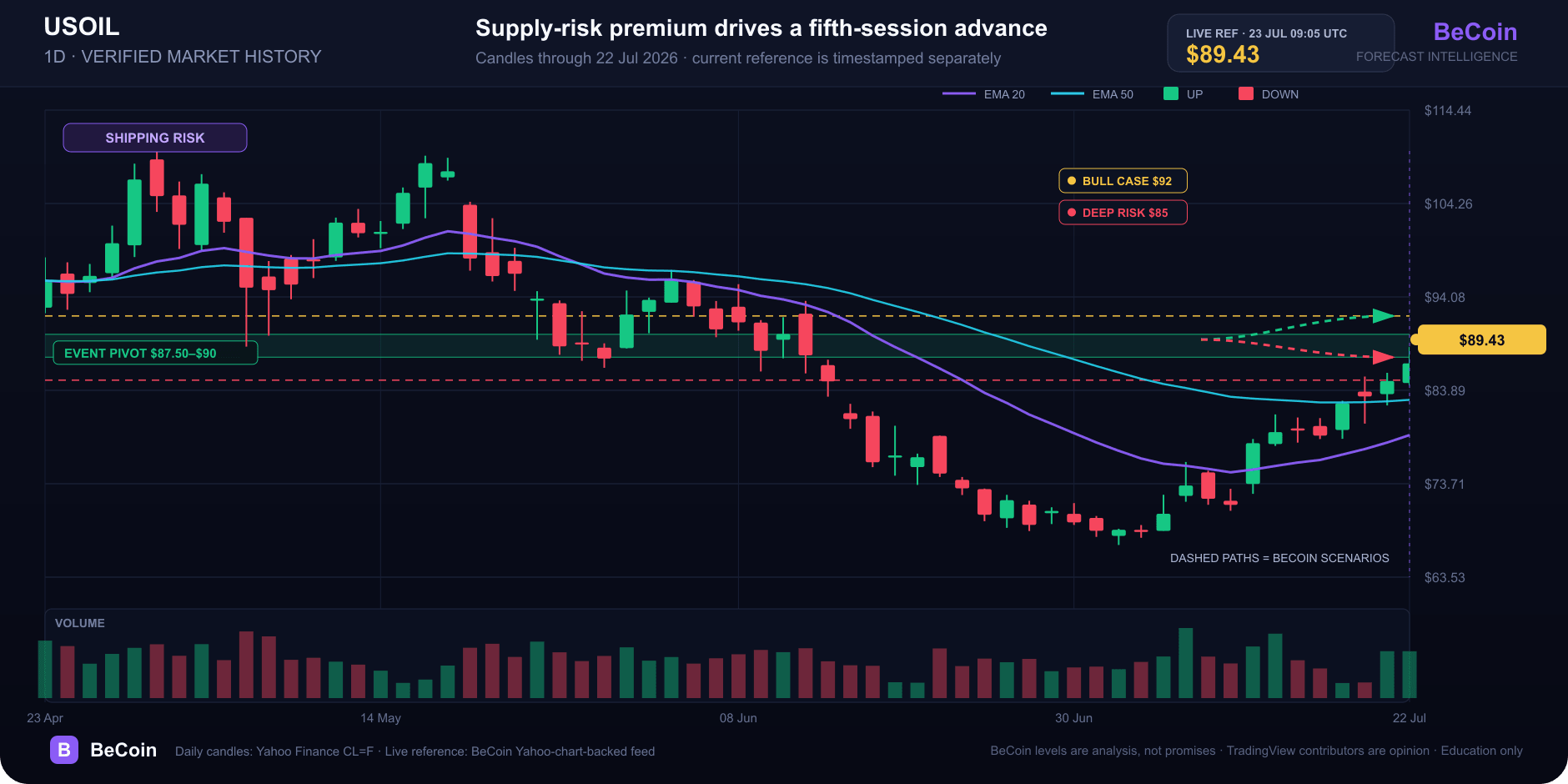
WTI reaches $89.43 as Brent clears $95 on renewed supply risk
WTI traded near $89.43 while Brent moved above $95 as Middle East shipping risk lifted crude for a fifth session. Key levels, catalysts and invalidation.