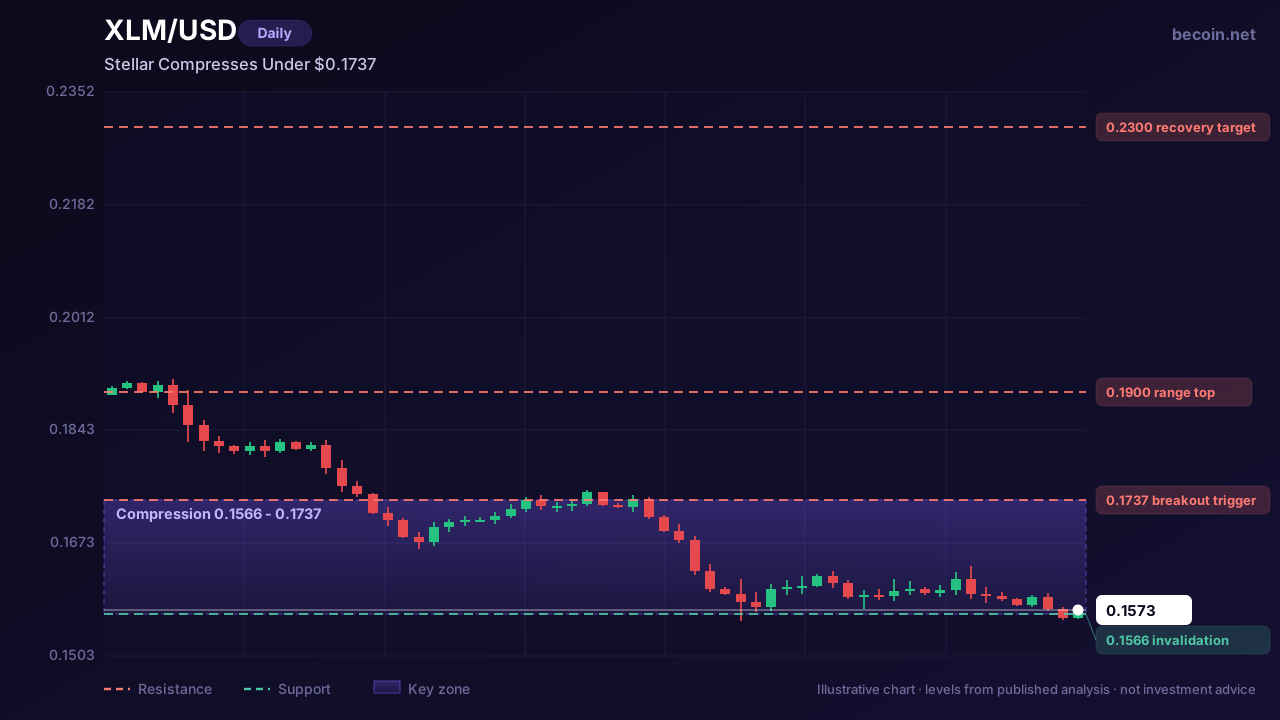
Stellar Compresses Under $0.1737 — The Breakout Nobody Is Watching
Stellar is trading at about $0.1573, essentially unchanged on the day, up a little over 2% for the week and still around 14% lower than a month ago. Nothing about those numbers is dramatic. That is precisely what makes the chart interesting.
A chart that has gone quiet
XLM has spent the last several weeks doing progressively less. Highs have come in lower, lows have come in higher, and daily ranges have contracted to a fraction of what they were during the decline. The token has slipped out of the conversation entirely, which is usually when the setup is forming rather than when it has passed.
Compression is one of the few chart conditions that carries genuine information. It tells you that the supply which was driving price lower has been absorbed, and that the demand which was buying dips has stopped chasing. Neither side has enough conviction to move price, so volatility collapses. That state is unstable by definition — it always resolves, and the resolution is usually disproportionate to the range that preceded it.
The two Stellar lines that define everything
The upper boundary sits around $0.1737. That is the level traders have been pointing at as the breakout trigger, and for good reason — it is where the last several rally attempts have been rejected and where the descending resistance from the highs currently intersects. A daily close above it, ideally with visible volume expansion, is the signal. Our Becoin.net Premium Forecast follows this token through each of those levels as the range resolves.
The lower boundary is around $0.1566. It is the shelf that has caught every decline in the compression, and it doubles as the natural invalidation. A close below it does not just mean the breakout failed — it means the range broke the wrong way, and the token likely revisits the deeper demand area that has not been tested in this move.
Current price at $0.1573 sits close to the bottom of that band, which is worth being honest about. It is a better place to buy a breakout attempt than to chase one, but it is also close enough to the invalidation that a break lower is not a distant risk.
Where a resolution would travel
If $0.1737 gives way, the first objective most analysts are working with is around $0.19, which is the top of the prior range and where the last distribution occurred. Beyond that, $0.23 is the level people keep citing as the recovery target — it corresponds to where the breakdown began and where a measured move from the compression projects.
Those are targets, not predictions. The value of a compression setup is not that it tells you where price is going; it is that it gives you a tight, clearly defined risk on a move whose size you cannot know in advance. That asymmetry is the whole trade.
The risk of trading the coil
The obvious failure mode is impatience. Ranges that narrow for weeks tend to produce several false breaks before the real one — a push above the line that closes back inside, a flush below support that reverses the same session. Traders who enter on the first touch of a boundary rather than on a close beyond it will be stopped out repeatedly on moves that ultimately go their way.
The second failure mode is size. A tight range invites a large position because the stop is close. That is mathematically fine until the resolution gaps through the level, which in crypto happens more often than the model assumes. Sizing for the stop you want rather than the slippage you might get is how a good setup becomes a bad outcome.
For now, XLM is doing nothing loudly. The two lines are drawn. The market will pick one.
Access levels for the daily level maps, scenario updates and alerts are set out on Becoin.net Tariff Plans.
This is market analysis for educational purposes and is not investment advice. Crypto assets are volatile and trading carries risk of loss.

The Day I Stopped Trading and Finally Started Making Money
It was a rainy Tuesday morning, and I was staring at my screen with a familiar knot in my stomach. The previous three days had been a slow, agonizing slide into the red. I had given back two weeks of hard-earned profits in less than seventy-two hours. Every asset I clicked on looked like a […]

Binomo First $10–$50 Test Deposit Plan: The Safest Way to Validate the Platform Before Scaling
I didn’t start with confidence. I started with doubt. Every time I searched for answers about Binomo, I found opinions, not proof. Some people claimed fast withdrawals. Others complained about delays. But almost nobody showed a complete journey from deposit to withdrawal using real money. So I stopped reading and started testing. Instead of risking […]

Which Broker Has Better Risk Management Tools?
The burning smell of my own account blowing up is a scent I will never forget. It was a rainy Tuesday afternoon a few years back. I sat huddled over my laptop, watching a currency pair oscillate. Confident, arrogant, and entirely unprotected, I clicked buy. Minutes later, a sudden market spike completely wiped out my […]

Which Broker Has Faster Withdrawals? Real 2026 Comparison for Traders
When most beginners choose a broker, they focus on bonuses, signals, or flashy interfaces. But after trading for a while, you realize one thing matters more than almost anything else: How fast can you actually withdraw your money? A broker can look perfect until your first withdrawal request gets stuck in “processing” for three days. […]

Deriv vs Binomo for Low-Risk Trading in 2026: Which Platform Is Better for Safer Growth?
Most beginners enter trading with one simple goal: avoid blowing up their account in the first week. That is exactly why low-risk trading matters more than fast profits. Two platforms that constantly appear in beginner discussions are Deriv and Binomo. Both allow small deposits, short-term trading, and beginner-friendly access. But when your focus is protecting […]

Binomo vs IQ Option for Small Accounts: Which Platform Is Better for Beginners in 2026?
Most people entering online trading do not start with thousands of dollars. They start small. Usually with $10, $20, or maybe $50. That small balance changes everything about how a trader behaves. Every loss feels bigger, every win feels emotional, and every mistake has a stronger impact on the account. This is exactly why beginner […]