Millionaire Statistics 2026: How Many in America?
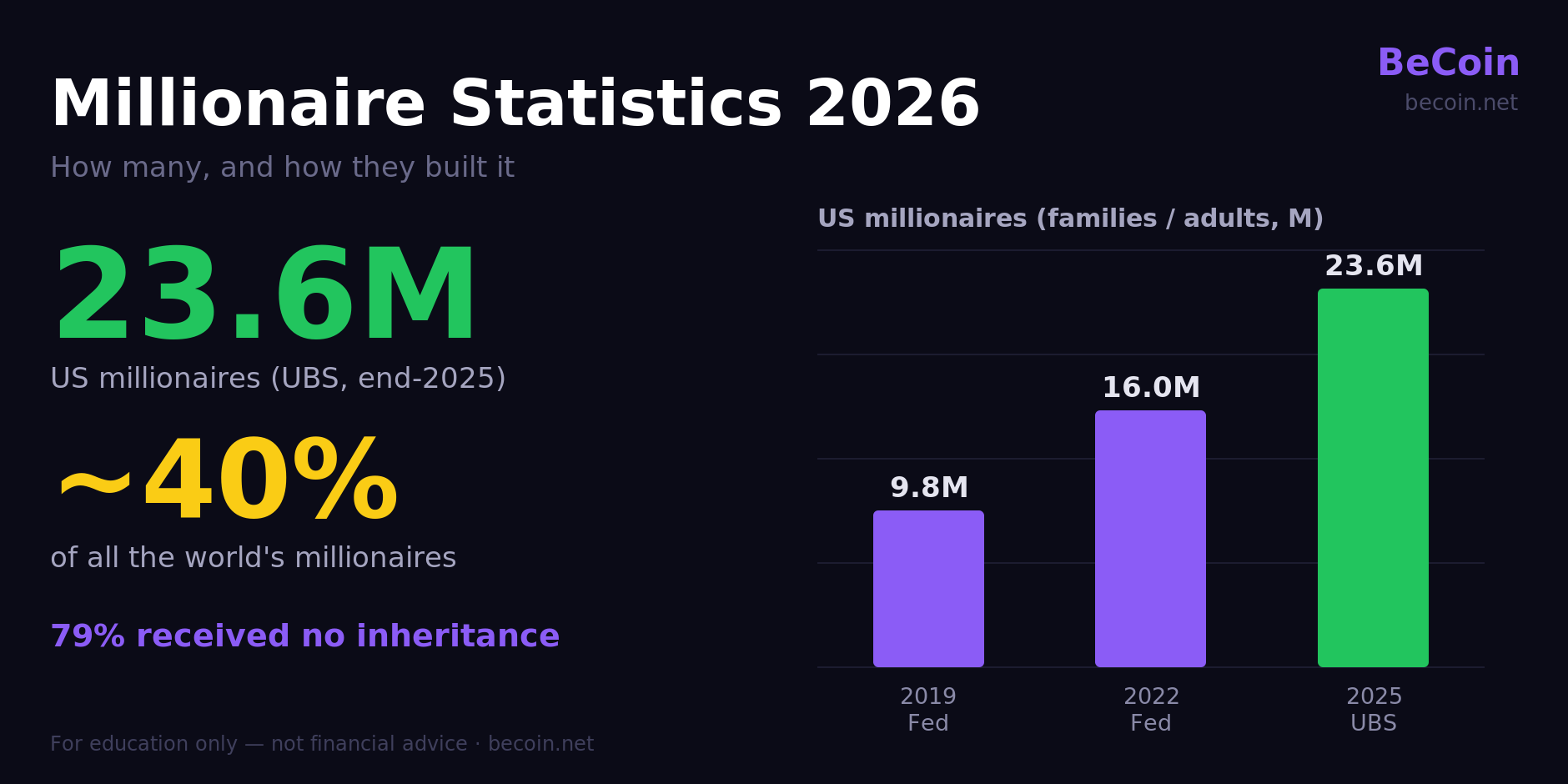
There are about 23.6 million millionaires in the United States as of the end of 2025 — roughly 40% of the world's estimated 58 million millionaires, despite the US holding only about 4% of the global population. That is the count from the 2026 UBS Global Wealth Report, which measures adults with wealth over $1 million. Put another way, roughly 1 in every 15 American adults is a dollar millionaire. And contrary to the stereotype, most of them did not inherit it: in the largest US study of millionaires, 79% received no inheritance at all.
How many millionaires are in the US?
The most-cited answer — about 23.6 million — comes from UBS, which counts individual adults whose total net wealth (including their home) tops $1 million in US dollars. But the Federal Reserve's Survey of Consumer Finances counts households, not adults, and reaches a different figure. Both are authoritative; they simply measure different things.
| Source | Count | Unit measured | As of |
|---|---|---|---|
| UBS Global Wealth Report 2026 | ~23.6 million | Adults with wealth > $1M | End of 2025 |
| Federal Reserve (SCF) | ~16 million | Families with net worth ≥ $1M (~12% of all families) | 2022 survey |
The United States added a record 441,078 new millionaires in 2025 alone, according to UBS — more than 1,200 per day, and nearly half of all the new millionaires created worldwide that year. A quotable way to frame it: America mints roughly one new millionaire every 70 seconds. The Fed's data shows the same upward trend over a longer window — the number of millionaire families jumped about 61%, from 9.8 million in 2019 to 16 million in 2022, and for the first time the average US family net worth crossed $1 million.
What percentage of Americans are millionaires?
Using the UBS adult count of about 23.6 million against roughly 260 million US adults, close to 9% of American adults are dollar millionaires — about 1 in 15. On the household side, the Fed found that slightly more than 12% of American families had a net worth of at least $1 million in 2022. Both figures have climbed sharply this decade, driven largely by rising stock and home prices. For a sense of how ordinary incomes stack up against these wealth milestones, our income percentile calculator shows exactly where any salary lands.
How many millionaires are in the world?
Globally, UBS counts about 58 million millionaires as of the end of 2025, and the population is heavily concentrated in a handful of rich countries. The United States dominates, holding roughly 40% of the world's millionaires by itself.
| Rank | Region / country | Approx. share of world millionaires |
|---|---|---|
| 1 | United States | ~40% |
| — | Rest of world combined | ~60% |
The concentration is striking: with about 4% of the world's people, the US accounts for more dollar millionaires than the next several countries combined. Nearly one million people worldwide crossed the million-dollar threshold in 2025, propelled largely by a strong year in global stock markets. For the bigger picture on where all this wealth sits, see our breakdown of how much money there is in the world.
Why do the millionaire numbers disagree?
If you have seen figures ranging from 16 million to 24 million for the US, the gap is not error — it is methodology. Four choices explain almost all of it. First, adults vs households: UBS counts individual adults, so a married couple sharing a $1.5 million net worth can register as two half-millionaires or, depending on how wealth is split, as counts that differ from a single "millionaire household." Second, the snapshot year: the Fed's most recent complete survey is 2022, while UBS runs through end-2025 — and markets rose substantially in between. Third, what counts as wealth: UBS includes home equity and nets out debt, which pulls millions of homeowners above the line. Fourth, currency and coverage: UBS works in US dollars across a global model, while the Fed samples US families directly. None of the sources is "wrong"; serious coverage cites the measure that fits the question.
How did most millionaires get rich?
The largest study of American millionaires — Ramsey Solutions' National Study of more than 10,000 US millionaires — found that wealth is overwhelmingly built, not inherited. The most-cited findings:
- 79% received no inheritance at all from their parents or family.
- 89% are first-generation wealth — they did not inherit their money.
- 93% said they got wealthy through hard work, not a big salary.
- Only 31% averaged $100,000 or more per year over their career, and about a third never earned six figures in a single working year.
- 8 in 10 built wealth primarily by investing in their company 401(k).
- Only 15% held senior-leadership roles such as VP or C-suite.
The behavioral lesson is that consistency and time in the market — not windfalls or executive pay — did most of the work. The same compounding math that builds a seven-figure retirement account is illustrated in our what-if-I-invested tool.
What jobs do millionaires have?
The Ramsey study's top five millionaire careers surprise people who expect a list of glamorous, high-paying professions:
| Rank | Career |
|---|---|
| 1 | Engineer |
| 2 | Accountant |
| 3 | Teacher |
| 4 | Management |
| 5 | Attorney |
Teacher on a top-five list is the tell: steady saving and disciplined investing, sustained over decades, beat raw income for most of the people who reach a million. This is the opposite of the get-rich-quick pitch — and it is worth contrasting with the very top of the wealth pyramid in our companion piece, billionaire statistics 2026.
Millionaires vs billionaires: the scale gap
A millionaire and a billionaire are far less alike than the words suggest. A billion is a thousand million — so the roughly 3,428 billionaires Forbes counts sit atop a pyramid whose base is the 23.6 million US millionaires. To put the distance in human terms: counting to a million takes about 11 days at one number per second; counting to a billion takes about 31 years. The wealthiest slice matters for markets far out of proportion to its size, which is why we track it separately in billionaire statistics and in the assets behind those fortunes on our forecast hub.
FAQ
How many millionaires are in the US in 2026?
About 23.6 million US adults were dollar millionaires as of the end of 2025, per the 2026 UBS Global Wealth Report. The Federal Reserve's 2022 survey counted about 16 million millionaire families (slightly over 12% of households) — a different but complementary measure.
What percentage of Americans are millionaires?
Roughly 9% of US adults (about 1 in 15) are dollar millionaires by the UBS measure, and slightly more than 12% of US households by the Fed's household measure.
How many millionaires are in the world?
About 58 million as of end-2025, according to UBS. Nearly one million people became new millionaires globally in 2025, and the United States alone holds roughly 40% of the world total.
Are most millionaires self-made?
Yes. In Ramsey's study of over 10,000 US millionaires, 79% received no inheritance and 89% represent first-generation wealth. Only 31% ever averaged $100,000 or more a year over their careers.
How much net worth do you need to be in the top 1%?
Well above $1 million. The Fed's 2022 data put roughly 8 million US families above $2 million in net worth; the top 1% threshold sits substantially higher still, which is why "millionaire" and "top 1%" are not the same thing.
Which country has the most millionaires?
The United States, by a wide margin — around 40% of the world's millionaires live there, more than the next several countries combined, despite the US holding only about 4% of the global population.
Methodology and sources
Figures are drawn from primary, dated sources: the UBS Global Wealth Report 2026 (17th edition, published June 30, 2026; wealth measured per adult in US dollars as of end-2025, including the US total of 23,627,000 millionaires and 441,078 added in 2025) and the US Federal Reserve's Survey of Consumer Finances 2022 (family net worth, released 2023). Behavioral statistics come from Ramsey Solutions' National Study of Millionaires (more than 10,000 US millionaires surveyed). Derived figures — millionaires as a share of adults, one-new-millionaire-per-70-seconds — are our own calculations from those totals. Wealth counts shift with markets and survey timing; treat all numbers as dated snapshots.
This article is for educational purposes only and is not financial advice. Wealth estimates are approximations by the cited publishers.
Curious how the assets behind these fortunes might move next? Get full access to all 100+ assets →

How Many People Own Bitcoin? (2026 Data, Charts & Country Breakdown)
About 365 million people owned Bitcoin in 2025 - roughly 4-4.5% of the world and nearly half of all crypto owners. See the year-by-year growth curve, country data, whole-coin rarity, and why estimates disagree.

Deriv vs IQ Option for Synthetic Indices: Which Platform Is Better in 2026?
Synthetic indices have become one of the most talked about trading categories among beginners and experienced traders alike. Unlike forex or crypto markets that depend on real world events, synthetic indices operate 24/7 using algorithm driven price movements. That means traders can access opportunities at any time without waiting for market openings or major news […]

Chasing Safety in a High-Stakes World: My Quest for the Best Low-Risk Trading Platforms
I still remember the sinking feeling in my stomach when I lost my first tiny trading account. It wasn’t a massive fortune, but it was mine. That night, I realized a brutal truth about this industry: most beginners fail not because they lack passion, but because they dive into high-risk environments without a life jacket. […]

Why Traders Move from Binomo to Deriv in 2026: The Real Reasons Behind the Switch
If you spend enough time around trading communities, you’ll notice a pattern. Many traders start with Binomo. Then, after a few months, a surprising number begin looking at Deriv. Some switch completely. Others keep both accounts but gradually move most of their trading activity to Deriv. I noticed this trend while talking to beginner traders […]

Best Trading Platform for Slow Internet in 2026
A slow internet connection can ruin trades faster than a bad strategy. Charts freeze, apps reload, and delayed execution creates unnecessary losses. This is especially common for traders using mobile data, shared WiFi, or older smartphones. Most broker reviews ignore this issue completely. After testing multiple platforms on weaker connections and low-end Android devices, some […]

Best Broker for Pakistani Traders in 2026
Finding the best broker in Pakistan is not as simple as choosing the platform with the biggest ads or the highest payout percentage. Pakistani traders face unique challenges including payment method limitations, withdrawal delays, unstable strategies, and brokers that look attractive at first but become difficult to use later. Many beginners deposit money into the […]