Billionaire Statistics 2026: Counts, Wealth and Trends
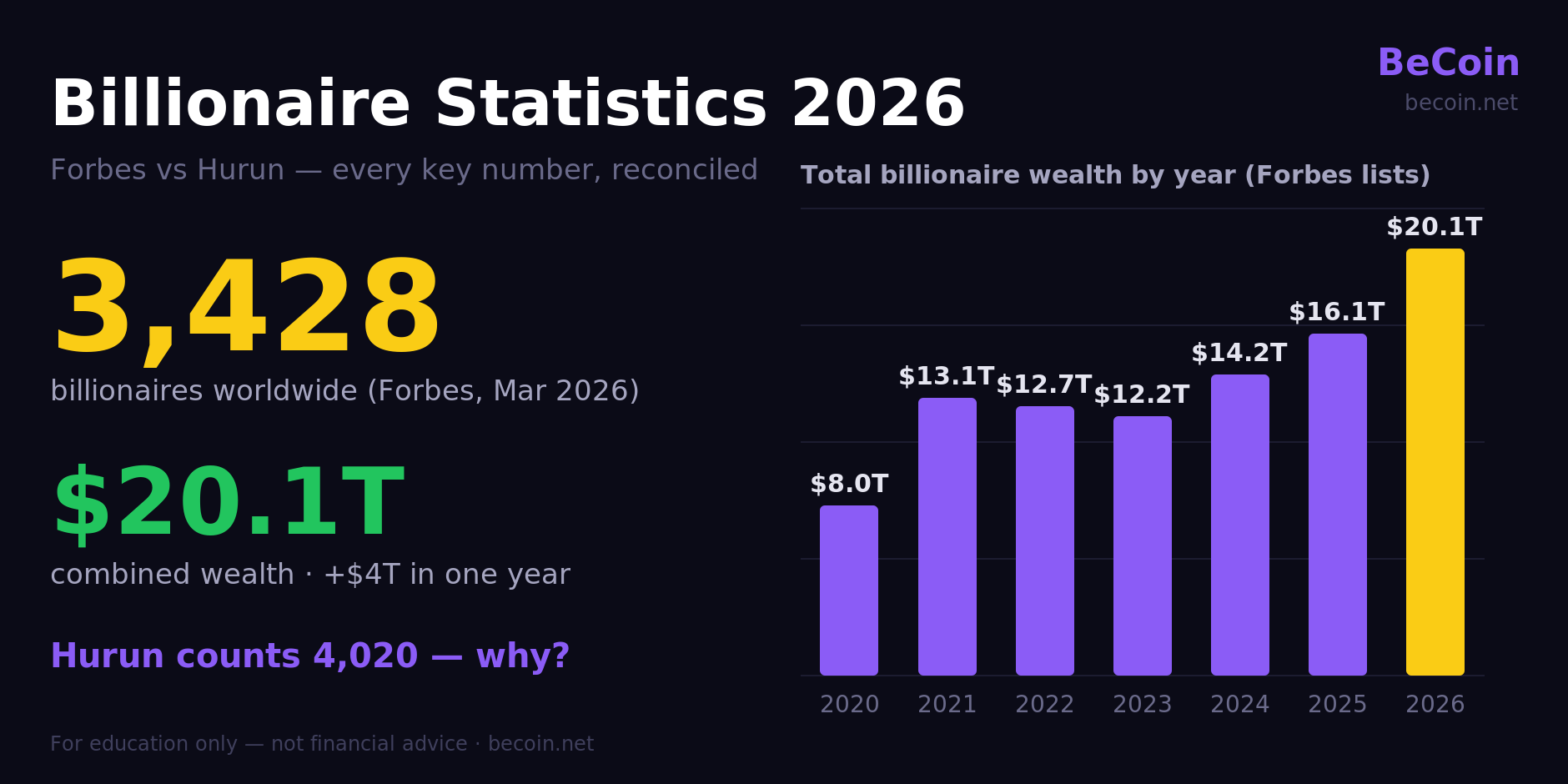
There are a record 3,428 billionaires in the world in 2026, worth a combined $20.1 trillion, according to the Forbes World's Billionaires List (March 2026). The rival Hurun Global Rich List counts 4,020. The planet added more than one new billionaire per day over the past year, and the billionaire class grew $4 trillion richer. Forbes puts the United States first with 989 billionaires; Hurun puts China first with 1,110 — and the reason the two most-cited lists disagree tells you a lot about how extreme wealth is actually measured.
How many billionaires are there in the world?
The answer depends on who is counting. The two most authoritative trackers disagree by almost 600 people:
| Source | Billionaires (2026) | Change vs 2025 | Combined wealth | Snapshot date |
|---|---|---|---|---|
| Forbes World's Billionaires List | 3,428 | +400 | $20.1 trillion | March 1, 2026 |
| Hurun Global Rich List | 4,020 | +578 | n/a (not directly comparable) | January 15, 2026 |
By the Forbes count, the average billionaire is now worth $5.8 billion, up from $5.3 billion in 2025. With roughly 8.2 billion people on Earth, that works out to about one billionaire for every 2.4 million people. For context on how billionaire wealth compares with all money on the planet, see our breakdown of how much money there is in the world — the entire billionaire class holds roughly 4% of humanity's total net wealth.
Which country has the most billionaires?
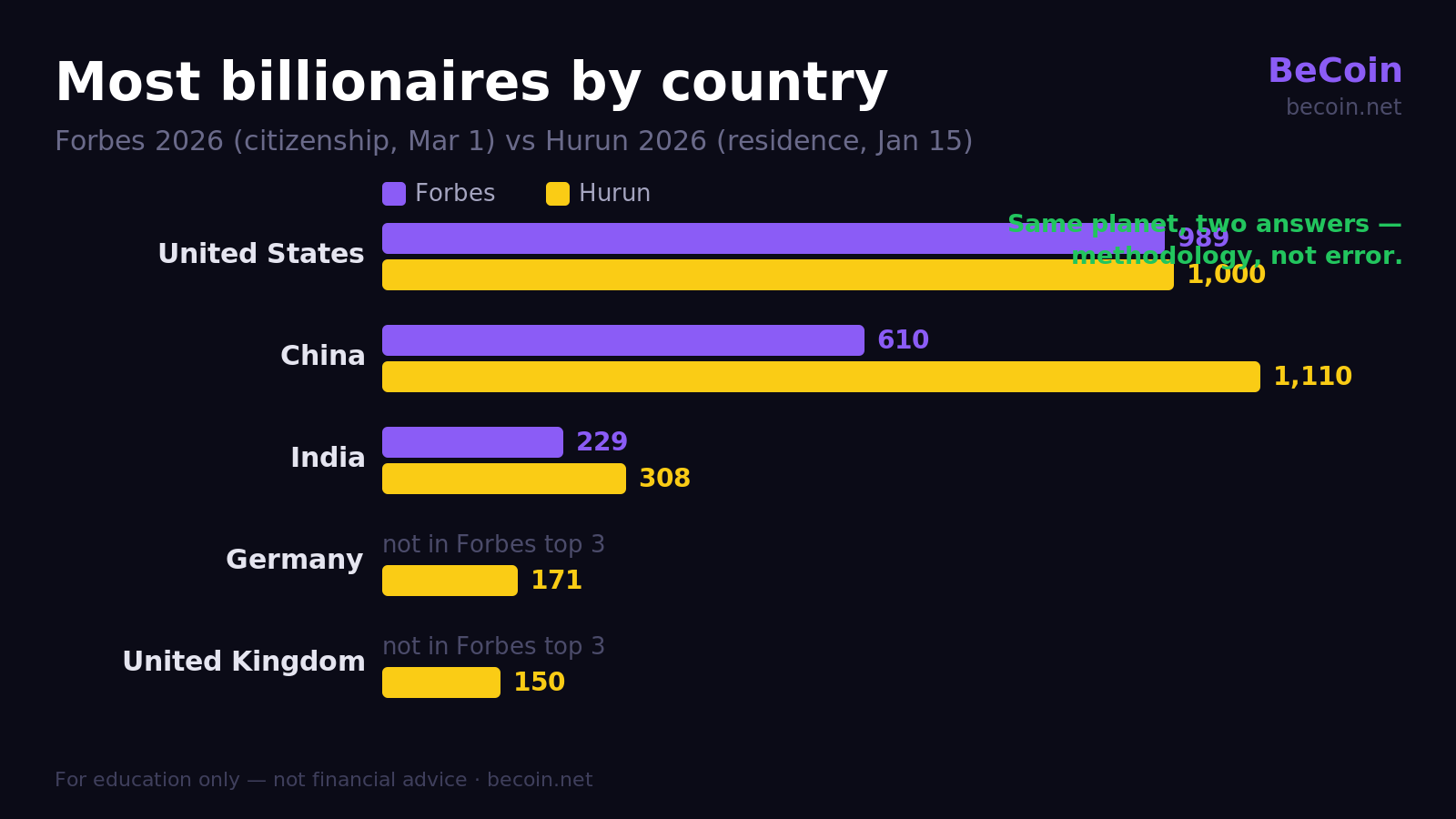
This is where the two lists split most sharply. Forbes counts by citizenship and finds the United States on top; Hurun counts by residence, applies a looser evidence threshold, and finds China on top.
| Rank | Forbes 2026 (citizenship) | Count | Hurun 2026 (residence) | Count |
|---|---|---|---|---|
| 1 | United States | 989 | China | 1,110 |
| 2 | China (incl. Hong Kong) | 610 | United States | 1,000 |
| 3 | India | 229 | India | 308 |
| 4 | — | Germany | 171 | |
| 5 | — | United Kingdom | 150 | |
| 6 | — | Switzerland | 114 | |
| 7 | — | Russia | 105 | |
Under either method, the US and China together are home to roughly half of all billionaires on Earth. Forbes' 3,428 billionaires come from 80 countries and territories — from Afghanistan, which gained its first billionaire citizen this year, to Zimbabwe. According to Hurun, 75% of China's billionaires were not on the list ten years ago.
Who is the richest person in the world?
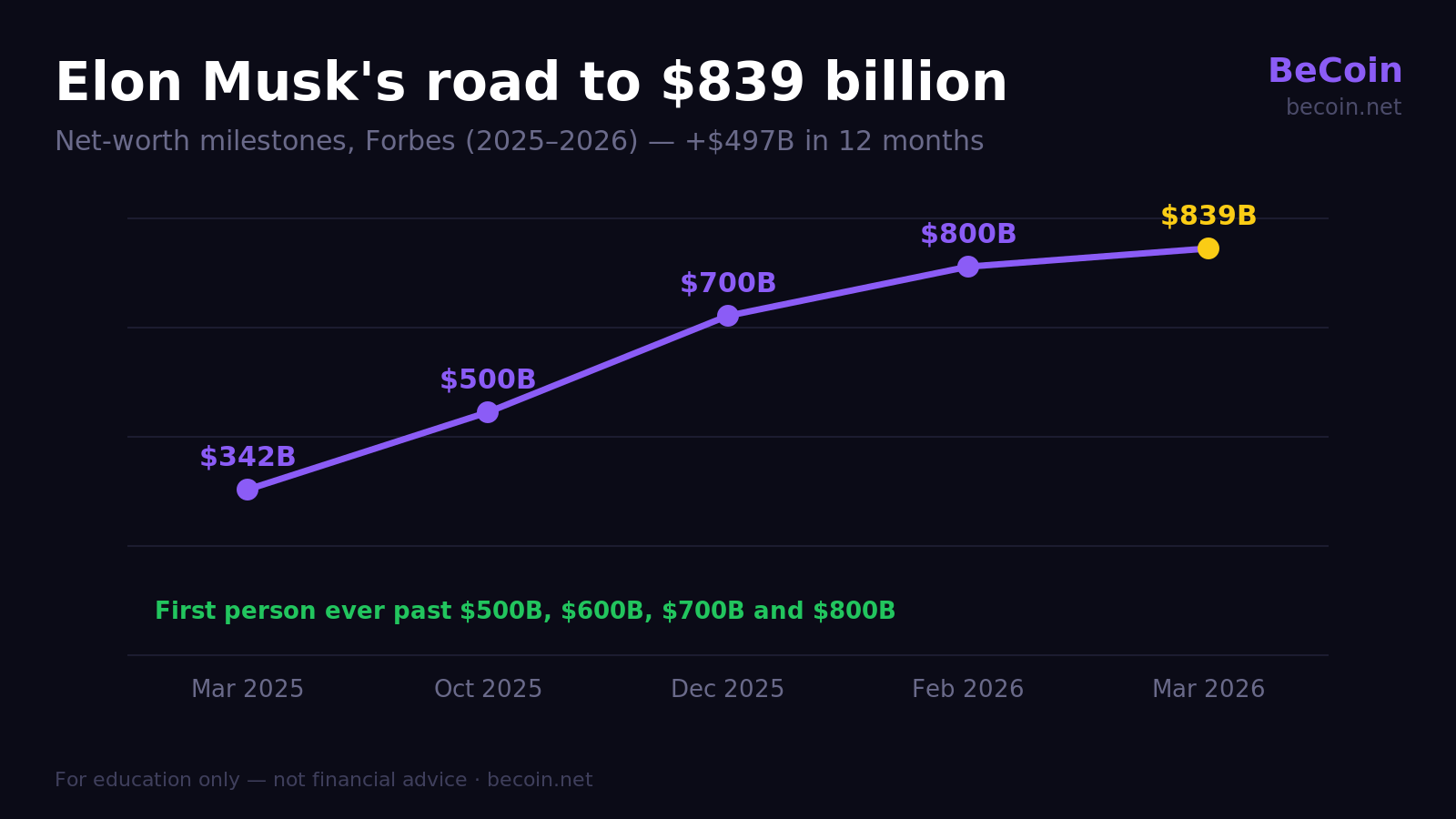
Elon Musk tops the 2026 Forbes list with a record $839 billion fortune — $497 billion more than a year earlier, and more than three times his closest competitor. Musk became the first person ever to reach $500 billion in October 2025, crossed $600 billion and $700 billion within four days in December, and passed $800 billion in February 2026. His fortune alone equals about 4.2% of all billionaire wealth on the planet.
| Rank | Name | Net worth (Mar 2026) | Main source |
|---|---|---|---|
| 1 | Elon Musk | $839 billion | Tesla, SpaceX, xAI |
| 2 | Larry Page | $257 billion | Google (Alphabet) |
| 3 | Sergey Brin | $237 billion | Google (Alphabet) |
A record 20 people now belong to the "$100 Billion Club" of centibillionaires, up from 15 in 2025 — and nearly half of them made their fortunes in tech. The richest woman in the world is Walmart heir Alice Walton at $134 billion. Much of this wealth sits in publicly traded stocks — you can follow the companies behind the biggest fortunes, including Tesla and Alphabet, on our forecast hub or test how their shares might move with AI-powered forecasts.
How fast is billionaire wealth growing?
Billionaire wealth is compounding far faster than the global economy. Total billionaire wealth on the Forbes list grew about 25% in a single year (from $16.1 trillion to $20.1 trillion), while the number of billionaires grew 13%.
| Year (Forbes list) | Billionaires | Combined wealth |
|---|---|---|
| 2020 | 2,095 | $8.0 trillion |
| 2021 | 2,755 | $13.1 trillion |
| 2022 | 2,668 | $12.7 trillion |
| 2023 | 2,640 | $12.2 trillion |
| 2024 | 2,781 | $14.2 trillion |
| 2025 | 3,028 | $16.1 trillion |
| 2026 | 3,428 | $20.1 trillion |
In six years the billionaire population grew by roughly 64% and billionaire wealth by about 151%. If you are curious where your own income places you against the broader population rather than the three-comma club, try our income percentile calculator.
The AI billionaire boom
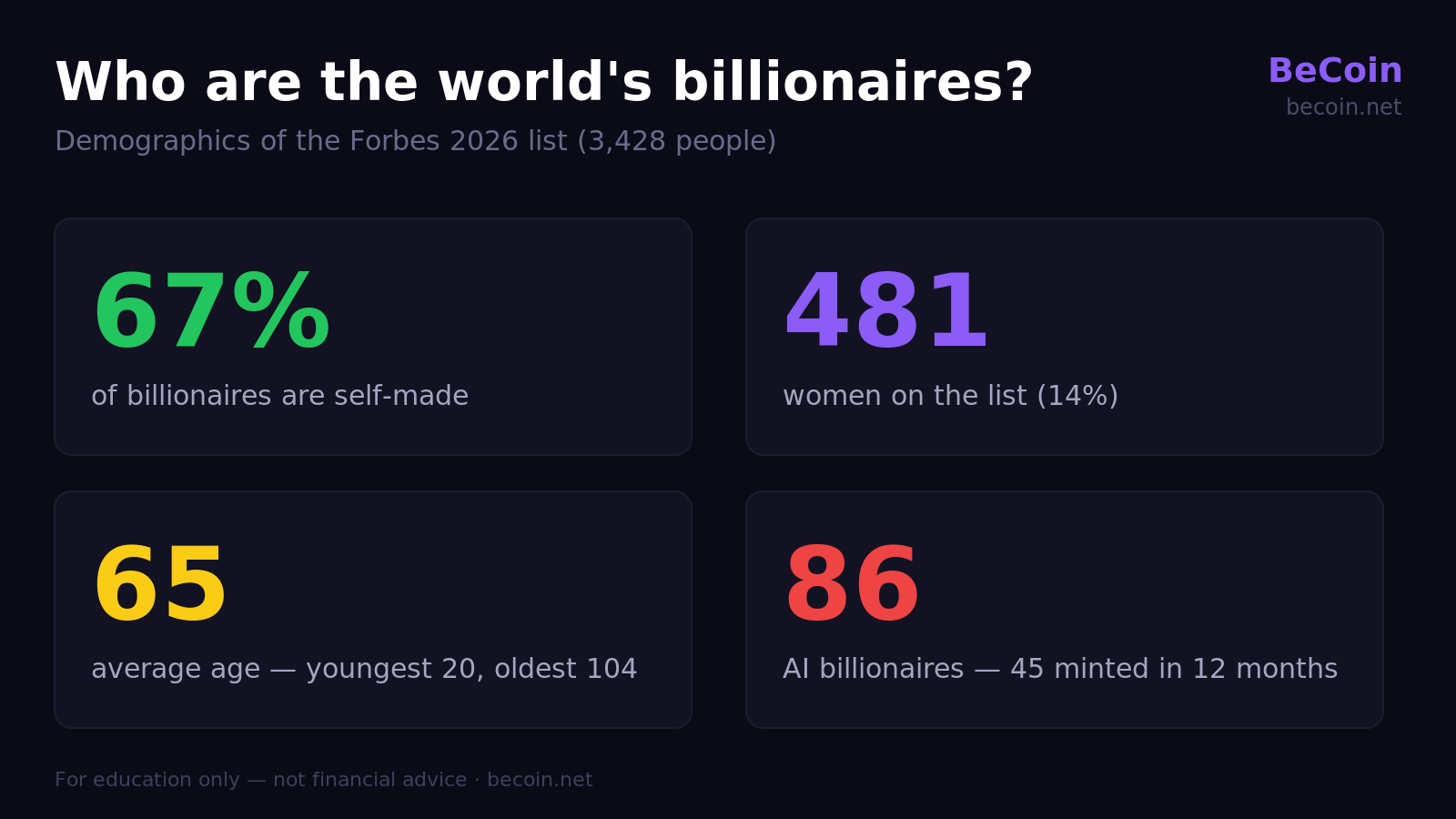
The driving force behind the 2026 surge is artificial intelligence. At least 86 billionaires on the Forbes list owe their fortunes in a major way to AI, and 45 of them — more than half — reached billionaire status in the past 12 months alone, including founders of Perplexity, Mistral, Cursor and Cognition. The list's richest newcomer is Surge AI founder Edwin Chen at an estimated $18 billion.
AI is also making billionaires younger, faster. A record 35 billionaires are under 30, and the new youngest self-made billionaire — Mercor co-founder Surya Midha — is just 22, beating the record Mark Zuckerberg set when he debuted at 23 nearly two decades ago.
Self-made vs inherited: key demographic statistics
A few of the most-cited numbers from the 2026 Forbes list, in one place:
- 67% of the world's billionaires are self-made.
- 481 billionaires are women — 14% of the list, up from 13.4% in 2025. Of those, 122 are self-made.
- 390 newcomers joined the list this year, including Beyoncé, Dr. Dre and Roger Federer.
- The average billionaire is 65 years old. The youngest is 20; the oldest, insurance tycoon George Joseph, is 104.
- 89 people dropped off the list and 39 members of the 2025 list died.
Crypto wealth is part of the story too: Binance founder Changpeng Zhao ("CZ") joined the $100 billion club at an estimated $110 billion, making him richer than Bill Gates. For how widely crypto wealth is actually distributed, see how many people own Bitcoin.
From ballerina to billionaire
The 2026 lists are not only a scoreboard of inherited fortunes. Forbes profiles show how quickly new industries can create extreme wealth: Kalshi co-founder Luana Lopes Lara moved from ballet training into prediction markets; Edwin Chen built Surge AI around specialist data work for artificial-intelligence systems; and the age range runs from insurance veteran George Joseph to young technology heir Amelie Voigt Trejes. Their paths are different, but they underline the same point: the composition of the billionaire class changes faster than the headline count.
Why Forbes and Hurun disagree
Three methodological choices explain almost the entire 592-person gap between the lists. First, the snapshot date: Hurun locked wealth on January 15, 2026, Forbes on March 1, 2026 — six weeks apart in a fast-moving market. Second, geography: Forbes assigns billionaires by citizenship, Hurun by where they live, which shifts entire cohorts between the US, China and low-tax hubs like Monaco and Singapore. Third, the evidence bar: Hurun is generally more willing to credit hard-to-verify private fortunes, especially in China, which is the main reason its total count runs higher. Neither list is "wrong" — they measure slightly different things, which is why serious coverage cites both.
FAQ
How many billionaires are there in the world in 2026?
Forbes counts a record 3,428 billionaires worth a combined $20.1 trillion as of March 1, 2026. Hurun counts 4,020 as of January 15, 2026. The difference comes from methodology, not error.
How many billionaires are in the United States?
Forbes counts a record 989 US billionaires by citizenship in 2026; Hurun counts 1,000 by residence. Fifteen of the 20 richest people on Earth live in the US.
Who is the richest person in the world in 2026?
Elon Musk, with a record $839 billion (Forbes, March 2026). He is the first person ever to pass $500 billion, $600 billion, $700 billion and $800 billion in net worth.
What percentage of billionaires are self-made?
67% of the world's billionaires are self-made according to Forbes' 2026 list. Among women billionaires the picture reverses: roughly three-quarters inherited their fortunes.
How much of the world's wealth do billionaires hold?
The $20.1 trillion held by Forbes-listed billionaires equals roughly 4% of total global net wealth (about $471 trillion per UBS) — held by 0.00004% of the world's population.
Methodology and sources
All figures are drawn from primary rankings and dated as of their snapshot: Forbes World's Billionaires List 2026 (wealth as of March 1, 2026; published March 10, 2026), Hurun Global Rich List 2026 (wealth as of January 15, 2026), and Visual Capitalist's country breakdown of Hurun data (June 2026). Historical totals come from Forbes' annual lists 2020–2025. Derived statistics (billionaires per capita, share of billionaire wealth) are our own calculations from those figures. Billionaire counts change daily with markets; treat all numbers as snapshots.
This article is for educational purposes only and is not financial advice. Wealth estimates are approximations by the cited publishers.
Want to track the assets behind the world's biggest fortunes — from Tesla to Bitcoin? Get full access to all 100+ assets →

Best Broker for Learning Price Action in 2026 (Tested by Real Traders)
Most traders think they need a better strategy. What they actually need is a better understanding of price. A few years ago, one of our community members had over ten indicators on his chart. RSI. MACD. Moving averages. Bollinger Bands. Stochastic. Every new YouTube video added another indicator. The result? More confusion. Not more profits. […]

Deriv vs IQ Option for Beginners in 2026: Which Platform Is Better to Start With?
Choosing your first trading platform can decide whether you stay consistent or quit after blowing your first account. Most beginners do not fail because trading is impossible. They fail because they start on platforms that confuse them, encourage emotional trading, or make risk management difficult. Two names that often appear in beginner discussions are Deriv […]

Binomo vs IQ Option for Small Accounts: Which Platform Is Better for Beginners in 2026?
Most people entering online trading do not start with thousands of dollars. They start small. Usually with $10, $20, or maybe $50. That small balance changes everything about how a trader behaves. Every loss feels bigger, every win feels emotional, and every mistake has a stronger impact on the account. This is exactly why beginner […]

How Many People Own Bitcoin? (2026 Data, Charts & Country Breakdown)
About 365 million people owned Bitcoin in 2025 - roughly 4-4.5% of the world and nearly half of all crypto owners. See the year-by-year growth curve, country data, whole-coin rarity, and why estimates disagree.

The Day I Stopped Trading and Finally Started Making Money
It was a rainy Tuesday morning, and I was staring at my screen with a familiar knot in my stomach. The previous three days had been a slow, agonizing slide into the red. I had given back two weeks of hard-earned profits in less than seventy-two hours. Every asset I clicked on looked like a […]