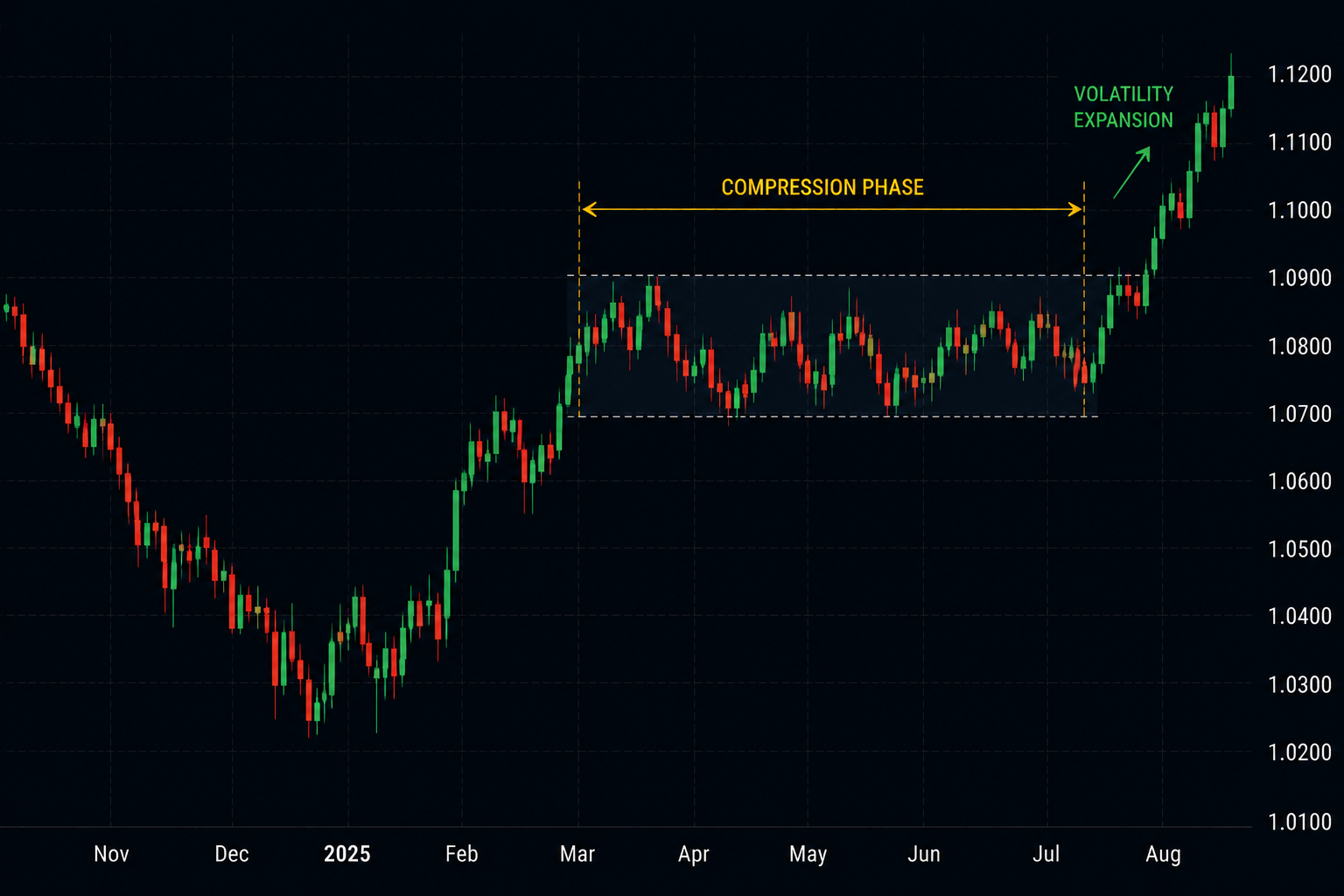
After the Squeeze: What Historically Follows Long Periods of Compressed FX Ranges
Currency markets spend far more time going nowhere than they do trending, and the periods of stillness are usually the least discussed. When a pair such as EUR/USD or AUD/USD grinds through weeks of shrinking daily ranges, most commentary simply calls the market boring and waits. That gap is worth filling, because compression is measurable, it has a history, and it tells you something about how positioning and liquidity are building beneath a flat price.
What compressed FX ranges actually measure
Compression is a statement about the distance price travels, not the direction it chooses. The common ways to quantify it are average true range relative to its own multi-month average, the width of a rolling standard-deviation band, realised volatility over ten or twenty sessions, and the spread between implied volatility on one-month options and what the spot market has actually delivered. When several of those readings sit in the lowest quartile of their own history at the same time, you are looking at genuine compression rather than a slow week.
Why quiet periods form
Ranges usually tighten for structural reasons rather than random ones. Two central banks may have converged on similar policy paths, which removes the rate-differential engine that drives trends. A major event may be scheduled just ahead, so market makers widen nothing and participants refuse to commit size. Seasonal liquidity gaps, holiday calendars and month-end rebalancing can all flatten activity. Understanding which of these is responsible matters, because a range caused by a pending central bank decision behaves very differently from one caused by an empty August calendar.
What tends to follow, and what does not
The honest version of the historical record is that volatility is persistent in the short run and mean-reverting over longer horizons. Quiet weeks tend to be followed by quiet weeks until something forces a repricing, and then the expansion is often faster and larger than the preceding calm would suggest. What the history does not support is any reliable read on direction. Compression is a volatility signal, not a directional one, and studies of breakout behaviour consistently show a high rate of false starts when the move is not accompanied by a change in the underlying macro driver.
The data worth watching during a squeeze
A few inputs help separate a coiled market from a dead one. Options markets show whether traders are paying up for future movement even while spot sits still, and a rising implied-to-realised gap is often the earliest hint of a regime change. Futures positioning shows whether the quiet period is being used to accumulate or to unwind. Rate differentials and the shape of the front end of the curve show whether the macro reason for the range is still intact. Volume distribution shows where liquidity has clustered, which is typically where the eventual expansion will meet resistance or find fuel. Our Market Forecast Hub is a useful place to line these inputs up against each other before drawing conclusions.
What would invalidate the idea
The compression thesis fails in two obvious ways. First, if implied volatility keeps falling alongside realised volatility, the market is not coiling, it is genuinely repricing to a lower-volatility regime, and waiting for an expansion becomes an expensive habit. Second, if a range breaks while positioning data, yield spreads and cross-asset volatility all stay unchanged, the move is more likely liquidity noise than the start of something durable. Both conditions are observable in advance, which is what makes the framework useful.
Becoin.net Tariff Plans ---> Here
How to use this as research
Treat compression as context rather than instruction. It tells you which pairs deserve monitoring, what conditions would confirm that the market is waking up, and what evidence would prove the whole idea wrong. It does not tell you which side to take, and this article deliberately offers no entries, exits or trade recommendations. The value is in knowing what the quiet is made of before it ends.

Which Broker Is Better for Weekend Trading?
It was a chilly Saturday morning, and while the rest of the world was sleeping in or catching up on shows, I was staring at a completely frozen screen. My usual EUR/USD chart looked like a heart monitor flatlining. The traditional markets were closed. The banks were shut down. For a long time, that was […]

Which Broker Is Better for Students in 2026?
For students, trading usually starts with one simple goal: learning how markets work without risking too much money. Most students are not starting with huge budgets. They are trading from a phone, using mobile internet, balancing studies, and trying to avoid losing money quickly. That changes what actually matters in a broker. The “best broker” […]

Deriv vs IQ Option for Beginners in 2026: Which Platform Is Better to Start With?
Choosing your first trading platform can decide whether you stay consistent or quit after blowing your first account. Most beginners do not fail because trading is impossible. They fail because they start on platforms that confuse them, encourage emotional trading, or make risk management difficult. Two names that often appear in beginner discussions are Deriv […]

Simple Daily Trading Routine for Consistency
Most traders do not fail because of strategy alone. They fail because they are random. They trade when emotional, skip planning, increase risk after losses, and ignore review sessions. Consistency in trading usually comes from routine more than prediction. A simple daily trading routine helps you stay disciplined, reduce emotional mistakes, and improve decision making […]

Biggest Beginner Mistakes That Kill Trading Accounts
Trading looks simple from the outside. Open an account, place a few trades, and grow your balance. But reality is different. Most beginners do not lose because markets are impossible. They lose because they repeat the same avoidable mistakes. A small account can survive bad market conditions. What usually kills it is poor decision-making, emotional […]

Trading Currency Strength Instead of Single Pairs
It was a Tuesday afternoon when I realized I was fighting a losing battle against a ghost. My screen was a chaotic web of indicators. I had the EUR/USD chart open, a moving average crossing over here, a relative strength index flashing oversold there, and a price action setup that looked textbook perfect. I clicked […]