Short answer: Binary options news trading means placing a fixed-payout "higher or lower" trade around a scheduled release, such as the US jobs report at 8:30 a.m. New York time.
A big move does not raise the payout. Only direction at the expiry second counts, so a guess that is right half the time loses about $10 per $100 at an 80% payout.
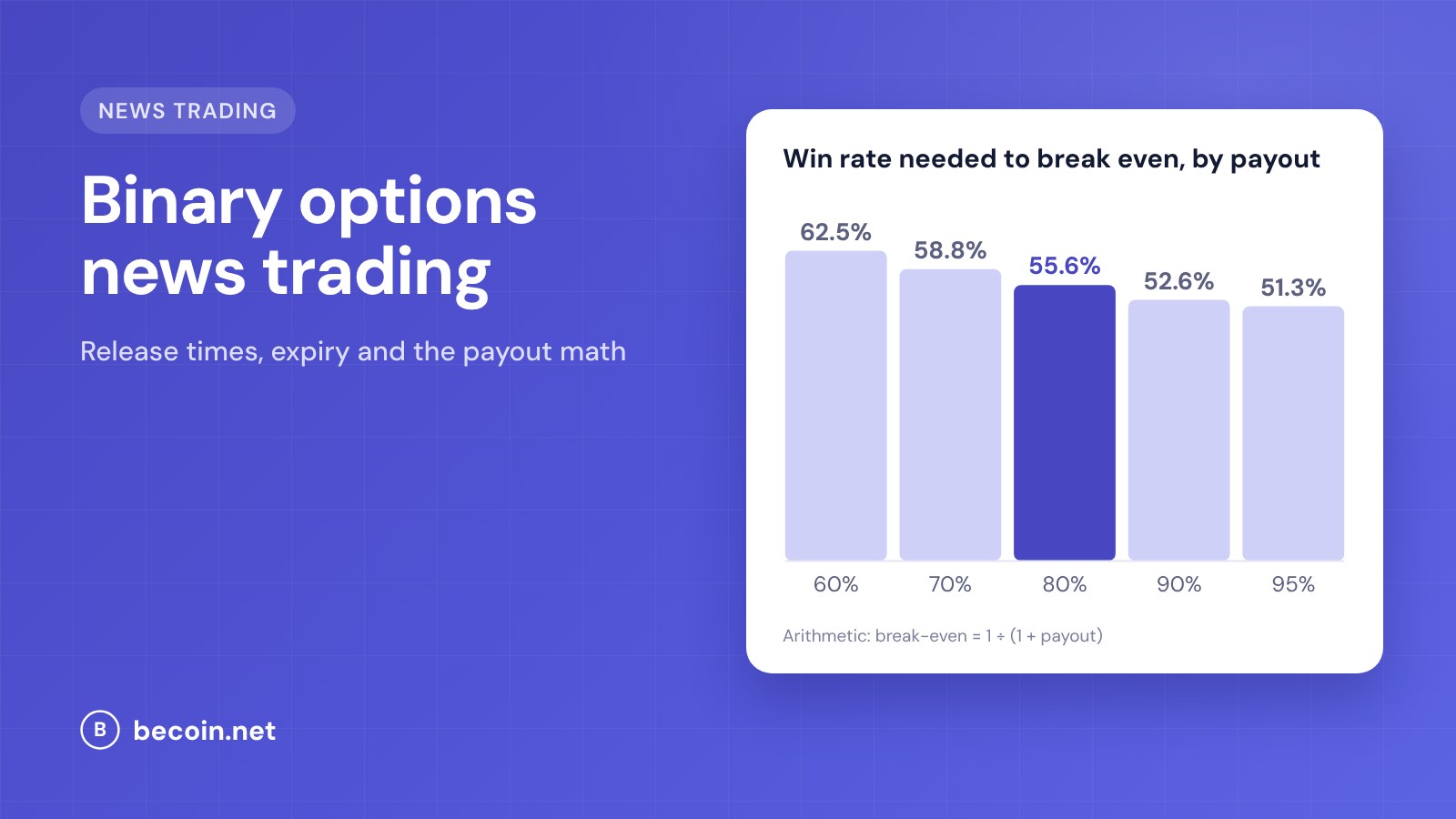
To break even at that payout, 55.6% of trades must win. News adds wider spreads, fast jumps and platform rules that can change prices or cancel trades.
What news trading means on a yes/no contract
A binary option asks one question with a fixed answer, such as "will EUR/USD be above 1.0800 at 13:35:00 UTC?". If yes, the trade pays a set amount. If no, the whole stake is lost.
The CFTC and SEC describe it the same way: at expiry the holder receives "either a pre-determined amount of cash or nothing at all", which is why these are also called "all-or-nothing" or "fixed-return" options.
News trading means timing these trades around a scheduled event. Common targets are US jobs and inflation data and central bank rate decisions, because their release times are published months ahead.
The idea sounds simple: big news makes big moves, so trade the move. The problem is that a binary option does not pay for size. It pays for being on the right side of one price at one second.
Why a big move does not help
With a spot or futures position, a larger move in your favour means a larger gain. With a binary option, the gain is capped at the payout. A 50-pip win pays the same as a 1-pip win.

So the size of the news reaction adds nothing to the trade's value. What decides the result is direction at expiry, and a loss costs more than a win earns.
If the direction call after a release is no better than a coin flip, the expected result per trade is negative at every payout below 100%. A volatile release does not change that; it only makes each outcome arrive faster.
Volatility can even work against a short trade. A fast jump that reverses within minutes can turn a correct first reaction into a loss if the expiry lands after the reversal.
The break-even win rate, worked through
Because a win pays less than a loss costs, you need to win more than half the time just to stand still. The formula:
Break-even win rate = 1 ÷ (1 + payout)
80% payout: 1 ÷ 1.80 = 55.6%
70% payout: 1 ÷ 1.70 = 58.8%
Expected value (EV) turns that into money. It is the average result per trade over many trades.
EV = (win rate × payout × stake) − (loss rate × stake)
$100 stake, 80% payout, 50% wins:
(0.50 × $80) − (0.50 × $100) = −$10
| Payout | Break-even win rate | EV per $100 at 50% wins |
|---|---|---|
| 60% | 62.5% | −$20.00 |
| 70% | 58.8% | −$15.00 |
| 80% | 55.6% | −$10.00 |
| 90% | 52.6% | −$5.00 |
| 95% | 51.3% | −$2.50 |

At 50% wins and an 80% payout, 100 trades of $100 have an expected result of −$1,000. The size of each news move does not enter the formula at all.
The SEC's binary options alert makes the same point with a $50 contract paying a 50% return at 50/50 odds. It says the expected return "is actually negative, resulting in a net loss to the customer."
Real accounts matched the math. Regulator data quoted by the Central Bank of Ireland found that 74–87% of retail binary options accounts lost money in the samples studied (2016–2017).
Run your own payout and win rate in the expectancy calculator or the win-rate section of the break-even calculator.
What moves prices: the surprise, not the number
A common mistake is to trade the headline: "jobs were weak, so the dollar must fall." Markets react to how the number compares with what was expected, and the expectation is already in the price.
The best-known study of this is Andersen, Bollerslev, Diebold and Vega (2003) in the American Economic Review. It used six years of real-time exchange-rate quotes, forecasts and actual data releases.
They found that "announcement surprises produce conditional mean jumps" in US dollar exchange rates. In other words, the jump comes from the gap between the release and the forecast.
They also found a sign effect: "bad news has greater impact than good news." Reactions are not symmetrical, which is one more reason a simple "good number, price up" rule can fail.
The consensus forecast is public before the release. To profit on direction, a trader has to predict the surprise, the part nobody published, and then predict how the market will read it.
Prices also adjust very fast. A study of the US Treasury market by Fleming and Remolona (1999) found that a major announcement "induces a sharp and nearly instantaneous price change".
The same study found that "the spread widens dramatically at announcement." After that, volatility persisted and spreads stayed "moderately wide" for a longer second stage.
Those findings are from professional bond and currency markets, not retail binary options platforms. They still show what a news-time quote is: a price that jumps in an instant, with buyers and sellers far apart.
How expiry length meets the release time
A binary option's result is set by one price: the quote at the expiry second. So the key question for any news trade is where entry and expiry fall relative to the release second.
Take a 5-minute "higher" trade on EUR/USD around the US jobs report, released at 8:30:00 a.m. New York time (13:30:00 UTC in December).
| Opened | Expires | What decides the result |
|---|---|---|
| 8:20 | 8:25 | Pre-release drift only. The news cannot affect this trade. |
| 8:27 | 8:32 | Entry at a pre-release quote; result set two minutes after the release, inside the fast, wide-spread window described above. |
| 8:29:50 | 8:34:50 | Entry seconds before the release. Check whether the platform blocks, requotes or delays orders at this moment. |
| 8:31 | 8:36 | The strike already includes the first jump. The result depends on what happens next, not on the number. |
Only the second row puts the release inside the trade with a pre-news entry price. That is the row where platform rules on news-time pricing matter most, and where a requote or cancellation hurts most.
Very short expiries, such as 60 seconds opened at the release, are decided by a handful of ticks during the widest spreads. The expiry price then depends on whose feed and clock the platform uses.
Longer expiries, such as hours or a day, dilute the release. The result then depends on everything else that happens in that window, so it is less of a "news trade" at all.
No expiry length turns a coin-flip direction call into a positive-EV trade. Expiry choice only decides which price you are betting on.
To see how far a market might move in a given window, the expected move calculator turns implied volatility into a price range. A range is not a direction.
Why "trading both sides" still loses
Several guides suggest buying a "higher" and a "lower" contract at the same time before a release, so that one of them wins whatever happens. With fixed payouts below 100%, the arithmetic does not work.
$100 "higher" + $100 "lower", same strike, 80% payout
One wins: +$80. One loses: −$100.
Net: −$20 on $200 staked (−10%)
| Payout | Staked | Net result |
|---|---|---|
| 70% | $200 | −$30 (−15%) |
| 80% | $200 | −$20 (−10%) |
| 90% | $200 | −$10 (−5%) |
The only certain outcome is a loss. If the price ends exactly at the strike, the result depends on the platform's tie rule, which some firms treat as a refund and others as a loss.
Range or "boundary" contracts with two strikes are different products with their own payouts. Their break-even is still set by the payout, and their prices are set by the firm.
Platform terms to check before any news trade
News time is when quotes move fastest and when firms' terms on pricing matter most. Before any trade near a release, read the firm's own client agreement and order execution policy for these points:
- Requotes and price changes at entry. Can the entry price differ from the price on screen when you click?
- Trade cancellation. Can the firm cancel or adjust trades for "erroneous quotes", "abnormal market conditions" or similar wording?
- Payout changes. Can the payout on offer drop, or the asset close for new trades, near scheduled releases?
- Expiry price source. Which price feed and which clock set the expiry quote? Is it the firm's own feed?
- Tie rule. What happens when the expiry price equals the strike?
- Withdrawal rules. Are there conditions, fees or turnover rules before money can be withdrawn?
Even on regulated US stock markets, the SEC notes that "the last-traded price is not necessarily the price at which a market order will be executed." Fast markets make that gap bigger.
With offshore binary options platforms, the risk is worse than slippage. The CFTC/SEC alert lists complaints that platforms manipulated software "to distort binary options prices and payouts."
Its example fits news-time trading closely: "when a customer's trade is 'winning,' the countdown to expiration is extended arbitrarily until the trade becomes a loss."
The same alert notes that some binary options trade on registered US exchanges or designated contract markets, "but this is only a portion of the binary options market." Check registration before anything else.
In the US, that means the CFTC's list of designated contract markets, FINRA BrokerCheck and the NFA's BASIC database. In the UK, the FCA says to deal only with authorised firms.
The high-impact calendar, with official times
Release times come from the agencies themselves. Third-party calendars copy them, sometimes in a different time zone, so check the official page when the exact second matters.
| Date | Release | Official time | UTC | Source |
|---|---|---|---|---|
| Fri 4 Dec | US Employment Situation (November) | 8:30 a.m. ET | 13:30 | BLS |
| Wed 9 Dec | FOMC statement (meeting 8–9 Dec) | 2:00 p.m. ET* | 19:00 | Federal Reserve |
| Thu 10 Dec | US Consumer Price Index (November) | 8:30 a.m. ET | 13:30 | BLS |
| Thu 17 Dec | ECB monetary policy decision | 14:15 CET | 13:15 | ECB |
*The Fed's calendar lists the meeting dates. Its 2026 statements so far have been released at 2:00 p.m., for example the 28 October statement "For release at 2:00 p.m. EDT". Confirm on the day.
The ECB says its decisions "are published in a press release at 14:15 CET on the day of the Governing Council monetary policy meeting." For 17 December 2026, that is 8:15 a.m. in New York.

The next dates on the BLS schedules: the jobs report on 8 January and 5 February 2027, and CPI on 13 January and 11 February 2027, all at 8:30 a.m.
The daylight saving caveat. US releases are fixed in New York time. In UTC, 8:30 a.m. is 13:30 in winter but 12:30 in summer, and 2:00 p.m. is 19:00 in winter and 18:00 in summer.
US daylight saving time begins on the second Sunday of March and ends on the first Sunday of November, according to NIST. EU summer time runs from the last Sunday in March to the last Sunday in October.
For a few weeks a year the two systems are out of step. In 2027, the US moves its clocks on 14 March and the EU on 28 March, so New York is 5 hours behind Frankfurt instead of 6 for two weeks.
A platform or calendar that shows times in its own server zone can therefore be an hour off in those weeks. For a trade decided by one second, check the release time in UTC.
Checklist before a news-time trade
- Is the product legal where you live, and is the firm on the regulator's register?
- What is the payout, and what break-even win rate does it imply (1 ÷ (1 + payout))?
- Do you have a logged, measured win rate above that line, from many trades? If not, the expected result is a loss.
- What is the exact release time in UTC, from the agency's own page, this week?
- Where do entry and expiry fall relative to the release second?
- Have you read the firm's terms on requotes, cancellations, payout changes, expiry price source and ties?
- Is the stake a small, fixed share of the balance, and not bigger because the last trade lost?
- Is this money you can afford to lose in full?
For staking rules, see binary options money management, and log every trade in the trading journal.
FAQ
Can you trade the news with binary options?
Platforms often let you place trades around releases, but the payout stays fixed while quotes jump and spreads widen. Where retail sale is banned, as in the UK and EU, offers aimed at retail clients are a red flag.
What is the best expiry time for news trading?
There is none that creates an edge. Expiry only decides which price settles the trade. Short expiries are settled during the jumpiest quotes; long ones dilute the release with other moves.
What time is the US jobs report released?
The BLS releases the Employment Situation at 8:30 a.m. Eastern time. Upcoming dates: 4 December 2026, 8 January 2027 and 5 February 2027. In UTC that is 13:30 in winter and 12:30 in summer.
Why did the price move against the news?
Prices react to the surprise against the forecast, not to whether the number sounds good or bad. A weak number that was less weak than expected can lift a currency. Research also finds bad news has a bigger impact than good news.
Is news trading with binary options profitable?
Only if your real win rate beats 1 ÷ (1 + payout), which is 55.6% at an 80% payout. Regulator data found that 74–87% of retail binary options accounts lost money in the samples studied.
Does buying both a call and a put before news work?
No. With an 80% payout, one $100 contract wins $80 and the other loses $100, a net −$20 every time the price ends away from the strike.
Are binary options legal?
Selling them to retail clients is banned in the UK (permanently since 2 April 2019) and was prohibited EU-wide by ESMA in 2018. In the US, some binary options trade on registered exchanges; check registration first.
Bottom line
News trading on binary options is a bet on direction at one second, with a payout that does not grow with the move. A coin-flip direction call loses about $10 per $100 at an 80% payout.
Research shows prices jump on the surprise against forecasts, almost instantly, while spreads widen sharply. That is the moment when platform terms on requotes, cancellations and expiry prices matter most.
If you trade anything around releases, use the official times in UTC, read the firm's terms, size stakes small and log every trade. In the UK and EU, the product is banned for retail clients.