ASML's Bull Flag Inside a Rising Channel: A Textbook Setup With a Real Deadline
The trend has not broken, and that is the starting point
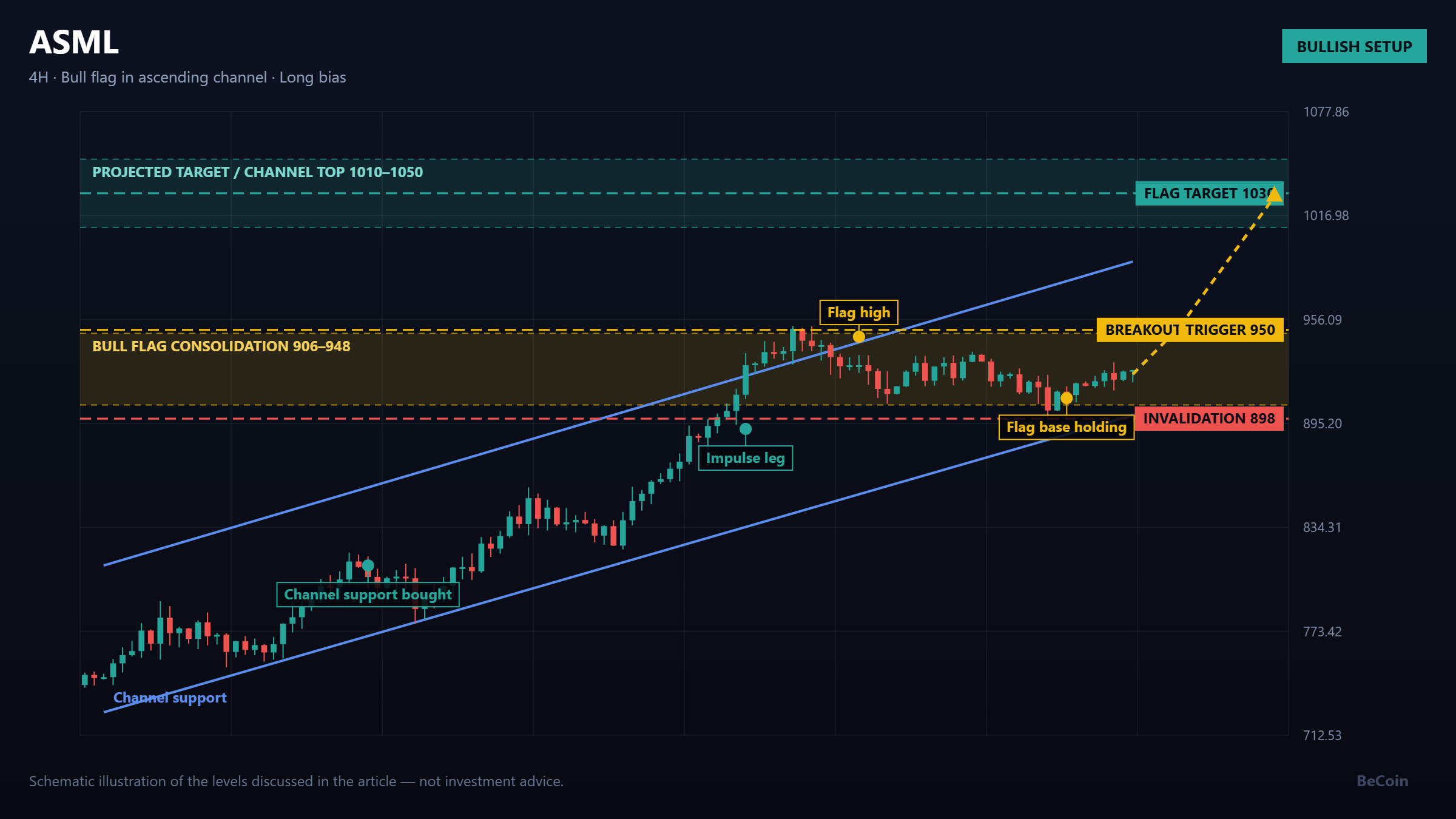
Before discussing patterns, it is worth stating the obvious: ASML remains in an uptrend that has not been invalidated. The stock has been travelling inside a well-defined ascending channel for a long stretch, and the lower boundary of that channel has been bought several times without exception. Nothing on the four-hour chart has changed that yet.
What has developed on top of that trend is a consolidation with a specific shape, and that shape is what makes the current setup interesting rather than merely ongoing.
Reading the ASML bull flag
The recent action has formed a bull flag: a sharp advance followed by a tight, slightly downward-drifting consolidation on declining range. Flags are continuation patterns because they represent a pause in participation rather than a change in ownership. Sellers are not taking control, they are simply meeting a market that has stopped chasing for a moment.
The internal structure has completed in the way these patterns typically do, with the consolidation making a full sequence of overlapping swings rather than an impulsive decline. Overlapping is the tell. Impulsive would be a different, and much worse, message.
What triggers the trade
The trigger is a decisive close above the upper boundary of the flag, ideally with volume expanding on the breakout candle. That single event converts the pattern from a hypothesis into a signal, and it usually happens quickly once it starts, which is why the level should be marked in advance rather than reacted to afterwards.
The projected objective from a flag is conventionally the height of the preceding advance measured from the breakout point. In this case that projects toward the upper boundary of the ascending channel, which conveniently doubles as a logical place to take profit rather than a place to add.
Where the idea dies
Two ways. The first is a breakdown through the lower boundary of the flag that then fails to recover, which suggests the consolidation was distribution rather than a pause. The second, and more decisive, is a close below the ascending channel's lower boundary. That level has held repeatedly; when it finally does not, the entire trend framework needs rebuilding.
Flags also have a time dimension that traders routinely ignore. A flag that consolidates for far longer than the advance that preceded it is no longer a flag, it is a range, and ranges resolve in either direction with equal enthusiasm.
The sector backdrop
ASML occupies a genuinely unusual position in semiconductor manufacturing, supplying equipment that has essentially no substitute at the leading edge. That structural advantage supports the multiple but does not immunise the stock from cyclical order patterns or from export-control headlines, which have repeatedly produced sharp single-day moves. Any technical setup in this name has to allow for that.
Bottom line
ASML is holding a bull flag inside an intact ascending channel. A confirmed breakout above the flag ceiling with volume points toward the channel's upper boundary. A failure back through the flag base, and especially a close below the channel support, cancels the continuation case. The pattern is clean; the discipline is in waiting for the trigger.
Becoin.net Premium Forecast - Becoin.net Tariff Plans
This article is educational market commentary and is not investment advice. Do your own research and manage risk accordingly.

Why Traders Move from Binomo to Deriv in 2026: The Real Reasons Behind the Switch
If you spend enough time around trading communities, you’ll notice a pattern. Many traders start with Binomo. Then, after a few months, a surprising number begin looking at Deriv. Some switch completely. Others keep both accounts but gradually move most of their trading activity to Deriv. I noticed this trend while talking to beginner traders […]

Which Broker Has Faster Withdrawals? Real 2026 Comparison for Traders
When most beginners choose a broker, they focus on bonuses, signals, or flashy interfaces. But after trading for a while, you realize one thing matters more than almost anything else: How fast can you actually withdraw your money? A broker can look perfect until your first withdrawal request gets stuck in “processing” for three days. […]

Deriv vs IQ Option for Synthetic Indices: Which Platform Is Better in 2026?
Synthetic indices have become one of the most talked about trading categories among beginners and experienced traders alike. Unlike forex or crypto markets that depend on real world events, synthetic indices operate 24/7 using algorithm driven price movements. That means traders can access opportunities at any time without waiting for market openings or major news […]
Binomo vs IQ Option Withdrawal Speed: Full 2026 Comparison Guide
Withdrawal speed is one of the most important factors for traders, especially beginners who want quick access to profits. A platform may look good for trading, but if getting your money takes too long, frustration builds fast. In this detailed comparison of Binomo and IQ Option, we will break down real withdrawal timelines, processing behavior, […]

Trading Currency Strength Instead of Single Pairs
It was a Tuesday afternoon when I realized I was fighting a losing battle against a ghost. My screen was a chaotic web of indicators. I had the EUR/USD chart open, a moving average crossing over here, a relative strength index flashing oversold there, and a price action setup that looked textbook perfect. I clicked […]
How Liquidity Affects Day Trading Results
When I first started trading day trading, I believed success was all about finding the perfect indicator. I spent weeks testing moving averages, RSI settings, support and resistance levels, and dozens of YouTube strategies that promised easy wins. Some worked for a few trades, but most failed. What confused me was that the same setup […]