
Rule of 72: How Fast Can Your Money Double?
Rule of 72: How to Calculate When Your Money Will Double
The Rule of 72 is one of the simplest and most useful financial formulas for investors, savers, and anyone interested in understanding compound growth. With just one calculation, you can estimate how many years it will take for your money to double based on an annual rate of return.
The formula is simple:
Years to Double = 72 ÷ Annual Rate of Return
For example, if an investment earns an average 8% per year, the Rule of 72 estimates that it will take approximately 9 years to double.
This simple calculation can help investors compare potential returns, understand the power of compound interest, and set realistic long-term financial goals. The SEC's Investor.gov describes the Rule of 72 as a rule of thumb for estimating how quickly an investment can double.
What Is the Rule of 72?

The Rule of 72 is a mathematical shortcut used to estimate the doubling time of an investment.
Instead of using a calculator or a complicated compound-interest formula, you simply divide 72 by the expected annual percentage return.
Rule of 72 Formula
Doubling Time = 72 ÷ Annual Return (%)
For example:
- At 4%, money doubles in about 18 years.
- At 6%, money doubles in about 12 years.
- At 8%, money doubles in about 9 years.
- At 10%, money doubles in about 7.2 years.
- At 12%, money doubles in about 6 years.
The higher the rate of return, the faster your money can potentially double.
However, the calculation is an estimate, not a guarantee. Actual investment returns can fluctuate from year to year.
How Does the Rule of 72 Work?
The Rule of 72 is closely connected to compound interest.
Compound growth means that returns are added to your investment, allowing future returns to be earned on both your original money and previous gains. The Consumer Financial Protection Bureau explains that compound interest means earning interest on the money saved as well as on interest earned along the way.
Consider a simple example.
You invest $10,000 and earn an average return of 8% per year.
Using the Rule of 72:
72 ÷ 8 = 9 years
So your $10,000 could approximately double to:
$20,000 after 9 years
If the same growth rate continued, it could approximately double again:
$20,000 → $40,000
and again:
$40,000 → $80,000
This demonstrates why time can be one of the most powerful factors in investing.
Rule of 72 Examples
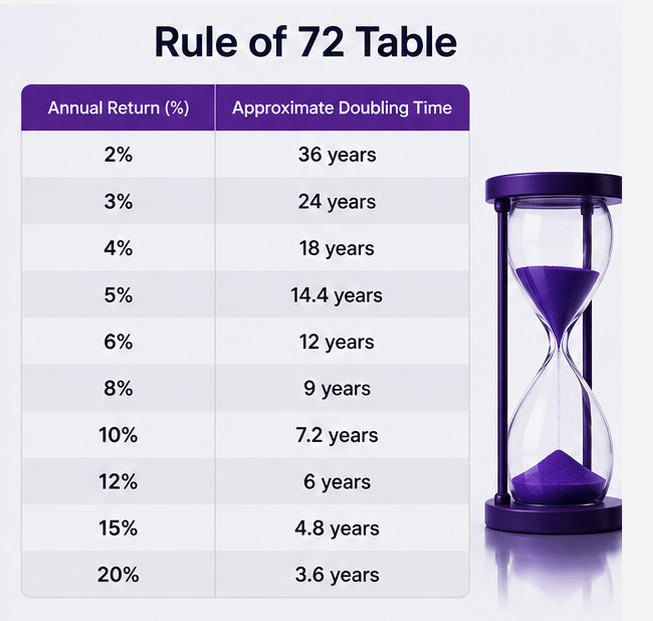
The following table provides a quick way to estimate investment doubling time:
| Annual Return | Approximate Doubling Time |
|---|---|
| 2% | 36 years |
| 3% | 24 years |
| 4% | 18 years |
| 5% | 14.4 years |
| 6% | 12 years |
| 7% | 10.3 years |
| 8% | 9 years |
| 9% | 8 years |
| 10% | 7.2 years |
| 12% | 6 years |
| 15% | 4.8 years |
| 20% | 3.6 years |
This makes the Rule of 72 particularly useful when comparing different investment return assumptions.
For example, an investment earning 6% would take roughly twice as long to double as one earning 12%.
How Long Does It Take to Double Your Money?
The answer depends primarily on the annual growth rate.
If you want to know how long it takes to double your money, simply divide 72 by your expected annual return.
For example:
72 ÷ 5 = 14.4 years
At a 5% annual return, your money could double in approximately 14.4 years.
At 10%:
72 ÷ 10 = 7.2 years
At 15%:
72 ÷ 15 = 4.8 years
The Rule of 72 therefore provides a quick mental shortcut for comparing different rates of return.
How to Use the Rule of 72 in Reverse
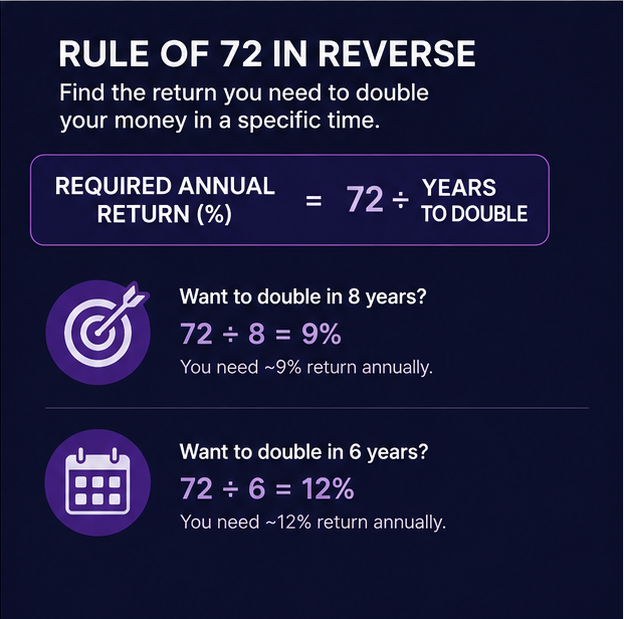
The Rule of 72 can also work backward.
Instead of asking how long your money will take to double, you can estimate the annual return needed to double your money within a specific period.
The formula becomes:
Required Annual Return = 72 ÷ Years to Double
Suppose you want your investment to double in 8 years.
72 ÷ 8 = 9%
You would need an average annual return of approximately 9%.
If your goal is to double your money in 6 years:
72 ÷ 6 = 12%
This reverse calculation can be useful when setting investment goals and evaluating whether a target return is realistic.
Rule of 72 and Compound Interest
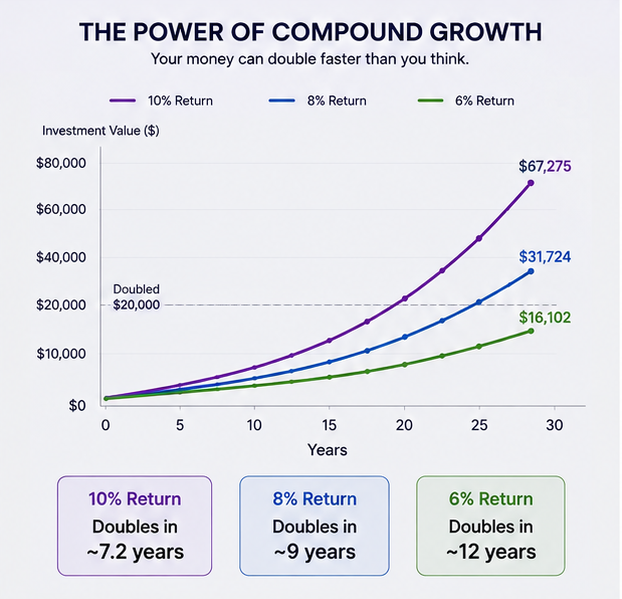
The Rule of 72 works because investment growth is exponential when returns are compounded.
For example, $1,000 earning 10% annually does not simply add $100 every year. The return is applied to the growing balance.
After the first year:
$1,000 → $1,100
After the second year:
$1,100 → $1,210
The second year's gain is larger because the investment is earning returns on previous growth as well.
This is the fundamental power of compound interest. The SEC uses similar examples to demonstrate how reinvested earnings can accelerate long-term growth.
Is the Rule of 72 Accurate?
The Rule of 72 is useful, but it is not an exact investment calculator.
The precise doubling time for periodic compounding can be calculated using:
Doubling Time = ln(2) ÷ ln(1 + r)
where r is the return expressed as a decimal.
The Rule of 72 is simply a convenient approximation that is much easier to calculate mentally.
For example, at an 8% annual return, the Rule of 72 gives:
72 ÷ 8 = 9 years
The exact mathematical result is slightly different, but the estimate is close enough for many quick financial calculations. The Federal Reserve Bank of St. Louis also presents the Rule of 72 as an approximation and demonstrates how it can be used to estimate long-term compound growth.
Rule of 72 for Stocks, ETFs and Other Investments
Investors can use the Rule of 72 to think about potential long-term returns from many types of assets, including:
- Stocks
- ETFs
- Mutual funds
- Bonds
- Savings accounts
- Retirement portfolios
- Business investments
- Other assets with compounding growth
However, the calculation should be based on a reasonable expected average return, rather than assuming that an investment will produce the same return every year.
Stock market returns, for example, can vary significantly from year to year. FINRA notes that investors should consider annualized returns when comparing investment performance over different periods.
Rule of 72 and Inflation
The Rule of 72 isn't only useful for investment growth. It can also illustrate the effect of inflation.
Suppose inflation averages 3% per year.
Using the Rule of 72:
72 ÷ 3 = 24 years
This suggests that prices could roughly double over about 24 years if that inflation rate remained constant.
This is important because doubling your investment balance does not necessarily mean doubling your purchasing power. Inflation can reduce the real value of money over time.
Investors should therefore consider both nominal returns and real returns after inflation when thinking about long-term wealth.
Rule of 72 vs. a Compound Interest Calculator
The Rule of 72 is best viewed as a quick estimation tool.
A compound interest calculator is better when you need to account for:
- Initial investment
- Regular contributions
- Different compounding frequencies
- Investment fees
- Taxes
- Inflation
- Variable rates of return
- Specific investment periods
For a quick question such as "How long will my money take to double at 9%?", the Rule of 72 is extremely convenient.
For detailed financial planning, however, a more precise compound-growth calculation is preferable.
Why the Rule of 72 Matters for Investors
The biggest lesson behind the Rule of 72 is not the number 72 itself. It is the relationship between return, time, and compounding.
A relatively small difference in annual returns can have a significant effect over decades.
For example, an investor earning 6% needs approximately 12 years for money to double, while an investor earning 12% needs approximately 6 years.
That difference becomes even more meaningful when money compounds through multiple doubling periods.
The Federal Reserve Bank of St. Louis illustrates this effect with long-term examples, showing how repeated doubling can dramatically increase an initial investment.
Final Thoughts
The Rule of 72 is a simple but powerful way to understand the relationship between investment returns and time.
Remember the core formula:
Years to Double = 72 ÷ Annual Return (%)
At 6%, money doubles in roughly 12 years.
At 8%, it doubles in roughly 9 years.
At 10%, it doubles in roughly 7.2 years.
And at 12%, it doubles in roughly 6 years.
The calculation is only an estimate, but it can provide a valuable first look at the potential impact of compound growth. For serious investment decisions, combine the Rule of 72 with accurate return calculations, fees, taxes, inflation assumptions, and an understanding of investment risk. Check the estimate calculation here on Compound Interest Calculator
Becoin.net Tariff PlansUltimately, the Rule of 72 turns a complicated question — "When will my money double?" — into a calculation that takes only a few seconds.

Binomo vs IQ Option Withdrawal Speed: Full 2026 Comparison Guide
Withdrawal speed is one of the most important factors for traders, especially beginners who want quick access to profits. A platform may look good for trading, but if getting your money takes too long, frustration builds fast. In this detailed comparison of Binomo and IQ Option, we will break down real withdrawal timelines, processing behavior, […]

Which Broker Has Faster Withdrawals? Real 2026 Comparison for Traders
When most beginners choose a broker, they focus on bonuses, signals, or flashy interfaces. But after trading for a while, you realize one thing matters more than almost anything else: How fast can you actually withdraw your money? A broker can look perfect until your first withdrawal request gets stuck in “processing” for three days. […]

Deriv vs Binomo Deposit Methods: My 2026 Real Money Comparison Guide
I sat in the corner of a crowded coffee shop, my eyes fixed on my phone screen. After months of testing strategies on a demo account, I had finally saved up a small pocket of risk capital. I felt ready to trade live. A high-probability setup was forming on my charts, and my heart rate […]

Which Broker Has the Cleanest Interface? Real Comparison for Beginners in 2026
Looking for the cleanest trading interface in 2026? Compare Binomo, IQ Option, Quotex, Deriv, and more based on speed, layout, usability, mobile experience, and beginner friendliness. When most beginners choose a broker, they focus on bonuses, payouts, or deposit methods. But after testing multiple platforms for months, I realized something surprising: A messy interface can […]

Best Broker for One Trade a Day Strategy in 2026
Most traders lose money because they trade too much. They enter random setups, chase candles, overreact emotionally, and turn a simple strategy into pure gambling. That is exactly why the one trade a day strategy is becoming more popular among smart traders in 2026. Instead of sitting in front of charts all day, this approach […]

Which Broker Is Better for Students in 2026?
For students, trading usually starts with one simple goal: learning how markets work without risking too much money. Most students are not starting with huge budgets. They are trading from a phone, using mobile internet, balancing studies, and trying to avoid losing money quickly. That changes what actually matters in a broker. The “best broker” […]