Real Yields or Nominal Yields — Which One Are FX Markets Actually Pricing?
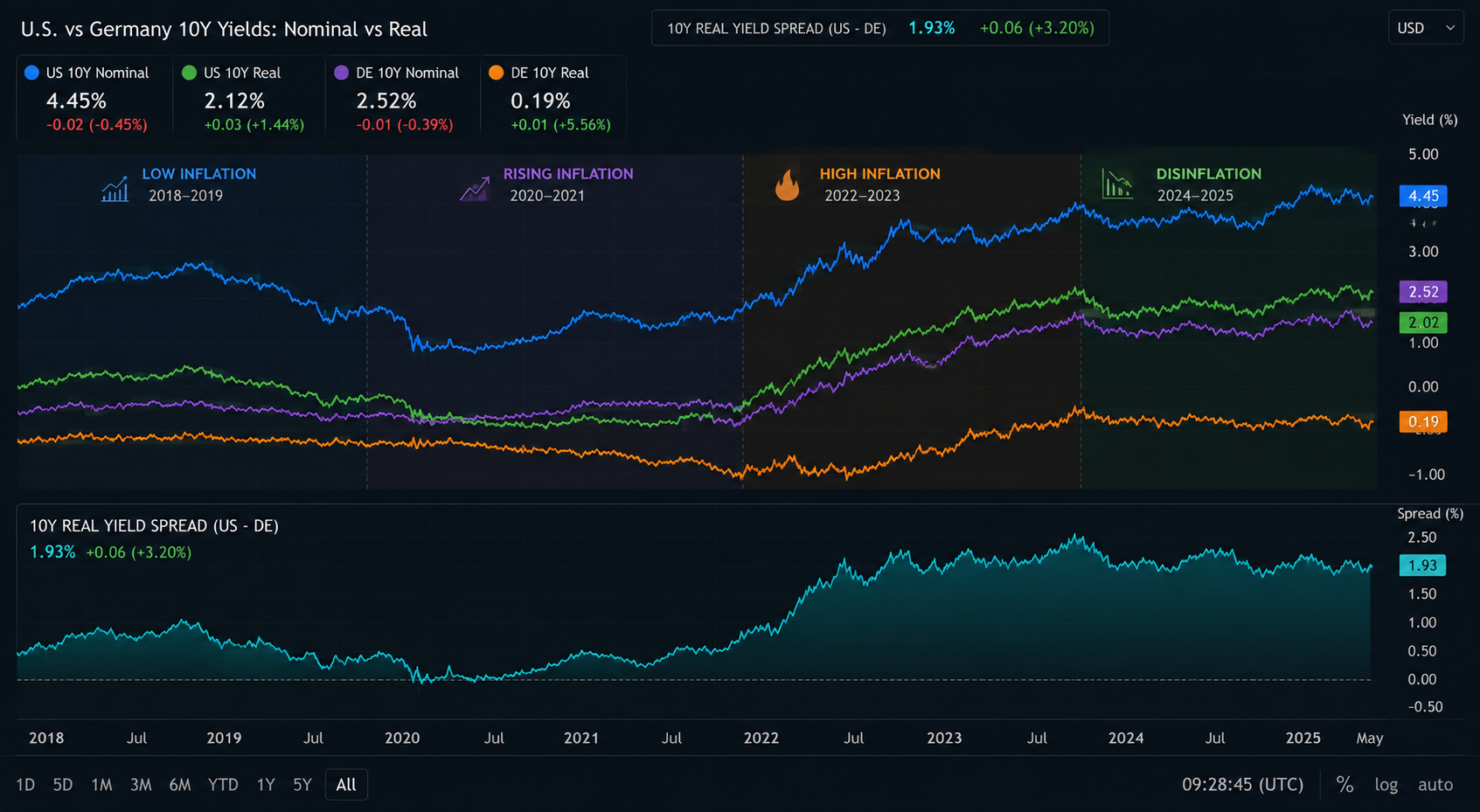
Almost every explanation of currency movementeventually arrives at interest rates. The usual shorthand is that money flows toward the higher yield, so the currency with rising rates strengthens. The shorthand is incomplete, because it does not specify which yield. A country offering six percent while inflation runs at eight is not paying investors anything in purchasing-power terms, yet its headline rate looks attractive. Separating the two measures changes how a lot of currency behaviour reads.
What real yields are and how they differ from nominal
The nominal yield is the number printed on the bond. The real yield is what remains after expected inflation is removed, and it can be observed directly through inflation-linked bonds or estimated from the spread between conventional and index-linked debt. The two measures agree when inflation expectations are stable and diverge sharply when they are not. Periods of disagreement are the interesting ones, because that is when a currency can weaken while its headline rates rise, a pattern that confuses anyone watching only the nominal number.
What the historical relationship suggests
Research on developed-market currencies generally finds that real rate differentials explain medium-term moves better than nominal ones, while short-term reactions cluster around nominal surprises. That combination makes sense. A central bank decision or an inflation print moves the nominal curve instantly, so the immediate reaction is nominal. Capital allocation decisions, which unfold over months, are made on purchasing-power terms. The result is a market that trades nominal in the hour and real over the quarter.
Where inflation expectations come from
Because the real yield depends on expected rather than realised inflation, the measurement is only as good as the expectation input. Break-even rates derived from index-linked bonds are the most market-based option, though they carry liquidity and risk premia of their own. Survey measures from central banks and professional forecasters are slower but less noisy. Inflation swaps offer a forward-looking read at specific horizons. Comparing all three gives a sense of whether a change in the real yield reflects genuine repricing or just a distortion in one instrument.
Where the distinction matters most
The gap between the two measures is largest where inflation is volatile. In high-inflation emerging markets, nominal yields can look extraordinary while real yields are negative, which is one reason carry positions in those currencies can produce losses even when the interest differential appears generous. Among majors, the distinction has mattered most during periods when one central bank tolerated above-target inflation while another moved aggressively, since the nominal spread and the real spread pointed in opposite directions.
The data worth tracking
A workable monitoring set includes ten-year and two-year real yields for each major economy, the break-even spreads that produce them, the policy rate path implied by forward markets, and realised inflation against target. Watching the direction of the real spread rather than its level is usually more informative, since currencies tend to respond to change. Cross-referencing these against positioning data helps show whether the market has already absorbed the shift, and the Market Forecast Hub is a practical place to compare those series side by side.
What would invalidate this framework
Two conditions would break it. If a currency consistently moves against its real rate differential over multiple quarters, something else is dominating, most likely capital controls, intervention, a commodity terms-of-trade shock or a risk premium tied to political uncertainty. And if inflation expectations become so unstable that break-even measures stop being reliable, the real yield itself becomes an estimate rather than an observation, at which point the analysis loses precision. Both are visible before they cause damage, which is the point of stating them.
Becoin.net Tariff Plan --> Here
Reading the two together
The practical conclusion is not that one measure is right and the other wrong, but that they answer different questions. Nominal yields explain the reaction. Real yields explain the allocation. An analysis that uses both will describe more of what a currency is doing than one that picks a side, and none of this constitutes a recommendation to take a position in any market.

Which Broker Has Faster Withdrawals? Real 2026 Comparison for Traders
When most beginners choose a broker, they focus on bonuses, signals, or flashy interfaces. But after trading for a while, you realize one thing matters more than almost anything else: How fast can you actually withdraw your money? A broker can look perfect until your first withdrawal request gets stuck in “processing” for three days. […]

Deriv vs IQ Option for Synthetic Indices: Which Platform Is Better in 2026?
Synthetic indices have become one of the most talked about trading categories among beginners and experienced traders alike. Unlike forex or crypto markets that depend on real world events, synthetic indices operate 24/7 using algorithm driven price movements. That means traders can access opportunities at any time without waiting for market openings or major news […]

Which Broker Is Better for Students in 2026?
For students, trading usually starts with one simple goal: learning how markets work without risking too much money. Most students are not starting with huge budgets. They are trading from a phone, using mobile internet, balancing studies, and trying to avoid losing money quickly. That changes what actually matters in a broker. The “best broker” […]

Deriv vs Binomo for Low-Risk Trading in 2026: Which Platform Is Better for Safer Growth?
Most beginners enter trading with one simple goal: avoid blowing up their account in the first week. That is exactly why low-risk trading matters more than fast profits. Two platforms that constantly appear in beginner discussions are Deriv and Binomo. Both allow small deposits, short-term trading, and beginner-friendly access. But when your focus is protecting […]

Binomo vs IQ Option Withdrawal Speed: Full 2026 Comparison Guide
Withdrawal speed is one of the most important factors for traders, especially beginners who want quick access to profits. A platform may look good for trading, but if getting your money takes too long, frustration builds fast. In this detailed comparison of Binomo and IQ Option, we will break down real withdrawal timelines, processing behavior, […]

Best Broker for Learning Price Action in 2026 (Tested by Real Traders)
Most traders think they need a better strategy. What they actually need is a better understanding of price. A few years ago, one of our community members had over ten indicators on his chart. RSI. MACD. Moving averages. Bollinger Bands. Stochastic. Every new YouTube video added another indicator. The result? More confusion. Not more profits. […]