Day Trading Success Rate 2026: The Real Statistics
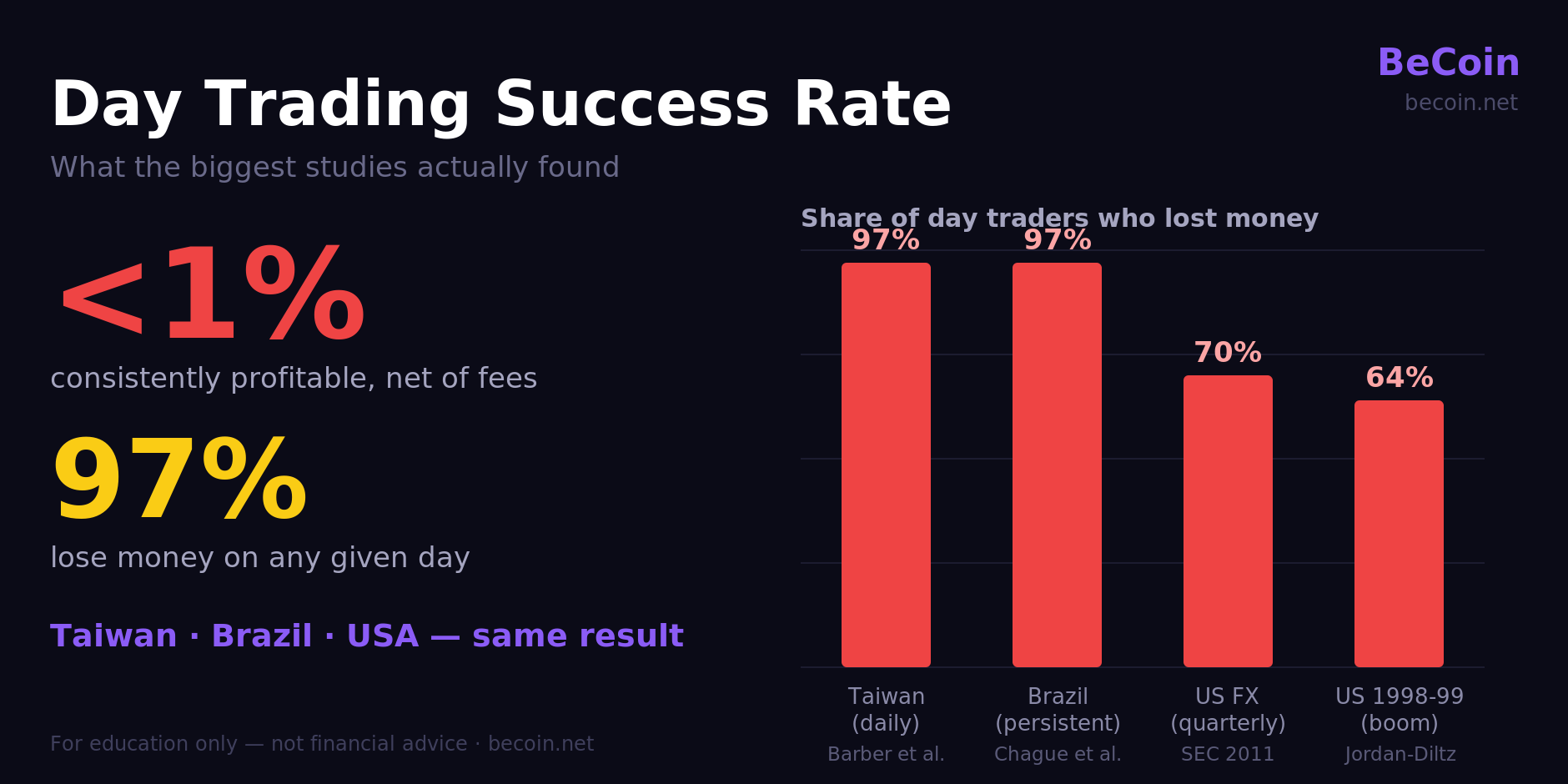
Fewer than 1% of day traders are consistently profitable after fees, and on any given day roughly 97% of them lose money net of trading costs. Those two figures come from the largest academic study of day trading ever conducted — fifteen years of complete data from the Taiwan Stock Exchange. The pattern repeats everywhere it has been measured: in Brazil, 97% of persistent day traders lost money; in the United States during the dot-com boom, 64% lost money even as the market doubled. Day trading is not a coin flip. The odds are far worse.
What percentage of day traders are successful?
The honest answer is that "success" has at least three different definitions, and mixing them up is how you get the wildly different numbers floating around online. Making money on a single day is common; making money over a year is rare; beating a simple index fund over years is rarer still. Here is what the peer-reviewed research actually found, study by study.
| Study | Market & period | Sample | Key measured result |
|---|---|---|---|
| Barber, Lee, Liu & Odean (2014) | Taiwan, 1992–2006 | ~450,000 day traders/yr | <1% consistently profitable net of fees; only ~19% beat the market in any given year |
| Barber, Lee, Liu, Odean & Zhang (2019) | Taiwan, 1992–2006 | Full exchange | On any given day, 97% of day traders lose money net of fees |
| Chague, De-Losso & Giovannetti (2020) | Brazil, 2013–2015 | ~20,000 new futures day traders | Of those persisting 300+ days, 97% lost money; 1.1% out-earned minimum wage |
| Jordan & Diltz (2003) | US, 1998–1999 | 324 day traders | 64% lost money; only 36% profitable — during a doubling Nasdaq |
| Barber & Odean (2000) | US, 1991–1997 | 66,465 households | Most active traders underperformed the market by ~10.3% per year |
| SEC / Philadelphia Financial (2011) | US retail FX, ~2008–2011 | 12 FX brokers | ~70% of retail forex day traders lost money every quarter |
Put simply: across four countries, three decades and hundreds of thousands of traders, the consistent-winner rate sits at or below 1%, and the majority-lose finding is essentially universal. Only about 1% to 3% of day traders reliably beat a broad index fund — which means more than 97% would have done better simply buying and holding the S&P 500. If you want to see what that passive alternative would have returned, our what-if-I-invested tool models the outcome for real assets.
The three "success rates" people confuse
Almost every argument about day trading online is really two people using the same word for different things. Keeping these separate is the single most useful thing you can do with the data:
- Won money today: common. Even a losing strategy wins on plenty of individual days — which is exactly why the activity feels winnable.
- Profitable over a year, net of fees: uncommon. In Taiwan, only about 19% of the heaviest traders managed this in any given year, and far fewer did it repeatedly.
- Consistently beats a passive index fund: rare — roughly 1%–3%. This is the only definition of "success" that actually matters for building wealth, and it is the one the marketing quietly avoids.
The biggest studies, in detail
The Taiwan research by Barber, Lee, Liu and Odean is the gold standard because it covers every trade on an entire national exchange for fifteen years — around 450,000 individual day traders per year. Their headline finding: fewer than 1% (about 4,000 people) earned reliable profits net of fees. The tiny group that did win was strikingly consistent — the top 500 traders earned about +37.9 basis points a day — which tells us that a real, learnable edge exists but is confined to a professional sliver. The other roughly 440,000 traders lost about 25–29 basis points a day, and a follow-up paper found that 74% of all day-trading volume came from people with no history of success at all.
The Brazilian study is arguably more relevant to anyone thinking of quitting their job to trade, because it followed only new traders — filtering out the seasoned professionals. Fernando Chague and colleagues tracked roughly 20,000 people who started day trading equity-index futures. Of the 1,500 most persistent (those who stuck with it for more than 300 trading days), 97% lost money and only 17 individuals — about 1.1% — earned more than the Brazilian minimum wage. Their conclusion was blunt: "it is virtually impossible for an individual to day trade for a living."
Even the most favorable environment imaginable did not help. Jordan and Diltz studied US day traders in 1998–1999, when the S&P 500 rose 30% and the Nasdaq more than doubled. Despite that once-in-a-generation tailwind, 64% of the traders still lost money.
Why do most day traders lose money?
Three forces drag returns below zero and keep them there. First, costs: spreads, commissions and taxes turn a break-even gross strategy into a losing net one — Jordan and Diltz found trades were profitable before fees but negative after them. Second, overconfidence: Barber and Odean's work repeatedly shows that the more people trade, the more they lose, because frequent trading is driven by overestimating one's own edge. Third, professional competition: retail traders are now up against high-frequency and algorithmic systems that react to information in microseconds, so the "public information" edge that once existed has largely been arbitraged away. A discrete, quotable version of the core finding: those who trade the most are hurt the most.
How much do day traders actually make?
For the overwhelming majority, the answer is negative. In the Brazilian sample, only 1.1% of committed traders earned more than a minimum wage — meaning day trading paid less than an entry-level job for 99% of the people who genuinely committed to it. In the SEC-published forex data, the average retail account held under $5,000, and clients frequently funded those accounts with credit cards. The realistic expected value of retail day trading, net of costs, is a loss. The rare professionals who do earn a living from it typically have institutional-grade technology, direct-market access, years of specialization and strict risk controls — not a laptop and a course. To gauge risk before ever risking real capital, traders can stress-test position sizing with our profit & loss calculator.
Can you get better at day trading over time?
The evidence here is discouraging. In the Brazilian study, the most active traders did not improve with experience — additional trading did not translate into learning. And behavior barely responds to results: Taiwanese data showed profitable traders had a 96.4% chance of trading again the next year, while unprofitable traders had a 95.3% chance — almost identical. People keep going regardless of whether it is working, which is a hallmark of activity driven by overconfidence rather than edge. There is a genuinely skilled minority, but the research suggests that skill is concentrated among a small number of professionals from the start, not gradually acquired by the average participant.
Day trading vs long-term investing
The same academic literature that condemns day trading points to a clear alternative: passive, diversified, long-term investing. Barber and Odean's central recommendation, after studying tens of thousands of accounts, was that investors would perform better in low-cost index funds than by trading actively. The math is stark — if 97% of day traders would beat their own results by simply holding the S&P 500, the "boring" strategy is, statistically, the aggressive one. For readers weighing where their money actually places them, our income percentile calculator and how much money is in the world breakdown put personal finances in context, and the forecast hub shows how longer-horizon, model-based analysis differs from minute-to-minute speculation.
FAQ
What percentage of day traders are profitable?
Fewer than 1% are consistently profitable net of fees over multi-year periods, according to the fifteen-year Taiwan Stock Exchange study by Barber, Lee, Liu and Odean. Only about 1%–3% reliably beat a broad index fund.
Do 90% of day traders lose money?
The measured loss rates are even higher on short horizons. On any given day, about 97% of day traders lose money net of trading fees, and in both Taiwan and Brazil the long-run majority-loses finding is close to universal. The commonly repeated "90% or 95% fail" figures are, if anything, optimistic.
How much money does the average day trader make?
The average day trader loses money after costs. In the Brazilian futures study, only 1.1% of committed traders earned more than the minimum wage, and the average retail forex account in SEC-published data held under $5,000.
Why do so many day traders fail?
Three reasons dominate the research: trading costs that turn gross break-even into net losses, overconfidence that causes over-trading (the more you trade, the more you lose), and competition from high-frequency and algorithmic systems that erase the retail edge.
Is day trading basically gambling?
Statistically it resembles a negative-expected-value game for the typical participant: the majority lose, the losses grow with activity, and results barely change behavior. A very small professional minority has a real, consistent edge — but that group is under 1% of all traders.
Is long-term investing really better than day trading?
The academic consensus says yes for almost everyone. Because more than 97% of day traders would have done better in a low-cost index fund, passive long-term investing is the higher-probability path to building wealth for the vast majority of people.
Methodology and sources
All statistics are drawn from named, dated, peer-reviewed or regulator-published research. Primary sources: Barber, Lee, Liu & Odean, "The Cross-Section of Speculator Skill: Evidence from Day Trading" (Journal of Financial Markets, 2014); Barber, Lee, Liu, Odean & Zhang, "Learning, Fast or Slow" (Review of Asset Pricing Studies, 2019); Chague, De-Losso & Giovannetti, "Day Trading for a Living?" (SSRN, 2020); Jordan & Diltz, "The Profitability of Day Traders" (Financial Analysts Journal, 2003); Barber & Odean, "Trading Is Hazardous to Your Wealth" (Journal of Finance, 2000); and Philadelphia Financial Management's retail-FX report filed with the SEC (2011). Cross-referenced against Current Market Valuation's literature review (updated October 2024). Figures describe the studied populations and periods; individual results vary.
This article is for educational purposes only and is not financial or investment advice. Trading involves risk of loss, including the loss of your entire capital.
Prefer analysis over adrenaline? Model longer-horizon moves across stocks, crypto, forex and more. Get full access to all 100+ assets →
Which Broker Has Faster Withdrawals? Real 2026 Comparison for Traders
When most beginners choose a broker, they focus on bonuses, signals, or flashy interfaces. But after trading for a while, you realize one thing matters more than almost anything else: How fast can you actually withdraw your money? A broker can look perfect until your first withdrawal request gets stuck in “processing” for three days. […]
The Day I Stopped Trading and Finally Started Making Money
It was a rainy Tuesday morning, and I was staring at my screen with a familiar knot in my stomach. The previous three days had been a slow, agonizing slide into the red. I had given back two weeks of hard-earned profits in less than seventy-two hours. Every asset I clicked on looked like a […]

Best Broker for Learning Price Action in 2026 (Tested by Real Traders)
Most traders think they need a better strategy. What they actually need is a better understanding of price. A few years ago, one of our community members had over ten indicators on his chart. RSI. MACD. Moving averages. Bollinger Bands. Stochastic. Every new YouTube video added another indicator. The result? More confusion. Not more profits. […]

Deriv vs IQ Option for Synthetic Indices: Which Platform Is Better in 2026?
Synthetic indices have become one of the most talked about trading categories among beginners and experienced traders alike. Unlike forex or crypto markets that depend on real world events, synthetic indices operate 24/7 using algorithm driven price movements. That means traders can access opportunities at any time without waiting for market openings or major news […]
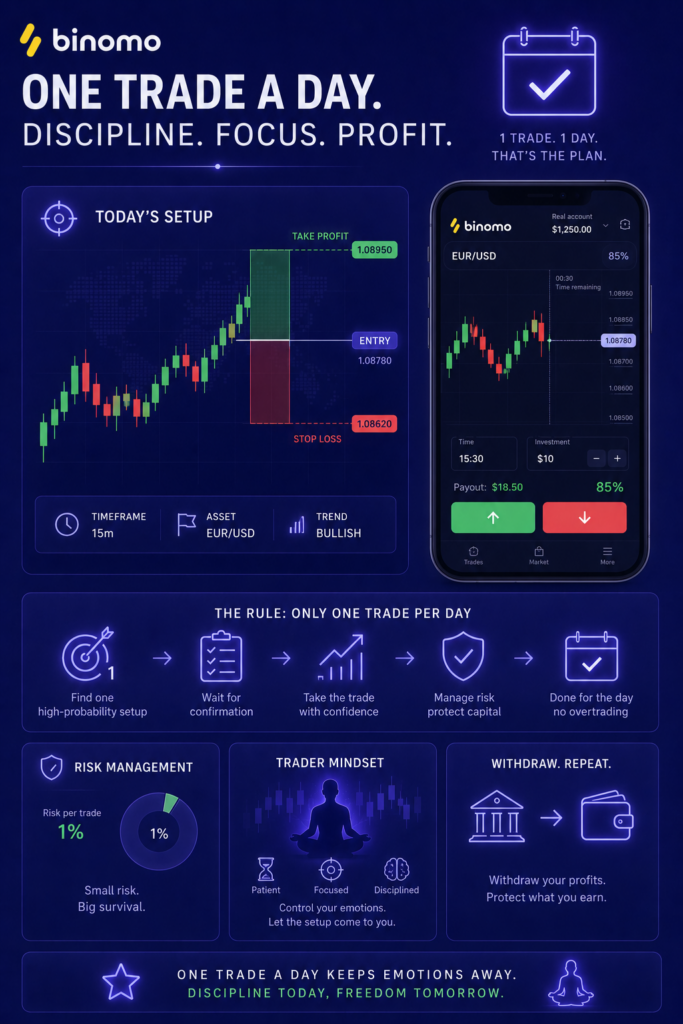
Best Broker for One Trade a Day Strategy in 2026
Most traders lose money because they trade too much. They enter random setups, chase candles, overreact emotionally, and turn a simple strategy into pure gambling. That is exactly why the one trade a day strategy is becoming more popular among smart traders in 2026. Instead of sitting in front of charts all day, this approach […]

Safest Trading Platforms (Risk Breakdown) – Real Comparison for 2026
Choosing a trading platform isn’t about features — it’s about avoiding hidden risk. Most traders compare brokers like Quotex vs Pocket Option vs Deriv vs Olymp Trade expecting a clear winner. Instead, they find conflicting reviews, promotional claims, and no real explanation of how these platforms behave when money is on the line. The real […]